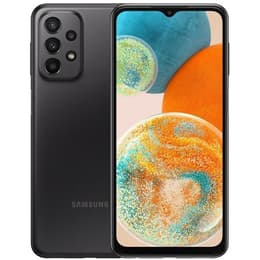

Galaxy A14 Vs Galaxy A23 5G

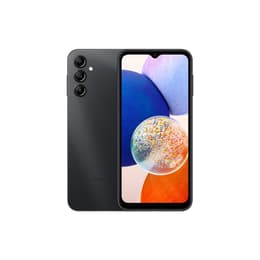
Galaxy A14
Galaxy A14
Starting at

Refurbished price:£81.00

Versus £269.00 new

See options
Galaxy A23 5G
Galaxy A23 5G
Starting at

Refurbished price:£100.00

Versus £300.00 new

See options

Ratings

The Samsung Galaxy A14 and the Samsung Galaxy A23 5G are both smartphones designed to offer a balanced experience for everyday use. While the Galaxy A23 5G was released in September 2022, the Galaxy A14 followed in January 2023, making it a slightly newer device. Both run on the Android operating system, but the A23 5G generally offers a smoother display and a more versatile camera system, while the A14 provides a solid foundation for essential smartphone functions.

Scores

Durability

When considering the long-term usability of a smartphone, software support and physical resilience are key factors. The Galaxy A14 and Galaxy A23 5G offer comparable commitments from Samsung regarding software updates, though their starting points differ.

  • Software Updates: The Galaxy A14, launched with Android 13, is expected to receive two major Android OS upgrades, bringing it up to Android 15, along with four years of security updates, likely extending until early 2027. The Galaxy A23 5G, released with Android 12, is also slated for two major OS upgrades, reaching Android 14 or potentially Android 15 in some regions, and four years of security patches.
  • Physical Durability: The Galaxy A23 5G incorporates Corning Gorilla Glass 5 for its display, offering enhanced scratch resistance compared to the Galaxy A14, which uses an unspecified glass protection. Both devices feature plastic constructions for their backs and frames.
  • Expected Lifespan: Users can anticipate a practical lifespan of several years for both models, benefiting from continued software and security support. The A23 5G's display protection might offer a slight edge in resisting everyday wear and tear.

Year of Release

2023

2022

Compatible with latest Update

No

Yes

OS

Android

Android

Foldable

No

No

Performance

The performance of these devices is tailored for daily tasks, with distinctions appearing in more demanding scenarios and multitasking capabilities.

  • System Responsiveness: The Galaxy A23 5G is powered by a processor that generally provides a responsive experience, handling typical applications and navigation smoothly. The Galaxy A14, while capable for essential functions, may exhibit occasional stutters or slower app loading times, particularly when managing multiple applications simultaneously.
  • Multitasking and Storage: Both phones are available with various RAM configurations, typically starting from 4GB, which is suitable for light multitasking. Higher RAM options on either device will contribute to a more fluid experience when switching between apps. Both offer expandable storage via microSD cards, allowing users to increase their digital capacity significantly.
  • Battery Behavior: Both devices are equipped with a 5000 mAh battery, providing substantial power for extended use. User reports indicate that both can comfortably last a full day, with lighter usage potentially extending to two days. The Galaxy A23 5G supports faster wired charging at 25W, allowing for quicker replenishment of its battery compared to the Galaxy A14's 15W charging.

Memory (GB)

4 GB

4 GB

Screen quality

The visual experience on both smartphones is designed for clarity and vibrant colors, though the Galaxy A23 5G offers a notable enhancement in display fluidity.

  • Display Technology and Clarity: Both the Galaxy A14 and Galaxy A23 5G feature 6.6-inch PLS LCD displays with Full HD+ resolution (1080x2408 pixels), ensuring sharp images and text for everyday viewing. The PLS LCD technology provides good color reproduction and viewing angles.
  • Refresh Rate: A key difference lies in the refresh rate; the Galaxy A23 5G boasts a 120Hz refresh rate, which results in noticeably smoother scrolling and more fluid animations compared to the Galaxy A14's 90Hz display. This higher refresh rate can enhance the perception of responsiveness during interaction.
  • Brightness and Viewing Experience: Both displays offer adequate brightness for indoor use. For outdoor visibility, the A23 5G's display can reach slightly higher peak brightness in auto mode, which can be beneficial under direct sunlight. The larger screen size on both devices provides an immersive viewing experience for media consumption.

Resolution

1080 x 2408

1080 x 2408

Screen type

PLS LCD

PLS LCD

Audiovisual

Both devices are equipped with multi-camera setups, but the Galaxy A23 5G provides a more comprehensive and stable photography experience.

  • Main Camera Capabilities: Both smartphones feature a 50-megapixel main camera that captures detailed photos in good lighting conditions. The Galaxy A23 5G distinguishes itself by including Optical Image Stabilization (OIS) on its main sensor, which helps reduce blur from handshakes, particularly in challenging lighting or when recording video.
  • Versatility in Photography: The Galaxy A23 5G includes a 5-megapixel ultrawide camera, allowing users to capture broader scenes, which is generally absent on the Galaxy A14 (some A14 variants may have a 5MP ultrawide, but many feature only 2MP macro/depth sensors). Both phones also include 2-megapixel macro and depth sensors for close-up shots and portrait effects, though their practical utility can be limited.
  • Video and Selfie Quality: Both devices are capable of recording video at 1080p resolution at 30 frames per second from both front and rear cameras. The Galaxy A14 features a 13-megapixel front-facing camera, while the Galaxy A23 5G has an 8-megapixel front camera.

Main camera

50 megapixels

50 megapixels

Front camera

13 megapixels

8 megapixels

Miscellaneous

Beyond core performance and display, several practical features and design elements differentiate these two Samsung Galaxy models.

  • Connectivity and Ports: Both the Galaxy A14 and Galaxy A23 5G support 5G connectivity, Wi-Fi 802.11 a/b/g/n/ac, Bluetooth, and NFC for contactless payments. They both retain a 3.5mm headphone jack and use a USB-C 2.0 port for charging and data transfer.
  • Biometrics and Sensors: For security, both phones feature a side-mounted fingerprint sensor integrated into the power button, offering convenient unlocking. They also include standard sensors like an accelerometer and proximity sensor.
  • Design and Handling: The Galaxy A23 5G is slightly thinner and lighter, measuring 165.4 x 76.9 x 8.4 mm and weighing 197g, compared to the Galaxy A14's 167.7 x 78 x 9.1 mm and 201-205g. Both devices are constructed with plastic, offering a practical and durable build for everyday handling.

Weight

201 g

197 g

Screen size (in)

6.6

6.6

Mobile network

4G

5G

SIM card

Dual Physical SIM

Dual Physical SIM

Carrier compatibility

Unlocked

Unlocked

The Samsung Galaxy A14 and Galaxy A23 5G both offer compelling features for users seeking a reliable Android smartphone. User feedback often praises the Galaxy A23 5G for its smooth 120Hz display and the inclusion of Optical Image Stabilization (OIS) on its main camera, contributing to clearer photos and videos. Its faster charging capability is also a frequently noted advantage. However, some users have reported that the A23 5G, particularly with lower RAM configurations, can experience occasional sluggishness in the user interface.

The Galaxy A14 is generally well-regarded for its strong battery life and a capable main camera for its segment. Criticisms often point to its 90Hz display being less fluid than competitors and the absence of an ultrawide camera in many variants. Performance can also be a point of concern for heavy users, with some noticing stutters during app usage.

Users prioritizing a smoother visual experience, more versatile camera options with OIS, and faster charging may find the Galaxy A23 5G to be a more suitable choice. Conversely, those who prioritize extended battery life, a solid main camera for casual photography, and a slightly newer release date might lean towards the Galaxy A14. Both devices represent a practical entry into the 5G ecosystem. For those considering these models, exploring quality-assured refurbished options can provide an eco-friendly alternative, extending the life cycle of these devices and offering a sustainable choice for consumers.


See all articles

Our recent comparisons