
Compare models
Galaxy Z Flip7 Vs Google Pixel 8a
- 1-year minimum warranty
- Free delivery on all items
- Free 30-day returns
Differences at a glance
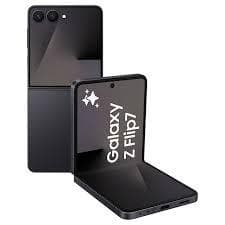
The Samsung Galaxy Z Flip7 (2025) and the Google Pixel 8a (2024) represent two distinct approaches to modern smartphone design, contrasting a foldable clamshell form factor with a traditional slate layout. While both run on the Android operating system and offer deep software integration, their physical form factors and core hardware architectures create entirely different daily user experiences.
Available Models
Colour
Storage (GB)
Scores
Durability
When examining hardware longevity and ongoing software support, both devices handle multi-year ownership well while employing different structural designs.
- Release timeline: The Google Pixel 8a launched in mid-2024, whereas the Galaxy Z Flip7 arrived in mid-2025, giving the Samsung model a one-year advantage in its overall hardware lifecycle.
- Software support: Both manufacturers provide long-term operating system updates, ensuring both devices stay current with security patches and platform features for many years.
- Structural durability: The Pixel 8a relies on a rigid slate body with standard water resistance, while the Galaxy Z Flip7 utilizes a folding hinge mechanism that requires careful handling over extended periods of daily use.
Year of Release
2025
2024
Performance
Daily multitasking, app responsiveness, and energy management differ significantly based on the internal hardware configurations of each device.
- Storage and memory: The Galaxy Z Flip7 offers higher baseline memory capacities and larger storage tiers, whereas the Pixel 8a provides modest storage configurations suited for standard media libraries.
- System responsiveness: Both devices handle everyday tasks, web browsing, and social media apps smoothly, though high-demand gaming runs with greater thermal efficiency on the Galaxy Z Flip7.
- Battery behavior: The Galaxy Z Flip7 includes a split-cell battery design configured for its folding body, while the Pixel 8a houses a traditional single-cell battery that manages power efficiently throughout a standard day of moderate use.
Screen quality
Display characteristics vary notably due to the folding nature of one screen versus the rigid panel of the other.
- Display technology: The Galaxy Z Flip7 features a foldable OLED main panel paired with an expanded exterior cover screen, while the Pixel 8a utilizes a standard, flat OLED display with consistent edge-to-edge clarity.
- Outdoor visibility: Both screens reach high peak brightness levels, ensuring text and images remain legible under direct sunlight.
- Refresh rate and smoothness: Each model supports a smooth refresh rate, resulting in fluid scrolling through menus, web pages, and supported applications.
Audiovisual
Photography, video recording, and media playback hardware cater to different user preferences across both devices.
- Camera capabilities: The Galaxy Z Flip7 utilizes a dual-lens rear system that benefits from flexible angles permitted by its folding hinge, while the Pixel 8a relies on computational photography software to process images from its dual-sensor layout.
- Low-light performance: Both phones capture clear details in dim environments, though automated image processing software handles shadows and highlights differently on each platform.
- Media consumption: Built-in stereo speakers on both models deliver clear audio for phone calls and casual video viewing, though neither includes a traditional headphone jack.
Miscellaneous
Physical dimensions, connectivity standards, and daily handling characteristics establish distinct ergonomic profiles for each device.
- Handling and dimensions: The Galaxy Z Flip7 folds in half to fit easily into smaller pockets, whereas the Pixel 8a maintains a standard slate footprint with balanced weight distribution.
- Connectivity: Both models support modern 5G networks, fast Wi-Fi standards, and Bluetooth pairing for wireless accessories.
- Authentication: The Pixel 8a uses an under-display fingerprint sensor alongside facial recognition, while the Galaxy Z Flip7 places its fingerprint sensor on the side power button for convenient access in either folded or unfolded states.
Screen size (in)
6.9
6.1
Mobile network
5G
5G
SIM card
Physical SIM + eSIM
Physical SIM + eSIM
Carrier compatibility
Unlocked
Unlocked
What the community thinks
User feedback highlights distinct preferences for each device across online communities. Owners of the Galaxy Z Flip7 frequently praise its compact pocketability when folded and the convenience of the large exterior cover screen for quick tasks. Conversely, Pixel 8a users often commend its reliable battery duration, clean software interface, and dependable everyday camera performance. Common discussions regarding the foldable model occasionally note the visible crease on the main screen, while discussions on the Pixel model sometimes mention thicker display bezels compared to flagship alternatives.
Users prioritizing pocket-sized portability and innovative folding designs will find the Galaxy Z Flip7 well-suited to their preferences, while users seeking a traditional, straightforward smartphone experience often lean toward the Google Pixel 8a. Exploring a quality-assured refurbished option provides a sustainable choice for acquiring either device while reducing electronic waste. Ultimately, the right choice depends entirely on whether a folding layout or a conventional slate form factor aligns better with your daily routine.