Compare models
Galaxy S26 Vs Galaxy S26 Ultra
- 1-year minimum warranty
- Free delivery on all items
- Free 30-day returns
Differences at a glance
The Samsung Galaxy S26 and the Samsung Galaxy S26 Ultra are high-end smartphones released in early 2026 as part of Samsung's flagship mobile device lineup. While both models run on the Android operating system with custom interface software, they cater to different physical preferences and capability tiers. The primary differentiators between the two devices center on overall physical footprint, display dimensions, and versatile camera capabilities.
Available Models
Colour
Storage
Scores
Durability
Both smartphones share the same modern software foundation and robust construction standards, ensuring long-term usability and dependable day-to-day operation over multiple years.
- Software longevity: Both models receive extended operating system and security updates for up to seven years from their launch date, maintaining feature parity and protection over time.
- Build durability: Both devices feature reinforced aluminum frames and high-grade protective glass sheets, though the Ultra variant incorporates an advanced armored glass formula designed to resist scratches and drops more effectively.
- Expected lifespan: Favorable repairability scores and strong internal component quality allow both models to sustain routine daily performance for many years of continuous ownership.
Year of Release
2026
2026
Compatible with latest Update
Yes
Yes
OS
Android
Android
Foldable
No
No
Performance
Powered by current-generation processing architecture and ample system memory configurations, both smartphones deliver fast execution speeds, fluid multitasking, and smooth handling of demanding applications.
- Multitasking and responsiveness: Both devices come equipped with generous system memory allocations, allowing users to switch rapidly between active applications without stutter or lag.
- Gaming and heavy use: Demanding games and graphics-heavy utilities run fluidly on both models, with advanced thermal management systems helping sustain high frame rates during extended sessions.
- Battery behavior: The Galaxy S26 relies on a smaller capacity power cell suited for moderate daily use, whereas the Galaxy S26 Ultra houses a larger battery that comfortably accommodates heavier, all-day power demands.
Screen quality
Both handsets utilize vibrant organic light-emitting diode panel technology with rapid refresh rates, offering crisp text rendering and fluid motion during everyday navigation.
- Display technology: Both models use advanced adaptive refresh rate panels that scale down during static viewing to conserve energy and scale up to high frequencies during scrolling and gaming.
- Brightness and clarity: High peak luminance levels on both screens ensure clear visibility under bright outdoor sunlight, complemented by high pixel densities for sharp media viewing.
- Physical dimensions: The Galaxy S26 provides a compact 6.3-inch viewing area for easy single-handed use, while the Galaxy S26 Ultra offers a larger 6.9-inch display canvas well-suited for productivity and immersive media consumption.
Resolution
1080 x 2340
1440 x 3120
Audiovisual
The two devices offer capable photographic systems, though they diverge significantly in optical zoom flexibility and specialized lens hardware configurations.
- Everyday photography: Both models capture sharp, color-accurate images in standard lighting conditions, supported by built-in stabilization to reduce blur during motion.
- Zoom capabilities: The Galaxy S26 Ultra incorporates dedicated long-range telephoto lenses that preserve fine detail at high magnification levels, whereas the standard Galaxy S26 relies on a shorter optical zoom range.
- Media consumption and audio: Both smartphones feature stereo speaker arrays that deliver clear audio output for calls and video playback, alongside multi-microphone systems for accurate sound recording.
Front camera
12.0
12.0
Miscellaneous
Practical day-to-day attributes distinguish the two models in terms of physical handling, accessory integration, and connectivity features.
- Physical dimensions: The Galaxy S26 has a lighter and more compact body weighing 167 grams, while the larger Galaxy S26 Ultra weighs 214 grams and offers a wider profile to accommodate its expanded screen space.
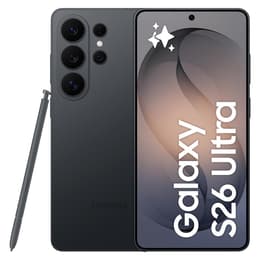
- Accessory support: The Galaxy S26 Ultra includes an integrated stylus slot for handwritten notes and precision drawing, a feature omitted on the smaller standard model.
- Connectivity: Both options support modern wireless standards including rapid fifth-generation cellular networks, high-speed Wi-Fi, and secure biometric authentication via under-display fingerprint sensors.
Weight
167 g
214 g
Screen size (in)
6.3
6.9
Mobile network
5G
5G
SIM card
Dual Physical SIM + eSIM
Physical SIM + eSIM
Carrier compatibility
Unlocked
Unlocked
Connector
USB-C
USB-C
What the community thinks
User feedback from online communities highlights distinct preference patterns for each device. Owners of the standard Galaxy S26 frequently praise its comfortable one-hand usability, lightweight build, and pocket-friendly dimensions. Conversely, users favor the Galaxy S26 Ultra for its expansive screen real estate, versatile zoom capabilities, and integrated stylus functionality, though some note its larger physical footprint requires deliberate two-handed handling. Users prioritizing a compact, easily portable device will find the Galaxy S26 well-suited to their needs, while those requiring maximum screen space and flexible camera optics often lean toward the Ultra variant. Shoppers exploring these models can also consider quality-assured refurbished options as a sustainable choice that reduces environmental impact while delivering equivalent day-to-day functionality. Ultimately, the choice depends entirely on individual preferences regarding physical size and specialized productivity features.