
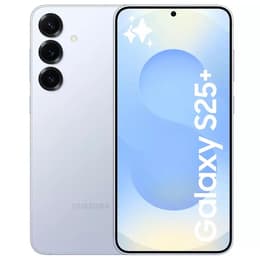


Galaxy S25+ Vs Google Pixel 8

Galaxy S25+
Galaxy S25+
Starting at

Refurbished price:£549.00

Versus £958.39 new

See options
Google Pixel 8
Google Pixel 8
Starting at

Refurbished price:£187.00

Versus £699.99 new

See options

Ratings

The Samsung Galaxy S25 Plus, released in early 2025, and the Google Pixel 8, launched in late 2023, represent distinct approaches to the premium Android smartphone experience. While both devices offer robust performance and advanced camera capabilities, they differentiate themselves through display size, camera hardware, and the underlying processing philosophy. Both run on the Android operating system, providing a familiar software environment, but with their respective manufacturer's custom interfaces and features.

Scores

Durability

When considering the long-term usability of a smartphone, software support and physical resilience are key factors. The Galaxy S25 Plus and the Google Pixel 8 both offer extensive software longevity, ensuring users receive updates for a considerable period.

  • Software Updates: The Samsung Galaxy S25 Plus, released in February 2025, is expected to receive seven years of OS and security updates, extending its software support well into the future. The Google Pixel 8, launched in October 2023, also promises seven years of updates, meaning its support will conclude earlier than the S25 Plus. [2, 10, 15, 17]
  • Physical Durability: Both devices feature robust construction. The Galaxy S25 Plus incorporates Gorilla Glass Victus 2 on its back and an aluminum frame, along with an IP68 rating for dust and water resistance. The Pixel 8 also uses Gorilla Glass Victus for its display and back, coupled with an aluminum frame and an IP68 rating, offering comparable protection against environmental elements. [2, 10, 12, 17]
  • Expected Lifespan: Users can anticipate a practical lifespan of several years from either device, supported by their long update cycles and durable builds. The S25 Plus, being newer, naturally offers a slightly longer window of official software support from its release date.

Year of Release

2025

2023

OS

Android

Android

Foldable

No

No

Performance

Performance is a critical aspect for daily smartphone use, influencing everything from app responsiveness to demanding tasks like gaming and video editing. Both the Galaxy S25 Plus and the Google Pixel 8 deliver capable performance, though they achieve it through different hardware.

  • Processing Power: The Galaxy S25 Plus is equipped with a current-generation processor, designed to handle intensive applications and multitasking with efficiency. This results in smooth navigation and rapid processing for complex tasks. [1, 4, 10, 18] The Pixel 8 features the Google Tensor G3, which is optimized for artificial intelligence and machine learning tasks, providing a fluid experience for everyday use and Google's unique AI features. [5, 6, 7, 8, 25]
  • Multitasking and Storage: The Galaxy S25 Plus comes with 12GB of RAM, providing ample capacity for running numerous applications simultaneously without slowdowns. It offers storage options typically starting at 256GB, with larger variants available. [1, 3, 4, 10, 15, 18] The Pixel 8 includes 8GB of RAM, which is sufficient for most multitasking needs, and offers 128GB or 256GB of internal storage. [2, 5, 6, 7]
  • Real-world Responsiveness: Users of the S25 Plus will experience quick app launches and seamless transitions, particularly beneficial for power users. The Pixel 8 provides a consistently responsive interface, with its processor excelling in tasks that leverage its AI capabilities, such as on-device language processing and advanced photo editing.

Memory (GB)

12 GB

8 GB

Screen quality

The display is the primary interface for smartphone interaction, and both devices offer high-quality viewing experiences, though with differences in size and resolution.

  • Display Technology and Clarity: The Galaxy S25 Plus features a larger 6.7-inch Dynamic AMOLED 2X display with a QHD+ resolution (3120x1440 pixels), resulting in sharp images and text. [1, 10, 15, 18, 20] The Google Pixel 8 has a 6.2-inch Actua OLED display with an FHD+ resolution (2400x1080 pixels), offering clear visuals in a more compact form factor. [2, 5, 6, 8, 17, 23]
  • Brightness and Smoothness: Both phones feature adaptive refresh rates up to 120Hz, ensuring smooth scrolling and fluid animations. The S25 Plus boasts a peak brightness of 2600 nits, providing excellent visibility even in bright outdoor conditions. [18, 20] The Pixel 8 reaches a peak brightness of 2000 nits, which is also very capable for outdoor use. [2, 6, 8, 17, 23]
  • Viewing Experience: The larger, higher-resolution screen of the S25 Plus is well-suited for media consumption and productivity tasks where screen real estate is valued. The Pixel 8's slightly smaller display offers a comfortable one-handed experience while still delivering vibrant colors and deep blacks characteristic of OLED technology.

Resolution

1440x3120

1080 x 2400

Audiovisual

Both the Galaxy S25 Plus and the Google Pixel 8 are designed to capture high-quality images and videos, each with its own strengths in camera hardware and computational photography.

  • Rear Camera Systems: The Galaxy S25 Plus features a versatile triple-camera setup, including a 50MP main sensor, a 12MP ultrawide lens, and a 10MP telephoto lens capable of 3x optical zoom. This configuration provides flexibility for various photographic scenarios, from wide landscapes to distant subjects. [1, 4, 9, 10, 19, 20] The Pixel 8 relies on a dual-camera system with a 50MP main sensor and a 12MP ultrawide lens. It excels in computational photography, using software to enhance image quality, particularly in challenging lighting conditions, but lacks a dedicated telephoto lens. [2, 5, 8, 16, 17, 19, 23, 25]
  • Photography Performance: The S25 Plus offers strong performance across its multiple lenses, with AI enhancements contributing to improved image processing and detail, especially in low light. [9, 10] The Pixel 8 is widely praised for its consistent image quality, natural color reproduction, and exceptional low-light performance, often leveraging its Tensor G3 chip for advanced image processing. [16, 17, 23, 25]
  • Video Capabilities: The Galaxy S25 Plus supports video recording up to 8K resolution at 30 frames per second, and 4K at 60 frames per second, offering high-resolution video capture. [10] The Pixel 8 records 4K video at 60 frames per second, providing smooth and detailed footage, with Google's software stabilization contributing to steady results. [5, 25]

Miscellaneous

Beyond core specifications, several other features contribute to the overall user experience and practical utility of these smartphones.

  • Connectivity and Ports: Both devices support 5G connectivity for fast mobile data. The Galaxy S25 Plus is expected to feature Wi-Fi 7 and Bluetooth 5.4, offering advanced wireless capabilities. [12] The Pixel 8 also supports Wi-Fi 7 and Bluetooth 5.3, ensuring modern wireless standards. Both utilize a USB-C port for charging and data transfer. [2, 8]
  • Biometric Security: For secure unlocking, the Galaxy S25 Plus includes an ultrasonic under-display fingerprint sensor and facial recognition. The Pixel 8 features an optical under-display fingerprint sensor and face unlock, providing convenient and secure access. [2]
  • Design and Handling: The Galaxy S25 Plus, with its 6.7-inch display, is a larger device, weighing approximately 190 grams. [10, 13, 19] The Pixel 8, with its 6.2-inch display, is more compact and lighter at 187 grams, potentially offering easier one-handed use for some users. [2, 5, 13, 17, 19] Both phones feature a premium build with glass backs and aluminum frames. [10, 12, 17]

Weight

190 g

187 g

Screen size (in)

6.7

6.2

Mobile network

5G

5G

SIM card

Dual Physical SIM

Physical SIM + eSIM

Carrier compatibility

Unlocked

Unlocked

The Samsung Galaxy S25 Plus and the Google Pixel 8 cater to slightly different user preferences, each excelling in distinct areas. Users frequently praise the Galaxy S25 Plus for its expansive, high-resolution display and the versatility offered by its triple-camera system, including a dedicated telephoto lens. Its raw processing power is also a common highlight, making it suitable for demanding applications and advanced multitasking. [1, 18]

Conversely, the Google Pixel 8 receives consistent acclaim for its exceptional computational photography, delivering impressive results even without a dedicated telephoto lens, and its clean Android experience with timely software updates. Users often appreciate its more compact form factor and the seamless integration of Google's AI features. Some user feedback indicates that while the Pixel 8's battery life is improved over previous generations, heavy users might still find themselves needing to recharge during the day. [16, 17, 23, 25]

Users prioritizing a larger, more immersive display and a comprehensive camera system with optical zoom capabilities may find the Galaxy S25 Plus better suited to their needs. Those who value a more compact device, a pure Android experience, and cutting-edge computational photography with strong AI integration will likely lean towards the Google Pixel 8. Both devices offer long-term software support, making them viable choices for extended use. For consumers looking for a sustainable choice, both models are available as quality-assured refurbished options, providing an eco-friendly alternative to purchasing new.


See all articles

Our recent comparisons





