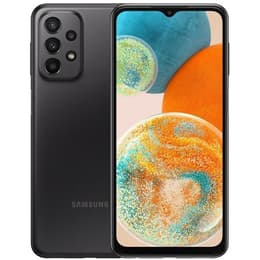
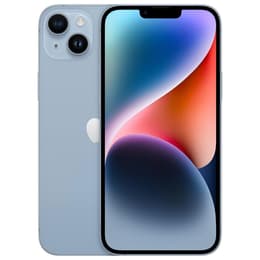

Galaxy A23 5G Vs iPhone 14 Plus

Galaxy A23 5G
Galaxy A23 5G
Starting at

Refurbished price:£100.00

Versus £300.00 new

See options
iPhone 14 Plus
iPhone 14 Plus
Starting at

Refurbished price:£242.00

Versus £699.00 new

See options

Ratings

The Samsung Galaxy A23 5G, released in August 2022, and the iPhone 14 Plus, launched in October 2022, are both smartphones designed for everyday use. While the Galaxy A23 5G operates on Android, offering a customizable experience, the iPhone 14 Plus runs on Apple's iOS, known for its integrated ecosystem. Key differentiators between these two models include their display technology, camera capabilities, and overall performance, catering to different user preferences.

Scores

Durability

When considering the longevity of these devices, both offer a solid foundation, though their update policies and build materials present distinct differences.

  • Software Support: The iPhone 14 Plus, running iOS, typically receives software updates for a longer duration, often 5-6 years from its release, extending its practical lifespan. The Galaxy A23 5G, an Android device, is expected to receive two major OS upgrades and four years of security updates, with support anticipated to continue into 2026.
  • Physical Durability: The iPhone 14 Plus features a Ceramic Shield front cover and an aluminum frame, contributing to its robust build and IP68 rating for water and dust resistance. The Galaxy A23 5G utilizes Gorilla Glass 5 for screen protection and has a plastic construction, but lacks an official IP rating for water and dust ingress.
  • Repairability: Both devices are designed with repairability in mind, though the iPhone 14 Plus has been noted for internal redesigns that can simplify certain repairs.

Year of Release

2022

2022

Compatible with latest Update

Yes

Yes

OS

Android

iOS

Foldable

No

No

Performance

The performance of a smartphone significantly impacts daily interactions, from app responsiveness to handling demanding tasks. These two devices approach performance with different underlying architectures.

  • Everyday Responsiveness: The iPhone 14 Plus is equipped with a powerful processor that ensures smooth navigation, rapid app loading, and efficient multitasking, providing a fluid user experience even with intensive applications. The Galaxy A23 5G offers capable performance for general use, though some users have reported occasional sluggishness or lag, particularly with the 4GB RAM variant or during demanding tasks like gaming.
  • Multitasking Capabilities: The iPhone 14 Plus handles multiple applications running simultaneously with ease, maintaining consistent performance. The Galaxy A23 5G, while generally competent for typical multitasking, may show limitations when managing numerous active applications or resource-heavy processes.
  • Battery Performance: The iPhone 14 Plus is recognized for its extended battery life, often lasting up to two days or more for many users, making it suitable for prolonged use without frequent charging. The Galaxy A23 5G also features a large battery capacity, with users frequently reporting it can last up to two days on a single charge.

Memory (GB)

4 GB

6 GB

Screen quality

The visual experience is a primary consideration for many users, and both phones offer distinct display technologies and characteristics.

  • Display Technology and Clarity: The iPhone 14 Plus features a 6.7-inch Super Retina XDR OLED display, delivering deep blacks, high contrast, and vibrant colors with a sharp resolution of 2778 x 1284 pixels. The Galaxy A23 5G comes with a 6.6-inch FHD+ PLS LCD screen, offering clear visuals with a resolution of 1080 x 2408 pixels.
  • Refresh Rate and Smoothness: A notable difference lies in the refresh rates. The Galaxy A23 5G boasts a 120Hz refresh rate, which contributes to smoother scrolling and a more fluid visual experience. In contrast, the iPhone 14 Plus maintains a standard 60Hz refresh rate. Users accustomed to higher refresh rates might notice this difference on the iPhone.
  • Brightness and Outdoor Visibility: The iPhone 14 Plus offers high typical brightness and a peak brightness for HDR content, enhancing visibility in various lighting conditions. The Galaxy A23 5G's display is generally considered good for its category, though it may not reach the same peak brightness levels as the iPhone's OLED panel.

Resolution

1080 x 2408

1284 x 2778

Screen type

PLS LCD

Super Retina XDR OLED

Audiovisual

For capturing moments and creating content, the camera systems on these devices offer different strengths and features.

  • Main Camera Performance: The iPhone 14 Plus features a dual-camera system with a 12MP main sensor that includes sensor-shift optical image stabilization (OIS) and a wide aperture, contributing to improved low-light performance and detailed photos. The Galaxy A23 5G is equipped with a 50MP main camera, also featuring OIS, which captures decent images in well-lit environments.
  • Versatility and Additional Lenses: The Galaxy A23 5G includes a 5MP ultrawide lens, a 2MP macro lens, and a 2MP depth sensor, offering more versatility for different types of shots, though the quality of the auxiliary lenses can vary. The iPhone 14 Plus also has a 12MP ultrawide camera, known for its consistent image quality.
  • Video Recording Capabilities: The iPhone 14 Plus supports video recording up to 4K Dolby Vision at 60 frames per second, along with an Action mode for enhanced video stabilization. The Galaxy A23 5G records video at up to 1080p at 30 frames per second, without 4K video capabilities.

Main camera

50 megapixels

12 megapixels

Front camera

8 megapixels

12 megapixels

Miscellaneous

Beyond the core features, several practical elements contribute to the overall user experience and connectivity of these smartphones.

  • Connectivity and Ports: Both devices support 5G connectivity for faster mobile data speeds. The Galaxy A23 5G includes a traditional 3.5mm headphone jack and a USB-C 2.0 port, along with expandable storage via a microSD card slot. The iPhone 14 Plus uses a Lightning port for charging and data transfer and does not feature a headphone jack or expandable storage.
  • Biometrics and Sensors: The iPhone 14 Plus relies on Face ID for secure facial recognition. The Galaxy A23 5G incorporates a side-mounted fingerprint sensor for biometric authentication.
  • Physical Characteristics: The iPhone 14 Plus measures 160.8 x 78.1 x 7.8 mm and weighs 203g. The Galaxy A23 5G has dimensions of 165.4 x 76.9 x 8.4mm and weighs 197g.

Weight

197 g

203 g

Screen size (in)

6.6

6.7

Mobile network

5G

5G

SIM card

Dual Physical SIM

Physical SIM + eSIM

Carrier compatibility

Unlocked

Unlocked

Connector

USB-C + Jack 3.5mm

Lightning

User feedback for the Samsung Galaxy A23 5G often highlights its impressive battery life and the smooth 120Hz display as strong points. However, some users have expressed concerns regarding its performance, particularly with the 4GB RAM variant, noting occasional lag or unresponsiveness during heavier use. There have also been isolated reports of overheating and signal reception issues.

The iPhone 14 Plus is widely praised for its exceptional battery longevity, large and vibrant OLED display, and consistent performance for daily tasks and demanding applications. Criticisms sometimes point to its 60Hz refresh rate, which some users find less fluid compared to devices with higher refresh rates, and the absence of a telephoto camera.

Users prioritizing a highly fluid display and expandable storage for media and files may find the Galaxy A23 5G well-suited to their needs, especially if long battery life is a key factor. Conversely, those who value a consistently powerful performance, a superior OLED screen, advanced video capabilities, and a longer software support window might lean towards the iPhone 14 Plus. Both models are available as quality-assured refurbished options, providing an eco-friendly alternative for consumers.


See all articles

Our recent comparisons