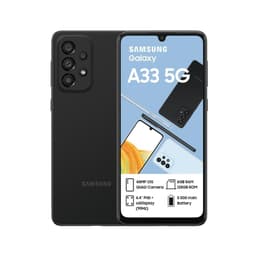

Galaxy A16 Vs Galaxy A33 5G

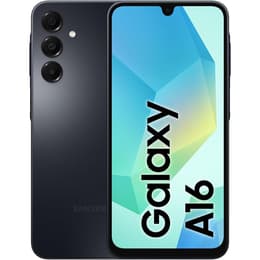
Galaxy A16
Galaxy A16
Starting at

Refurbished price:£100.62

Versus £206.96 new

See options
Galaxy A33 5G
Galaxy A33 5G
Starting at

Refurbished price:£102.00

Versus £389.00 new

See options

Ratings

The Samsung Galaxy A16 and Galaxy A33 5G are both smartphones from Samsung's A-series, designed to offer a balanced experience for everyday users. The Galaxy A33 5G was released in April 2022, while the Galaxy A16 followed later, with its official announcement in October 2024 and release in late 2024/early 2025. These devices cater to users seeking reliable performance and features without venturing into premium flagship categories. Both run on the Android operating system with Samsung's One UI.

Scores

Durability

The expected lifespan of a smartphone is significantly influenced by its release date and the manufacturer's software support policy.

  • Release Timeline and Software Support: The Galaxy A16, released in late 2024/early 2025, benefits from a more extended software support commitment, offering six years of major OS and security updates, potentially lasting until October 2030. In contrast, the Galaxy A33 5G, launched in April 2022, was promised four major OS updates and five years of security updates, meaning its support will conclude sooner. This difference translates to a longer period of receiving the latest Android features and security patches for the A16.
  • Physical Durability: The Galaxy A33 5G features an IP67 rating for dust and water resistance, allowing it to withstand submersion in up to 1 meter of freshwater for 30 minutes, and its front is protected by Gorilla Glass 5. The Galaxy A16 comes with an IP54 rating, indicating protection against dust and splashes. Both devices utilize plastic for their main body construction, contributing to a lighter feel.

Year of Release

2024

2022

Compatible with latest Update

Yes

Yes

OS

Android

Android

Foldable

No

No

Performance

Both devices are designed to handle daily tasks efficiently, though their internal components differ.

  • Processing Power: The Galaxy A16 is equipped with either a MediaTek Dimensity 6300 or an Exynos 1330 processor, depending on the region. This allows for smooth navigation through apps, social media, and streaming content, with some capacity for light multitasking. The Galaxy A33 5G features the Exynos 1280 processor, which provides smooth daily operation and is capable of handling typical smartphone usage, including moderate gaming and multitasking.
  • Memory and Storage: The Galaxy A16 offers configurations with 4GB, 6GB, or 8GB of RAM and 128GB or 256GB of internal storage, which is expandable via a microSD card. The Galaxy A33 5G typically comes with 6GB or 8GB of RAM and 128GB or 256GB of expandable storage. Both devices provide sufficient memory for running multiple applications and ample storage for media and files, with the option to expand further.
  • Battery Life: Both smartphones are powered by a 5000 mAh battery. Users of the Galaxy A16 can expect respectable screen-on time, with multimedia consumption being optimized. The Galaxy A33 5G is also noted for its dependable battery life, often lasting through a full day of typical use. Both support 25W fast charging.

Memory (GB)

4 GB

6 GB

Screen quality

The visual experience on both devices is characterized by vibrant displays, though with some distinctions.

  • Display Technology and Size: The Galaxy A16 features a larger 6.7-inch Super AMOLED display, offering vibrant colors and deep blacks. The Galaxy A33 5G has a 6.4-inch Super AMOLED display, also known for its vivid high-definition and true-to-life color reproduction. Both utilize FHD+ resolution for clear visuals.
  • Refresh Rate and Brightness: The Galaxy A16 offers a 90Hz or 120Hz adaptive refresh rate, contributing to smoother scrolling and animations. Its peak brightness is around 800 nits, which can be adequate for indoor viewing but might present challenges in very bright outdoor conditions. The Galaxy A33 5G also features a 90Hz refresh rate, providing a smooth viewing experience. Its outdoor visibility is generally fine for most scenarios, though not at flagship levels.
  • Design Elements: The Galaxy A16's display incorporates an age-old U-shaped notch cutout for the front camera. The Galaxy A33 5G also features an Infinity-U "waterdrop" notch for its selfie camera.

Resolution

1080 x 2340

1080 x 2400

Screen type

Super AMOLED

Super AMOLED

Audiovisual

Both smartphones offer capable camera systems and audio experiences for their segment.

  • Rear Camera System: The Galaxy A16 is equipped with a triple rear camera setup, including a 50MP main sensor, a 5MP ultrawide lens, and a 2MP macro camera. The Galaxy A33 5G features a quad-camera array with a 48MP main sensor that includes Optical Image Stabilization (OIS), an 8MP ultrawide, a 5MP macro, and a 2MP depth sensor. The OIS on the A33 5G's main camera is a notable advantage for steadier photos and videos, especially in challenging lighting.
  • Photography and Video Quality: Both devices are capable of capturing detailed photos in good lighting conditions. The A16's 50MP main camera can produce clear shots, while the A33 5G's OIS aids in sharper images and smoother video recording, even up to 4K at 30fps for both front and rear cameras, though stabilization is limited to 1080p at 30fps.
  • Front Camera and Audio: Both phones feature a 13MP front-facing camera for selfies and video calls. For audio, the Galaxy A16 has a single bottom-firing speaker, which delivers loud output. The Galaxy A33 5G offers stereo speakers, providing a more immersive audio experience for media consumption.

Main camera

50 megapixels

48 megapixels

Front camera

13 megapixels

13 megapixels

Miscellaneous

Beyond core features, several practical elements differentiate these devices.

  • Connectivity: Both the Galaxy A16 and Galaxy A33 5G support 5G connectivity, ensuring access to faster mobile network speeds where available. They also include standard Wi-Fi and Bluetooth capabilities for wireless connections.
  • Ports and Sensors: Both devices feature a USB Type-C port for charging and data transfer. The Galaxy A16 includes a side-mounted fingerprint scanner for security. The Galaxy A33 5G integrates an optical fingerprint sensor into its display for unlocking. The A33 5G notably lacks a traditional 3.5mm headphone jack, while the A16's specifications mention a USB Type-C audio jack, implying it might not have a dedicated 3.5mm port either.
  • Physical Attributes: The Galaxy A16 weighs approximately 200 grams. The Galaxy A33 5G is slightly lighter at around 186 grams. Both devices have a similar thickness, with the A33 5G measuring 8.1mm and the A16 at 7.9mm.

Weight

200 g

186 g

Screen size (in)

6.7

6.4

Mobile network

4G

5G

SIM card

Dual Physical SIM

Dual Physical SIM

Carrier compatibility

Unlocked

Unlocked

Connector

USB-C

USB-C

User sentiment for the Galaxy A33 5G often highlights its balanced performance, vibrant Super AMOLED display, and the inclusion of OIS in its main camera as strong points. Users appreciate its dependable battery life and the multi-year software support commitment. Some common criticisms include its processor not being the fastest for demanding tasks and the absence of a 3.5mm headphone jack.

For the newer Galaxy A16, early user impressions and specifications suggest a focus on extended software longevity and a larger display. Its 6-year update policy is a significant draw for users prioritizing long-term device usability. The performance is considered smooth for everyday activities, though power users might seek more robust options.

Users prioritizing a longer software support window and a slightly larger display may find the Galaxy A16 well-suited to their needs. Those who value a higher IP rating for water and dust resistance, optical image stabilization for photography, and stereo speakers might lean towards the Galaxy A33 5G. Both devices offer a solid foundation for daily smartphone use, and considering a quality-assured refurbished option for either model can be an eco-friendly alternative to purchasing new.


See all articles

Our recent comparisons