
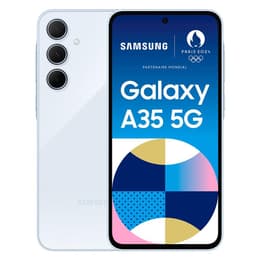

Galaxy A16 Vs Galaxy A35

Galaxy A16
Galaxy A16
Starting at

Refurbished price:£100.62

Versus £206.96 new

See options
Galaxy A35
Galaxy A35
Starting at

Refurbished price:£119.00

Versus £367.31 new

See options

Ratings

The Samsung Galaxy A16 and Galaxy A35 are both Android smartphones from Samsung's A series, released in 2024. While sharing the same operating system, they cater to slightly different user needs, with the Galaxy A35 offering enhanced durability and camera capabilities, and the Galaxy A16 focusing on extended software support and a larger display.

Scores

Durability

When considering the longevity of these devices, both offer substantial software support, though with different timelines and levels of physical protection.

  • Release and Software Support: The Galaxy A16 was released in late 2024, with its 5G variant becoming available in Europe in October 2024 and the US in January 2025. It stands out with a commitment to six years of operating system updates and six years of security updates, extending support until October 2030. The Galaxy A35, released in March 2024, is set to receive four years of OS updates and five years of security updates.
  • Physical Durability: The Galaxy A16 features an IP54 rating, indicating resistance to dust and splashes of water, making it suitable for everyday encounters with moisture. Its construction includes a plastic back and frame with a glass front. The Galaxy A35 offers a higher IP67 rating, providing more robust protection against dust and allowing for submersion in up to one meter of fresh water for up to 30 minutes. It also benefits from Corning Gorilla Glass Victus+ on the front for enhanced screen protection, alongside a glass back and plastic sides.
  • Expected Practical Lifespan: Users prioritizing the longest possible software longevity will find the Galaxy A16's extended update policy appealing. However, those seeking greater physical resilience against water and dust, coupled with advanced screen protection, may lean towards the Galaxy A35.

Year of Release

2024

2024

Compatible with latest Update

Yes

Yes

OS

Android

Android

Foldable

No

No

Performance

Both smartphones are designed to handle daily tasks efficiently, though the Galaxy A35 offers a more capable experience for demanding applications.

  • Processor Capabilities: The Galaxy A16 is equipped with a processor designed for everyday activities, handling basic tasks, light multitasking, and social media browsing smoothly. The Galaxy A35 features a processor that provides a responsive experience for regular tasks, including browsing and using productivity applications, with smooth transitions between apps.
  • Memory and Storage: Both devices offer flexible storage options, typically starting from 128GB and extending to 256GB, with support for expandable storage via a microSD card. The Galaxy A16 is available with 4GB, 6GB, or 8GB of RAM, while the Galaxy A35 typically comes with 6GB or 8GB of RAM. Higher RAM configurations on either device contribute to smoother multitasking.
  • Battery Behavior: Both the Galaxy A16 and Galaxy A35 are powered by a 5000mAh battery, supporting 25W fast charging. Users of the Galaxy A35 can expect the battery to last for approximately 1.5 days or around 38 hours with typical usage, providing about 7 hours of screen-on time. The Galaxy A16 also offers a full day of battery life with light use.

Memory (GB)

4 GB

6 GB

Screen quality

Both devices feature vibrant Super AMOLED displays, but they differ in size, refresh rate, and peak brightness, impacting the overall viewing experience.

  • Display Technology and Resolution: Both the Galaxy A16 and Galaxy A35 utilize Super AMOLED display technology, known for producing deep blacks and vibrant colors. They both offer Full HD+ resolution (1080 x 2340 pixels), ensuring clear and detailed visuals for content consumption.
  • Size and Refresh Rate: The Galaxy A16 features a slightly larger 6.7-inch display with a 90Hz refresh rate, providing a smooth scrolling experience. The Galaxy A35 has a 6.6-inch display, but it offers a higher 120Hz refresh rate, resulting in even smoother animations and a more fluid user interface.
  • Brightness and Outdoor Visibility: The Galaxy A16's display can reach up to 800 nits in High Brightness Mode, which provides adequate visibility indoors, though outdoor visibility in direct sunlight might be challenging. The Galaxy A35 offers a brighter display with a peak brightness of 1000 nits, enhancing outdoor visibility and overall clarity in various lighting conditions.

Resolution

1080 x 2340

1080 x 2340

Screen type

Super AMOLED

Super AMOLED

Audiovisual

Both smartphones are equipped with multi-camera systems, but the Galaxy A35 offers more advanced features for photography and videography.

  • Rear Camera System: The Galaxy A16 features a triple rear camera setup, including a 50MP main sensor, a 5MP ultrawide lens, and a 2MP macro lens. The Galaxy A35 also has a triple camera system, comprising a 50MP main camera with Optical Image Stabilization (OIS), an 8MP ultrawide camera, and a 5MP macro camera. The inclusion of OIS on the Galaxy A35's main camera helps in capturing clearer photos and more stable videos, especially in challenging conditions.
  • Photography Performance: The Galaxy A35's main camera produces detailed shots, with colors that are often vibrant, and its NPU (Neural Processing Unit) assists in processing details and maintaining dynamic range. While the Galaxy A16's 50MP main sensor is capable for everyday photos, it lacks OIS, which can impact clarity in lower light or when there is movement.
  • Video Recording and Front Camera: The Galaxy A16 supports video recording up to 1080p at 30 frames per second (fps) for both its rear and 13MP front cameras. The Galaxy A35 offers more advanced video capabilities, allowing for UHD 4K recording at 30fps from both its rear and 13MP front cameras. For audio, the Galaxy A35 includes stereo speakers, providing a more immersive sound experience for media consumption, while the Galaxy A16 features a single bottom-firing speaker.

Main camera

50 megapixels

50 megapixels

Front camera

13 megapixels

13 megapixels

Miscellaneous

Beyond core features, several practical elements differentiate the user experience between these two Samsung Galaxy models.

  • Connectivity and Ports: Both devices support 5G connectivity, enabling fast mobile data speeds where available. They both include USB Type-C 2.0 ports for charging and data transfer, and neither features a traditional 3.5mm headphone jack. The Galaxy A35 supports Wi-Fi 6, offering potentially faster and more stable wireless internet connections compared to the Galaxy A16's Wi-Fi 5 (802.11ac) standard. Both devices also feature Bluetooth 5.3 and NFC for wireless accessories and contactless payments.
  • Biometric Security and Handling: Both smartphones incorporate fingerprint sensors for secure unlocking. In terms of physical design, the Galaxy A16 measures 164.4 x 77.9 x 7.9 mm and weighs around 192-200 grams, offering a slightly thinner and lighter profile. The Galaxy A35 is marginally more compact in height and width at 161.7 x 78.0 x 8.2 mm, but slightly heavier at 209 grams. The Galaxy A35's design includes a glass back, which contributes to a more premium feel compared to the Galaxy A16's plastic back.
  • Additional Features: The Galaxy A16 includes Samsung Knox Vault for enhanced security, physically isolating sensitive data. The Galaxy A35 also integrates Samsung Knox Vault, providing similar robust security measures.

Weight

200 g

209 g

Screen size (in)

6.7

6.6

Mobile network

4G

5G

SIM card

Dual Physical SIM

Dual Physical SIM

Carrier compatibility

Unlocked

Unlocked

Connector

USB-C

USB-C

The Samsung Galaxy A16 and Galaxy A35 both offer compelling features within their respective segments, with user priorities largely dictating the more suitable choice.

Users often praise the Galaxy A35 for its vibrant Super AMOLED display with a smooth 120Hz refresh rate and its capable camera system, particularly the main sensor with Optical Image Stabilization, which contributes to clearer photos and more stable videos. Its IP67 water and dust resistance and Gorilla Glass Victus+ front are also frequently highlighted as significant advantages for everyday durability. Some users, however, note that while its performance is adequate for most tasks, it might not be the fastest in its class.

The Galaxy A16 receives positive remarks for its surprisingly long software support, promising six years of updates, which is a notable benefit for device longevity. Its large 6.7-inch display is also appreciated for media consumption. Criticisms sometimes point to its lower IP rating and the absence of OIS in its camera system, which can affect photo quality in certain situations.

Users prioritizing extended software longevity and a slightly larger screen for media consumption may find the Galaxy A16 well-suited to their needs. Conversely, those who value enhanced physical durability, a smoother display experience, and more advanced camera capabilities, especially for video and low-light photography, may lean towards the Galaxy A35. Both models represent solid choices in the mid-range Android market, and considering a quality-assured refurbished option for either device can be an eco-friendly alternative.


See all articles

Our recent comparisons