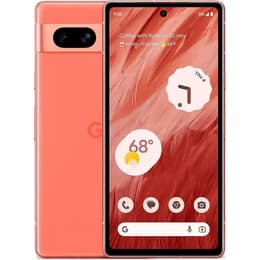

Google Pixel 7A Vs Sony Xperia 5 IV

Google Pixel 7A
Google Pixel 7A
Starting at

Refurbished price:£129.00

Versus £649.99 new

See options
Sony Xperia 5 IV
Sony Xperia 5 IV
Starting at

Refurbished price:£299.00

Versus £1,199.00 new

See options

Ratings

The Google Pixel 7a (released May 2023) and the Sony Xperia 5 IV (released September 2022) are both Android smartphones that offer distinct approaches to the mobile experience. While the Pixel 7a emphasizes computational photography and a streamlined software experience, the Xperia 5 IV focuses on multimedia consumption, manual camera controls, and a compact design. Both devices run on the Android operating system, but their underlying philosophies lead to different user interactions and feature sets.

Scores

Durability

When considering the long-term usability of a smartphone, factors like software support, physical durability, and repairability play a significant role. The Pixel 7a and Xperia 5 IV present different profiles in these areas.

  • Software Updates: The Google Pixel 7a is expected to receive five years of OS and security updates from its release date, extending its software longevity until at least May 2028 for security updates and May 2026 for OS updates. The Sony Xperia 5 IV, released earlier, typically follows Sony's policy of two major Android updates and three years of security updates, meaning its official Android OS updates have concluded with Android 14, and security updates are expected to continue until around September 2025.
  • Physical Durability: The Xperia 5 IV features Corning Gorilla Glass Victus on both its front and back panels, along with IP65/IP68 water and dust resistance, suggesting a robust build. The Pixel 7a uses Corning Gorilla Glass 3 for its display and has an IP67 rating for water and dust resistance.
  • Repairability: The Pixel 7a initially received a 4/10 repairability score from iFixit, later uprated to 5/10 after Google provided service manuals and made them freely available. Genuine parts for the Pixel 7a are also available for DIY repairs. Information regarding the repairability score for the Xperia 5 IV is less readily available, though some users have reported screen repair costs.

Year of Release

2023

2022

Compatible with latest Update

Yes

No

OS

Android

Android

Foldable

No

No

Performance

Both devices are equipped with capable processors designed to handle daily tasks and demanding applications, though they utilize different hardware architectures.

  • Processing Power: The Pixel 7a is powered by Google's Tensor G2 chip, which is optimized for AI and machine learning tasks, contributing to features like advanced image processing and voice recognition. The Xperia 5 IV uses a current-generation processor known for strong general performance and gaming capabilities.
  • Multitasking and Responsiveness: Both phones come with 8GB of RAM, allowing for smooth app switching and efficient multitasking. Users of the Pixel 7a generally report smooth performance for everyday use, though some have noted that it may not offer the fastest charging speeds. The Xperia 5 IV has been noted for its strong performance in benchmarks, capable of handling demanding applications.
  • Storage and Battery Behavior: The Pixel 7a offers 128GB of internal storage without expansion options. The Xperia 5 IV provides 128GB or 256GB of internal storage and includes a microSD card slot for expandable storage up to 1TB. The Pixel 7a has a 4385 mAh battery, with users reporting it generally lasts a full day, though some have experienced varying battery life and slower charging speeds. The Xperia 5 IV features a larger 5000 mAh battery, which contributes to its extended battery life.

Memory (GB)

8 GB

8 GB

Screen quality

The visual experience on both the Pixel 7a and Xperia 5 IV is delivered through high-quality OLED panels, but with some distinctions in their specifications and user experience.

  • Display Technology and Clarity: Both devices feature 6.1-inch OLED displays, offering deep blacks and vibrant colors. The Pixel 7a has a 2400 x 1080 pixel resolution, resulting in a pixel density of approximately 431 ppi. The Xperia 5 IV offers a 2520 x 1080 pixel resolution with a 21:9 aspect ratio, providing a slightly higher pixel density of around 449 ppi.
  • Refresh Rate and Brightness: The Pixel 7a's display supports a 90Hz refresh rate, providing a smoother scrolling experience compared to standard 60Hz displays. The Xperia 5 IV steps this up with a 120Hz refresh rate, offering even smoother visuals. The Xperia 5 IV's display also boasts higher peak brightness levels, reaching almost 1,000 nits in auto mode, which can improve outdoor visibility.
  • Viewing Experience: The Xperia 5 IV's 21:9 aspect ratio is designed for an immersive cinematic viewing experience, particularly for movies and widescreen content. The Pixel 7a's display, while offering good quality, has been noted by some users for having slightly thicker bezels compared to some other devices.

Resolution

1080 x 2400

1080 x 2520

Screen type

OLED

OLED

Audiovisual

Both smartphones offer capable camera systems, but they cater to different photographic preferences and strengths.

  • Rear Camera Systems: The Pixel 7a features a dual-camera setup with a 64-megapixel main sensor and a 13-megapixel ultrawide lens. It is known for its computational photography, which enhances image quality and detail, especially in various lighting conditions. The Xperia 5 IV comes with a versatile triple 12-megapixel camera system, including a main wide lens, an ultrawide lens, and a telephoto lens with 2.5x optical zoom. Sony's camera approach often emphasizes more manual controls and a natural color science.
  • Low-Light and Everyday Photography: The Pixel 7a generally excels in point-and-shoot scenarios, consistently producing good results across different conditions due to its advanced image processing. The Xperia 5 IV's main camera captures detailed photos with natural colors in good lighting.
  • Video Recording and Audio: Both devices are capable of recording 4K video. The Pixel 7a supports 4K video recording at 30 or 60 frames per second. The Xperia 5 IV offers advanced video features, including a Video Pro app for more granular control over recording settings. For audio, the Xperia 5 IV includes a 3.5mm headphone jack and front-facing stereo speakers, providing a rich media consumption experience. The Pixel 7a features stereo speakers, though some users have described them as less cinematic.

Main camera

64 megapixels

12 megapixels

Front camera

13 megapixels

12 megapixels

Miscellaneous

Beyond the core features, several practical elements differentiate the Pixel 7a and Xperia 5 IV, influencing daily usability and connectivity.

  • Connectivity and Ports: Both phones support 5G connectivity, Wi-Fi 6E (Pixel 7a) or Wi-Fi 6 (Xperia 5 IV), and Bluetooth 5.3 (Pixel 7a) or Bluetooth 5.2 (Xperia 5 IV). A notable difference is the inclusion of a 3.5mm headphone jack on the Xperia 5 IV, a feature absent on the Pixel 7a. Both devices utilize a USB-C port for charging and data transfer.
  • Biometric Security: The Pixel 7a incorporates an under-display fingerprint sensor and also offers face unlock. User experiences with the Pixel 7a's fingerprint sensor have been mixed, with some finding it inconsistent. The Xperia 5 IV features a side-mounted fingerprint sensor, which users often find fast and reliable.
  • Design and Handling: The Pixel 7a weighs 193.5 grams and has dimensions of 152 x 72.9 x 9 mm. The Xperia 5 IV is lighter at 172 grams and measures 156 x 67 x 8.2 mm, making it a more compact device with a narrower form factor. The Xperia 5 IV also includes a dedicated two-step hardware shutter key for its camera.

Weight

193 g

172 g

Screen size (in)

6.1

6,1

Mobile network

5G

5G

SIM card

Physical SIM + eSIM

Physical SIM + eSIM

Carrier compatibility

Unlocked

Unlocked

User sentiment for the Google Pixel 7a often highlights its strong camera performance, particularly its computational photography capabilities, and the clean, timely Android software experience. Some common criticisms include concerns about battery life for heavy users and the speed of charging. There have also been reports of battery swelling issues for some Pixel 7a units, leading to an extended repair program. The Sony Xperia 5 IV receives praise for its compact design, excellent battery life, and the inclusion of a 3.5mm headphone jack and expandable storage. However, some users have noted concerns regarding software update longevity and potential overheating during intensive camera use.

Users prioritizing a consistent point-and-shoot camera experience and a streamlined Android interface with extended software support may find the Google Pixel 7a well-suited to their needs. Those who value a compact form factor, superior battery endurance, a headphone jack, expandable storage, and more manual control over their photography and videography might lean toward the Sony Xperia 5 IV. Both devices offer compelling features, and choosing between them often comes down to these specific user priorities. For those considering either device, exploring quality-assured refurbished options can provide an eco-friendly alternative.


See all articles

Our recent comparisons