
Compare models

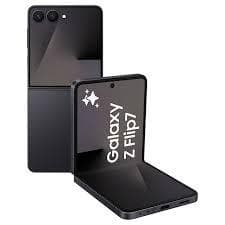
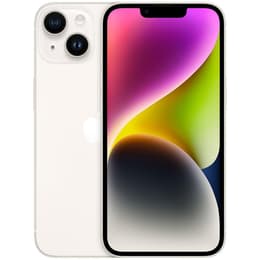
Galaxy Z Flip7 Vs iPhone 14

  • 1-year minimum warranty
  • Free delivery on all items
  • Free 30-day returns
Galaxy Z Flip7
Starting at

Refurbished price:£486.00

Versus £1,156.31 new

See options
iPhone 14
Starting at

Refurbished price:£229.00

Versus £599.00 new

See options

Differences at a glance

The Samsung Galaxy Z Flip7 (2025) and the iPhone 14 (2022) represent two distinct approaches to modern smartphone design, contrasting a compact foldable form factor with a traditional candy bar layout. While both devices serve daily communication and multimedia needs, they differ significantly in their physical construction, operating systems, and display layouts. The Galaxy Z Flip7 runs on Android with customized foldable window features, whereas the iPhone 14 operates on Apple's iOS platform. These structural and software differences shape how users interact with each device throughout the day.

Available Models

Colour

Storage (GB)

Scores

Durability

Device longevity and update support vary between these models due to their release timelines and differing manufacturer support schedules.

  • Software Support Window: The Galaxy Z Flip7 benefits from an extended multi-year update commitment typical of newer Android releases, while the iPhone 14 follows Apple's standard extended support lifecycle of approximately five to six years from its launch date.
  • Hardware Durability: The iPhone 14 utilizes a rigid glass and aluminum structure with fixed glass panels, whereas the Galaxy Z Flip7 employs a complex folding hinge mechanism that requires careful handling during long-term use.
  • Expected Lifespan: Users seeking a conventional rigid chassis may find predictable wear patterns on the iPhone, while foldable device users must account for routine hinge and flexible screen maintenance over years of operation.

Year of Release

2025

2022

Compatible with latest Update

Yes

Yes

OS

Android

iOS

Foldable

Yes

No

Performance

Both smartphones handle daily applications, streaming, and light gaming efficiently, though their underlying hardware architectures and memory configurations vary.

  • Multitasking Capacity: The Galaxy Z Flip7 includes generous random access memory paired with efficient processing architecture, keeping multiple background applications active smoothly, whereas the iPhone 14 relies on optimized software integration to manage everyday tasks with fewer resources.
  • Storage Configurations: Both devices offer tiered internal storage capacities starting at baseline levels suitable for standard media libraries, scaling upward for users who store extensive video files locally.
  • Battery Behavior: The iPhone 14 provides reliable power management for standard daily routines, while the Galaxy Z Flip7's dual-screen configuration and larger battery capacity handle mixed usage between the main folding screen and the outer display.

Screen quality

Visual experiences differ fundamentally due to the foldable display engineering of one model versus the rigid flat panel of the other.

  • Display Technology: The iPhone 14 features a rigid flat organic light-emitting diode panel with fixed dimensions, while the Galaxy Z Flip7 offers an expansive folding internal display complemented by a functional outer cover screen.
  • Outdoor Visibility: Both panels deliver high peak brightness levels that maintain legibility under direct sunlight, ensuring clear viewing angles for navigation and messaging outdoors.
  • Refresh Rate and Smoothness: The Galaxy Z Flip7 supports a high refresh rate for fluid scrolling animations, whereas the iPhone 14 utilizes a standard refresh rate for interface transitions.

Resolution

1080x2520

1170 x 2532

Audiovisual

Imaging capabilities on both devices cater to everyday photography, low-light environments, and high-definition video recording.

  • Rear Camera Systems: Both smartphones feature dual rear configurations incorporating main wide-angle lenses alongside ultra-wide options for capturing expansive landscapes.
  • Video Recording: The iPhone 14 provides steady stabilization modes and cinematic focus effects, while the Galaxy Z Flip7 leverages its folding design to enable stable hands-free recording angles without requiring an external stand.
  • Media and Audio Output: Stereo speaker setups on both models deliver clear sound reproduction for hands-free calls, podcasts, and casual video playback.

Main camera

50 megapixels

12 megapixels

Front camera

10 megapixels

12 megapixels

Miscellaneous

Practical everyday features, physical dimensions, and connectivity standards define the handling characteristics of each smartphone.

  • Connectivity Standards: Both devices support modern fifth-generation cellular networks, rapid wireless protocols, and precise location tracking sensors.
  • Physical Dimensions: The iPhone 14 maintains a uniform, pocket-friendly rectangular footprint, whereas the Galaxy Z Flip7 folds cleanly in half to occupy minimal pocket space while being slightly taller when fully unfolded.
  • Authentication Methods: The iPhone 14 relies entirely on facial recognition technology, while the Galaxy Z Flip7 incorporates a side-mounted fingerprint sensor embedded within the power button alongside facial recognition.

Weight

188 g

172 g

Screen size (in)

6.9

6.1

Mobile network

5G

5G

SIM card

Physical SIM + eSIM

Physical SIM + eSIM

Carrier compatibility

Unlocked

Unlocked

Connector

USB-C

Lightning

What the community thinks

User discussions across community forums highlight distinct preferences for each device based on form factor and operating ecosystem. Owners of the iPhone 14 frequently praise its reliable build quality, straightforward software interface, and dependable daily battery retention. Conversely, Galaxy Z Flip7 users often emphasize the convenience of the compact folded size, the utility of the outer cover screen for quick notifications, and the fluidity of the internal display. Common criticisms for the folding model center on the visible crease across the main screen and the extra care required for the hinge mechanism, while iPhone users sometimes note a desire for faster display refresh rates.

Users prioritizing a pocket-friendly footprint and innovative foldable screen layouts will find the Galaxy Z Flip7 well-suited to their preferences, while users seeking a traditional, straightforward operating system and a rigid structure will lean toward the iPhone 14. For those interested in a quality-assured refurbished option, exploring sustainable choices through Back Market offers a reliable path to acquiring either device with verified performance standards.