
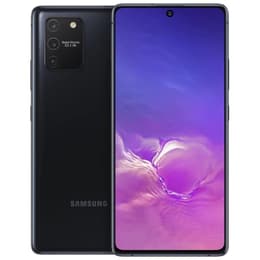

Galaxy S10 Vs Galaxy S10 Lite

Galaxy S10
Galaxy S10
Starting at

Refurbished price:£102.00

Versus £459.00 new

See options
Galaxy S10 Lite
Galaxy S10 Lite
Starting at

Refurbished price:£95.88

Versus £509.00 new

See options

Ratings

The Samsung Galaxy S10, released in March 2019, and the Samsung Galaxy S10 Lite, launched in January 2020, are both Android smartphones from Samsung's S10 series. While the original S10 offered a compact form factor with a premium build and advanced features, the S10 Lite arrived later with a focus on a larger display, a more substantial battery, and a distinct camera setup, aiming to cater to a slightly different user base.

Scores

Durability

The practical lifespan of these devices is influenced by their release timelines and software support. The Galaxy S10 was released in March 2019, while the Galaxy S10 Lite followed in January 2020.

  • Software Longevity: Both the Galaxy S10 and S10 Lite were promised three major Android OS updates and four years of security updates. The original Galaxy S10 models ceased receiving regular security updates around early 2024, and the S10 Lite also reached the end of its software and security update support around early 2024.
  • Repairability: The Galaxy S10 received a low repairability score of 3 out of 10 from iFixit. This was attributed to extensive adhesive use, a charging port soldered to the motherboard, and difficulties in replacing the battery and the ultrasonic fingerprint sensor. While a specific iFixit score for the S10 Lite is not readily available, Samsung phones from this era generally presented challenges for repair due to similar construction methods.
  • Expected Practical Lifespan: Given that both devices have concluded their official software and security update cycles, users should consider this when evaluating their long-term usability, particularly concerning security vulnerabilities.

Year of Release

2019

2020

Compatible with latest Update

No

No

OS

Android

Android

Foldable

No

No

Performance

Both the Galaxy S10 and S10 Lite offer capable performance for daily tasks, though they differ in battery capacity and regional processor availability.

  • Processing Power: The Galaxy S10 was equipped with either an Exynos 9820 or a Snapdragon 855 processor, depending on the region of sale. The Galaxy S10 Lite, however, featured the Snapdragon 855 processor globally. Both chipsets are designed to handle demanding applications, multitasking, and mobile gaming smoothly.
  • Multitasking and Storage: The Galaxy S10 typically came with 8GB of RAM, while the S10 Lite offered configurations with either 6GB or 8GB of RAM. Both devices provided a base storage of 128GB, with the option to expand storage further using a microSD card.
  • Battery Behavior: The Galaxy S10 features a 3400 mAh battery, which generally provides enough power for a full day of moderate use. The Galaxy S10 Lite, in contrast, includes a significantly larger 4500 mAh battery, often resulting in extended usage times that can comfortably last through a full day and into the next morning for many users. The S10 supports 15W fast charging, along with wireless charging and reverse wireless charging capabilities. The S10 Lite supports faster 25W wired charging, with some reports indicating up to 45W, but it does not offer wireless charging.

Memory

8 GB

8 GB

Screen quality

The visual experience on both devices is characterized by vibrant displays, though they differ in size, resolution, and specific panel technology.

  • Display Technology: The Galaxy S10 features a Dynamic AMOLED panel, while the Galaxy S10 Lite utilizes a Super AMOLED Plus display. Both technologies deliver vibrant colors, deep blacks, and excellent contrast, contributing to an engaging viewing experience.
  • Resolution and Clarity: The Galaxy S10 has a 6.1-inch display with a QHD+ resolution (3040x1440 pixels), resulting in a very high pixel density and exceptionally sharp visuals. The Galaxy S10 Lite offers a larger 6.7-inch display but with a Full HD+ resolution (2400x1080 pixels). While still providing clear images, its larger size and lower pixel count result in less pixel density compared to the S10.
  • Brightness and Smoothness: The S10 Lite's display can achieve significantly higher brightness levels, potentially up to 50% brighter, which can improve visibility in bright outdoor conditions. Both devices typically feature a standard refresh rate, providing a smooth experience for general navigation and media consumption.

Resolution

1440 x 3040

1080 x 2400

Screen type

Dynamic AMOLED

Super AMOLED Plus

Audiovisual

Both smartphones offer versatile camera systems, but with different sensor configurations and specialized features.

  • Rear Camera System: The Galaxy S10 is equipped with a triple rear camera setup, including a 12-megapixel wide-angle lens with dual aperture, a 12-megapixel telephoto lens offering 2x optical zoom, and a 16-megapixel ultra-wide-angle lens. The Galaxy S10 Lite also features a triple rear camera system, consisting of a 48-megapixel main sensor with Super Steady Optical Image Stabilization (OIS), a 12-megapixel ultra-wide-angle lens, and a 5-megapixel macro lens. The S10 Lite's macro camera was a new addition for Samsung at its release.
  • Front Camera and Video: For selfies, the Galaxy S10 has a 10-megapixel front camera. The S10 Lite features a higher-resolution 32-megapixel front camera. Both devices offer features like Scene Optimizer for enhanced photography. The S10 includes Super Steady video recording, while the S10 Lite's main lens incorporates Super Steady OIS for smoother video capture.
  • Audio Experience: The Galaxy S10 retains a 3.5mm headphone jack, a feature absent on the S10 Lite. The S10 Lite also lacks stereo speakers, which are present on the S10.

Main camera

12 megapixels

48 megapixels

Front camera

10 megapixels

32 megapixels

Miscellaneous

Beyond their core functionalities, several practical elements differentiate the Galaxy S10 and S10 Lite in terms of connectivity, physical design, and additional features.

  • Connectivity and Ports: Both devices support 4G LTE networks, Wi-Fi 5 (802.11ac), and Bluetooth 5.0 for reliable wireless connections. The Galaxy S10 includes a 3.5mm headphone jack and a USB-C port. The S10 Lite, however, omits the 3.5mm headphone jack, relying solely on its USB-C port for wired audio and charging. The S10 Lite also lacks support for newer Wi-Fi 6 standards.
  • Security and Build: Both smartphones feature in-display fingerprint sensors for biometric security, with the S10 using an ultrasonic sensor and the S10 Lite employing an optical one. Both also support face recognition. The Galaxy S10 boasts a premium glass back and an IP68 rating for dust and water resistance. The S10 Lite uses a 'Glasstic' (plastic) back panel, which can be more resistant to shattering but does not come with an official IP rating for dust and water protection.
  • Dimensions and Handling: The Galaxy S10 is more compact and lighter, weighing 157 grams with dimensions of 149.9 x 70.4 x 7.8mm. The S10 Lite is larger and heavier at 186 grams, measuring 162.5 x 75.6 x 8.1mm, offering a more expansive screen experience but a less compact feel.

Weight

157 g

186 g

Screen size (in)

6.1

6.7

Network

4G

4G

SIM card

Dual Physical SIM

Physical SIM

Carrier compatibility

Unlocked

Unlocked

User feedback often highlights distinct advantages for each device. The Galaxy S10 is frequently praised for its compact size, premium glass build, the inclusion of a traditional headphone jack, and wireless charging capabilities. Its QHD+ display is also noted for its exceptional sharpness. However, some users mention its relatively smaller battery capacity as a point of consideration.

Conversely, the Galaxy S10 Lite is often lauded for its significantly larger battery, which provides extended usage, and its expansive screen, making it well-suited for media consumption. Its consistent performance, thanks to the global Snapdragon processor, is also a frequent positive. Criticisms sometimes point to the absence of a headphone jack, wireless charging, and an official IP rating, as well as its plastic back panel.

Users prioritizing a compact, feature-rich device with a very sharp display and traditional conveniences like a headphone jack and wireless charging may find the Galaxy S10 aligns better with their needs. Conversely, users who value a larger screen, superior battery life, and consistent performance across regions may lean toward the Galaxy S10 Lite. Both devices, available as quality-assured refurbished options, offer an eco-friendly alternative for consumers seeking capable smartphones.


See all articles

Our recent comparisons