
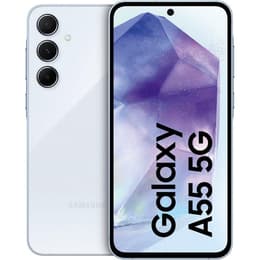

Galaxy A55 Vs Google Pixel 8a

Galaxy A55
Galaxy A55
Starting at

Refurbished price:£192.21

Versus £479.00 new

See options
Google Pixel 8a
Google Pixel 8a
Starting at

Refurbished price:£216.00

Versus £467.97 new

See options

Ratings

The Samsung Galaxy A55 and the Google Pixel 8a, both released in 2024, represent compelling options in the smartphone market. While the Galaxy A55 (March 2024) offers a larger display and robust build, the Pixel 8a (May 2024) focuses on a compact experience with advanced camera capabilities and extended software support. Both devices run on the Android operating system, providing users with a familiar and customizable interface.

Scores

Durability

When considering the long-term usability of a smartphone, software support and physical resilience are key factors. Both the Galaxy A55 and Pixel 8a offer a good level of protection against dust and water, rated at IP67, meaning they can withstand immersion in up to 1 meter of fresh water for 30 minutes.

  • Software Longevity: The Google Pixel 8a stands out with an impressive commitment to seven years of OS and security updates, ensuring the device remains current and secure well into the future. In contrast, the Samsung Galaxy A55 is promised four major OS upgrades and five years of security updates. This difference means the Pixel 8a will receive new Android versions and security patches for a significantly longer period.
  • Physical Durability: The Galaxy A55 features a glass back protected by Gorilla Glass Victus+ and a metal frame, contributing to a more premium feel and enhanced scratch resistance. The Pixel 8a utilizes a plastic back and Gorilla Glass 3 for its display, offering a sturdy build that is less prone to fingerprints.
  • Practical Lifespan: Users who prioritize having the latest software features and security for an extended duration may find the Pixel 8a's update policy more appealing. For those who value a more robust physical construction with glass and metal, the Galaxy A55 presents a durable option.

Year of Release

2024

2024

Compatible with latest Update

Yes

Yes

OS

Android

Android

Foldable

No

No

Performance

Both devices are equipped with their respective manufacturers' current-generation processors, designed to handle daily tasks and multitasking efficiently. The real-world performance often comes down to how these components are optimized for the user experience.

  • Everyday Responsiveness: The Pixel 8a, powered by its Tensor G3 processor, delivers a smooth and snappy experience, particularly noted for its optimization with Google's Android software. Users report that it handles demanding applications and multitasking without significant slowdowns. The Galaxy A55, with its Exynos 1480 processor, also provides good speed for daily use, with fast app opening and closing times.
  • Gaming and Demanding Apps: For more intensive tasks like gaming, the Pixel 8a generally shows stronger graphical performance, allowing for smoother gameplay and higher graphical settings in many titles. While the Galaxy A55 performs well for casual gaming and most applications, some users note that it is a mid-range device and might not excel in the most graphically demanding games.
  • Storage and Multitasking: Both phones typically come with 8GB of RAM, which is sufficient for managing multiple applications simultaneously. The Galaxy A55 offers expandable storage via a microSD card, providing flexibility for users who need more space for photos, videos, and apps. The Pixel 8a does not include a microSD card slot, relying solely on its internal storage options.

Memory (GB)

8 GB

8 GB

Screen quality

The display is a primary interaction point for any smartphone, and both the Galaxy A55 and Pixel 8a offer vibrant and responsive screens, though with distinct characteristics.

  • Display Technology and Clarity: The Samsung Galaxy A55 features a 6.6-inch Super AMOLED display, known for its deep blacks and vibrant, punchy colors. The Google Pixel 8a comes with a 6.1-inch OLED display, which also provides excellent contrast and color reproduction. Both displays offer a Full HD+ resolution, ensuring sharp visuals for text and images.
  • Brightness and Outdoor Visibility: The Pixel 8a boasts a higher peak brightness, reaching up to 2000 nits for HDR content and around 1400 nits in real-life usage, making it particularly well-suited for outdoor visibility in bright conditions. The Galaxy A55 offers a typical brightness of 1000 nits, which is still bright enough for most outdoor scenarios.
  • Refresh Rate and Viewing Experience: Both devices feature a 120Hz refresh rate, contributing to smoother scrolling and a more fluid user experience. The larger screen size of the Galaxy A55 provides a more expansive viewing area, which can be beneficial for media consumption and multitasking, while the Pixel 8a's smaller screen offers a more compact and manageable form factor for one-handed use.

Resolution

1080 x 2340

1080 x 2400

Screen type

Super AMOLED

OLED

Audiovisual

Both the Galaxy A55 and Pixel 8a offer capable camera systems, each with its own strengths in capturing images and videos.

  • Rear Camera Capabilities: The Pixel 8a features a dual-camera setup with a 64MP main sensor and a 13MP ultrawide lens, excelling in computational photography to produce detailed images with natural colors, especially in challenging lighting conditions. The Galaxy A55 has a triple-camera system, including a 50MP main sensor with optical image stabilization, a 12MP ultrawide, and a 5MP macro lens. It performs well in good lighting, often producing warmer and more saturated images.
  • Low-Light and Video Performance: The Pixel 8a generally outperforms the Galaxy A55 in low-light photography, capturing more detail and less noise due to its advanced software processing. For video recording, the Pixel 8a supports 4K at 30fps across all lenses, with the main camera capable of 60fps, and offers strong stabilization. The Galaxy A55 also records 4K video at 30fps, with good overall quality, though some users note that its low-light video can show graininess.
  • Front Camera and User Experience: The Galaxy A55 is equipped with a 32MP front camera, which delivers clear selfies. The Pixel 8a has a 13MP front camera that also provides good results, often benefiting from Google's image processing. The Pixel 8a also includes various AI photo features like Magic Eraser, enhancing the post-capture editing experience.

Main camera

50 megapixels

64 megapixels

Front camera

32 megapixels

13 megapixels

Miscellaneous

Beyond the core specifications, several practical elements contribute to the overall user experience of these smartphones.

  • Connectivity and Ports: Both devices support 5G connectivity, Wi-Fi 6, and Bluetooth 5.3, ensuring fast and reliable wireless connections. The Galaxy A55 uses a USB-C 2.0 port for charging and data transfer, while the Pixel 8a also features a USB-C port. Neither phone includes a traditional 3.5mm headphone jack.
  • Biometric Security: Both the Galaxy A55 and Pixel 8a incorporate in-display fingerprint sensors for secure unlocking. The Pixel 8a also offers face recognition, which works effectively in well-lit conditions.
  • Design and Handling: The Galaxy A55 has a larger footprint with its 6.6-inch display, measuring 161.1 x 77.4 x 8.2mm and weighing 213g. Its metal frame and glass back contribute to a substantial feel. The Pixel 8a is more compact and lighter, with dimensions of 152.1 x 72.7 x 8.9mm and a weight of 188g, making it easier for one-handed use. The Pixel 8a features a matte plastic back, which is less prone to fingerprints compared to the A55's glossy glass finish.

Weight

213 g

188 g

Screen size (in)

6.6

6.1

Mobile network

5G

5G

SIM card

Dual Physical SIM

Physical SIM + eSIM

Carrier compatibility

Unlocked

Unlocked

The Samsung Galaxy A55 and Google Pixel 8a each present a strong case for users seeking a capable Android smartphone, with their strengths aligning with different priorities. User feedback often highlights the Pixel 8a's exceptional camera performance and its long-term software support as significant advantages. Many appreciate the Pixel's ability to capture detailed and color-accurate photos, particularly in challenging lighting, and the promise of seven years of updates provides peace of mind for extended ownership. Some users, however, note that the Pixel 8a's battery life, while generally good, might not match the endurance of the Galaxy A55, and its charging speed is slower.

Conversely, the Galaxy A55 receives praise for its robust build quality, featuring a glass back and metal frame that contribute to a premium feel. Its larger display is often cited as a benefit for media consumption and productivity, and its larger battery capacity typically translates to longer usage between charges. Some common criticisms for the A55 include its camera performance in low light, which can be less consistent than the Pixel 8a, and its software update policy, while still generous, is shorter than Google's offering.

Users prioritizing a compact device with a leading-edge camera system and the longest possible software support may find the Google Pixel 8a well-suited to their needs. Its computational photography and consistent updates make it a strong contender for those who value a refined software experience and excellent imaging. On the other hand, users who prefer a larger screen, superior battery life, and a more physically robust design with expandable storage might lean towards the Samsung Galaxy A55. Both devices offer a quality experience, and considering a quality-assured refurbished option for either model can be an eco-friendly alternative for making an informed choice.


See all articles

Our recent comparisons





