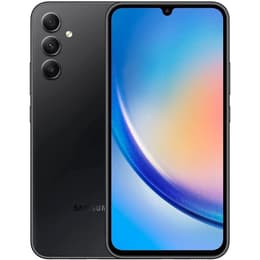


Galaxy A34 Vs Google Pixel 8 Pro

Galaxy A34
Galaxy A34
Starting at

Refurbished price:£105.00

Versus £399.00 new

See options
Google Pixel 8 Pro
Google Pixel 8 Pro
Starting at

Refurbished price:£253.00

Versus £960.91 new

See options

Ratings

The Samsung Galaxy A34, released in March 2023, and the Google Pixel 8 Pro, launched in October 2023, are both Android smartphones offering distinct user experiences. While the Galaxy A34 focuses on delivering a balanced set of features for everyday use, the Pixel 8 Pro emphasizes advanced camera capabilities, enhanced software intelligence, and extended software support. Both devices operate on the Android platform, but they cater to different priorities in terms of hardware and software integration.

Scores

Durability

When considering the long-term usability of these devices, their release timelines and software support policies are key factors.

  • Software Longevity: The Google Pixel 8 Pro offers an extensive software commitment, promising seven years of operating system updates, feature drops, and security patches from its October 2023 release. This provides a significantly longer period of up-to-date software compared to the Samsung Galaxy A34, which was released in March 2023 and is expected to receive four major OS upgrades and five years of security updates, typically extending until 2027.
  • Physical Durability: Both devices offer protection against environmental elements. The Galaxy A34 features an IP67 rating for dust and water resistance, meaning it can withstand submersion in up to one meter of freshwater for 30 minutes. Its display is protected by Corning Gorilla Glass 5, and it has a plastic back and sides. The Pixel 8 Pro steps up with an IP68 rating, offering slightly better protection against dust and water ingress.
  • Repairability: The Samsung Galaxy A34 generally receives a higher repairability score, often around 8.0 to 8.3 out of 10, indicating that it is relatively straightforward to disassemble and reassemble, with components like the battery and screen being accessible. In contrast, the Google Pixel 8 Pro typically scores moderately lower, around 4.0 to 7.0 out of 10, due to the use of strong adhesives for the battery and screen, and soldered components, making DIY repairs more challenging.

Year of Release

2023

2023

Compatible with latest Update

Yes

Yes

Foldable

No

No

Performance

The performance of these smartphones is influenced by their internal components, impacting how smoothly applications run and how efficiently they manage power.

  • Everyday Responsiveness: The Google Pixel 8 Pro is equipped with a current-generation processor designed for demanding tasks and advanced artificial intelligence features, resulting in very fluid navigation, quick app loading, and efficient handling of complex operations like advanced photo editing. The Galaxy A34, powered by an octa-core processor, provides smooth performance for daily applications, multitasking, and moderate gaming, offering a responsive experience for most users.
  • Multitasking and Storage: The Pixel 8 Pro comes with 12GB of RAM, facilitating seamless multitasking and quick switching between numerous applications. It offers storage options up to 1TB, though without expandable storage. The Galaxy A34 is available with 6GB or 8GB of RAM and 128GB or 256GB of internal storage, with the added flexibility of microSD card expansion up to 1TB, which is beneficial for users requiring extensive local storage for media and files.
  • Battery Endurance: Both devices feature large battery capacities. The Galaxy A34 houses a 5000 mAh battery, which typically provides reliable all-day power for average usage. The Pixel 8 Pro has a slightly larger 5050 mAh battery, and while it aims for beyond 24-hour battery life, user experiences can vary, with some reporting all-day usage under heavy conditions and others noting more frequent charging needs.

Memory (GB)

6 GB

12 GB

Screen quality

The visual experience on a smartphone is largely defined by its display, with both devices offering distinct characteristics.

  • Display Technology and Clarity: The Samsung Galaxy A34 features a 6.6-inch Super AMOLED display with a Full HD+ resolution (1080 x 2340 pixels), delivering vibrant colors, deep blacks, and sharp visuals suitable for media consumption and daily tasks. The Google Pixel 8 Pro boasts a larger 6.7-inch LTPO OLED display with a higher QHD+ resolution (2992 x 1344 pixels), offering superior clarity and detail, making it particularly well-suited for high-resolution content and intricate visual work.
  • Brightness and Smoothness: The Galaxy A34's display can reach up to 1000 nits of peak brightness, ensuring good visibility even in bright outdoor conditions, and features a 120Hz refresh rate for smooth scrolling and animations. The Pixel 8 Pro's display is significantly brighter, with a peak brightness of up to 2400 nits, providing excellent outdoor readability. It also features an adaptive refresh rate that can dynamically adjust from 1Hz to 120Hz, optimizing power consumption while maintaining fluid visuals.
  • Viewing Experience: The Galaxy A34 offers a flat display with a waterdrop notch for the front camera. The Pixel 8 Pro also features a flat display, moving away from the curved edges of some predecessors, which can be preferred by some users for a more consistent viewing area and reduced accidental touches.

Resolution

1080 x 2340

1344 x 2992

Screen type

Super AMOLED

LTPO OLED

Audiovisual

The camera systems on both smartphones are designed to capture different types of photographic and videographic content, with varying strengths.

  • Rear Camera Capabilities: The Samsung Galaxy A34 features a triple rear camera setup, including a 48MP main sensor with Optical Image Stabilization (OIS), an 8MP ultrawide lens, and a 5MP macro lens. It performs well in daylight, producing natural colors, and its Night Mode helps in darker settings. The Google Pixel 8 Pro offers a more advanced triple camera system, comprising a 50MP main sensor with OIS, a 48MP ultrawide lens, and a 48MP telephoto lens capable of 5x optical zoom. This setup provides greater versatility and detail, especially for zoomed-in shots.
  • Photography Performance: The Pixel 8 Pro leverages its advanced processor and computational photography to deliver consistently high-quality images across various conditions, including challenging low-light scenarios, with features like Magic Editor and other AI enhancements for photo and video. The Galaxy A34's camera is capable for everyday photography, offering good detail and color in well-lit environments, and its ultrawide and macro lenses add creative options.
  • Video Recording and Front Camera: Both devices support 4K video recording at 30 frames per second. For selfies, the Galaxy A34 has a 13MP front camera that captures clear and balanced images. The Pixel 8 Pro features a 10.5MP ultrawide front camera, which is also capable of high-quality selfies and video calls, benefiting from Google's image processing.

Main camera

48 megapixels

50 megapixels

Front camera

13 megapixels

10.5 megapixels

Miscellaneous

Beyond the core features, several other practical elements contribute to the overall user experience of these smartphones.

  • Connectivity Standards: The Samsung Galaxy A34 supports 5G connectivity, Wi-Fi 5 (802.11 a/b/g/n/ac), and Bluetooth 5.3, providing reliable wireless connections for most users. The Google Pixel 8 Pro features more advanced connectivity, including 5G (with both sub-6GHz and mmWave support), Wi-Fi 7 (802.11be), and Bluetooth 5.3, offering faster speeds and improved efficiency for compatible networks and accessories.
  • Ports and Biometrics: Both devices utilize a USB-C port for charging and data transfer, though the Galaxy A34 uses USB-C 2.0. Neither device includes a traditional 3.5mm headphone jack. For security, both phones feature an in-display fingerprint sensor. The Pixel 8 Pro also offers advanced Face Unlock, which meets a higher Android security level.
  • Design and Handling: The Galaxy A34 measures 161.3 x 78.1 x 8.2 mm and weighs 199g, featuring a plastic frame and back. The Pixel 8 Pro is slightly larger and heavier at 162.6 x 76.5 x 8.8 mm and 213g, with a more premium build that includes a glass back. The Pixel 8 Pro also supports dual SIM functionality (physical SIM + eSIM), which can be convenient for travelers or those managing multiple lines.

Weight

199 g

213 g

Screen size (in)

6.6

6.7

Mobile network

5G

5G

SIM card

Dual Physical SIM

Physical SIM + eSIM

Carrier compatibility

Unlocked

Unlocked

The Samsung Galaxy A34 and Google Pixel 8 Pro cater to different user needs, each excelling in specific areas. Users frequently praise the Galaxy A34 for its vibrant Super AMOLED display with a smooth 120Hz refresh rate, its dependable battery life, and the inclusion of expandable storage via microSD, which is becoming less common in modern smartphones. Some common criticisms for the A34 include its camera performance being merely passable in certain conditions and its plastic build quality, which some users might perceive as less premium.

The Google Pixel 8 Pro is often lauded for its exceptional camera system, particularly its advanced computational photography and AI-powered editing features, as well as its bright, high-resolution LTPO OLED display. Its commitment to seven years of software updates is also a significant draw for users prioritizing long-term software support. However, some users have noted concerns regarding its battery life under heavy usage and its lower repairability score compared to some other devices.

Users prioritizing a device with a long software support lifespan, advanced camera capabilities, and a premium display for detailed viewing may find the Google Pixel 8 Pro well-suited to their needs. Conversely, users who value expandable storage, a highly repairable device, and a balanced performance for everyday tasks might lean toward the Samsung Galaxy A34. Both devices offer a quality Android experience, and choosing between them often comes down to these specific priorities. For those looking for a more sustainable choice, considering a quality-assured refurbished option for either model can be an excellent way to extend product lifecycles.


See all articles

Our recent comparisons