iPhones

Updated on 25 September 2026
25 September 2026
6 mins read

Thomas Hobbs
The Smartphone Extraction Gap Report by Back Market highlights the need for more education on the raw materials extracted to create our tech and its devastating impacts on the planet. Thomas Hobbs spoke to experts about the report’s revealing findings.
While 48% of us automatically link the production of clothing to child labour, only 19% of us have made the same leap when it comes to fast tech, responsible for producing electronic consumer products like laptops, wearables and electric cars and much more.
In fact, an overwhelming 69% of the public have never looked more deeply into the sourcing of products such as smartphones, primarily due to a lack of public resources and information.
These were the stark findings of The Smartphone Extraction Gap, a new global report by Back Market exploring how the average consumer tends to be unaware of the fact at least 60 raw materials including cobalt, copper and gold make up their smartphone; that extracting them often requires child labour for mining, while also acting as a catalyst for wars, death, slavery, environmental damage, and geopolitical instability.
Back Market surveyed 6,000 respondents across six markets (the US, UK, France, Spain, Germany and Japan), and the findings come as the refurbished tech brand launches the Mine My Phone campaign. This is a new public interest, digital experience platform built around answering the simple question: Do you know the true weight of your phone?

Mining for raw materials in the DRC. Photo by Per-Anders Petterson.
Here are five things we learned from reading The Smartphone Extraction Gap report, with plenty of evidence to suggest that consumers are ready and willing to learn more about the realities of extraction behind their most trusted electronic device, the smartphone, and to push governments to make changes.
Our report showed a clear gap in knowledge when it comes to understanding the realities of the Fast Tech supply chain. Six in 10 people didn’t know how many distinct raw materials go into the production of a smartphone, with 50% believing it to be 10 (FYI: the answer is actually more than 60), and 52% couldn’t name a single raw material (these include cobalt, lithium, gold, tin, tantalum etc.) used in the production process by giants such as Apple, Google and Samsung.
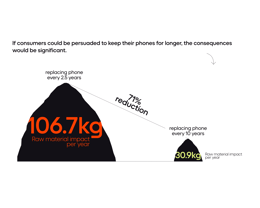
This lack of awareness has a literal weight to it. Manufacturing a single 200g smartphone requires extracting 266kg of material from the ground, which is more than 1,300 times the finished device's own weight.
“The true weight of a smartphone must include not only the materials extracted from the Earth, but also the human, cultural and social costs carried by the communities at the beginning of its supply chain, when the mine pit is open and the tailings, built,” agreed Edson Krenak, an indigenous activist and writer and advocate of Back Market’s report.
Two of the most well-known raw materials are lithium and copper, but they are unfamiliar to 28% and 39% of respective global respondents. And even though cobalt, a metal essential for electronic batteries, has more awareness at 60%, only 26% of our respondents would be able to link cobalt to armed conflict or child labour; two things that are prevalent in the Congo.
Materials like tantalum, gallium, indium, and rare earth elements like neodymium and dysprosium, are virtually unheard of by global audiences. Meanwhile, only three in ten people (31%) have ever actively explored where the raw materials in their smartphone comes from.
“The true weight of a smartphone must include the materials extracted from the Earth, but also the human, cultural and social costs carried by the communities at the beginning of its supply chain" - Edson Krenak, indigenous community activist and environmental writer
Of those who did look, 85% came away “without finding much” information, with more than half (52%) believing their actions as an individual would make no changes to the Fast Tech supply chain.
"We are in a context where consumers are made to equate ‘new’ with ‘better’ and as a sign of 'progress'. Even when consumers have a working device, they are presented with new models as if they absolutely need them,” said Eric Ngang, an environmental and climate governance expert from Afrewatch International.
Ngang hopes the Mine My Phone digital experience, and the negatives it uncovers about raw material extractivism, will trigger people to prioritise supporting refurbished tech, become more educated on the issue.
However, despite there being a general feeling that an individual alone won’t be able to clear up the Fast Tech supply chain, the people we surveyed did show an appetite for systemic, government-led change.
Of all respondents, 66% said they would support legalisation requiring manufacturers to make devices more durable, repairable, and supported with software for at least two years. This support is strongest in France (73%) and Spain (72%), with the UK (70%), Germany (70%) and Japan (49%) each behind. This would reduce the stress on the extractivism supply chain.
Less than half of those surveyed (46%) realised that mining for smartphone materials directly helped fund armed conflict, while a similar number (47%) were unaware that reserves of several key metals will be depleted within twenty years at current aggressive extraction rates.
Paula Diaz Levi, the Chilean environmental journalist, hopes Mine My Phone will be able to improve awareness around these subjects. "Behind every smartphone lies a chain of social, economic and environmental impacts in the territories where its raw materials are extracted,” said Levi.
“These livelihoods depend on water and healthy ecosystems. When we think about the technologies we use every day, we should also ask how their benefits and costs are distributed. We need mining to produce the materials our devices require, but not at any cost. We need to ask what kind of mining we need, where, and under what environmental, social and governance standards."
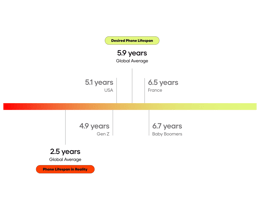
So, what can be the solution? Our survey showed 5.9 years is the desired collective lifespan of a smartphone, but this contrasts with the true global average of 2.5 years. It also shows a clear appetite to make devices last longer, while proving there’s still a lot more work to do to convince the public of Back Market’s own stance: that smartphones should stay in circulation for at least 10 years.
"We need mining to produce the materials our devices require, but not at any cost" - Paula Diaz Levi, a Chilean environmental journalist
Buying a refurbished phone is estimated to save 261kg of raw materials. When it comes to the reasons why people would consider buying a refurbished phone, 58% referenced cost in some way, with 41% saying the appeal was better value for money, and 39% citing lower costs. Only 17% were motivated knowing it was better for the environment; further proof that there’s still a long way to go in terms of educating the public on how raw material extractivism is damaging our planet.
As Ngang concluded: “To make refurbishment the default, there is a need to make longevity, repair, and the benefits of reuse, including the environmental and social benefits, very visible to consumers rather than buying new." Mining your phone, then, is hopefully just the beginning.
Back Market is fighting for a world where phones last for 10 years, through care, repair, reuse and refurbishment. You can find more information by visiting the Mine My Phone digital platform here.
Thomas Hobbs is a UK-based freelance journalist who has written for titles including the Guardian, Financial Times, Telegraph, Pitchfork, New Statesman, Stereogum, BBC Culture and many others. He has interviewed everyone from Nas to Usher, Weyes Blood, and Joe Hisaishi, while collecting and playing vintage video games is one of his favourite past times.