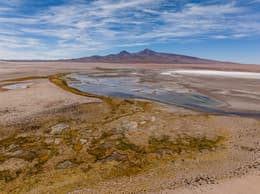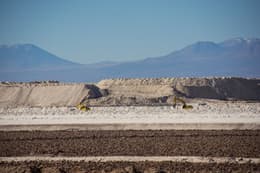
Lithium mining in the Atacama Salt Flat. Credit: Paula Diaz Levi
Around 13.7 billion years ago, just minutes after the Big Bang, the element of lithium formed in the universe alongside hydrogen and helium. Today, it is present in the lives of millions of people—whether in pharmaceuticals, electric cars, or just by being the fuel keeping our smartphones going—and has become one of the most sought-after natural resources on the planet. This is due to its central role in the batteries that power much of modern technology, and keep the Fast Tech world mechanics churning on.
In fact, lithium is ideal for rechargeable batteries because it is the lightest metal and can pack a large amount of energy into a small, lightweight battery. During charging and discharging, lithium ions move back and forth between the battery's two electrodes, while electrons flow through an external circuit to produce the electric current that powers a device. This efficient movement of ions and electrons allows lithium-ion batteries to be recharged hundreds of times, while delivering high performance for various popular electronic products.
Yet lithium is also at the epicenter of growing environmental, social, and political disputes. The vast amounts of water required to extract it have raised concerns about depleting the desert’s groundwater reserves as well as the loss of biodiversity—including declining flamingo populations—and negative impacts on the livelihoods, cultures, and future of Indigenous communities that have depended on these salt flats for thousands of years. Many of these tensions are concentrated in the so-called Lithium Triangle, a region spanning northern Chile, Argentina, and Bolivia, which hosts some of the world's largest known lithium resources.
At the heart of this region lies Chile’s Salar de Atacama, a vast 3,000 km² landscape that was inhabited long before lithium became a strategically valuable resource in the global economy. For more than 10,000 years, different people have developed ways of life in this place, which today has become a symbol of passionate extractivism debates in South America.
“The Salar de Atacama is not simply a deposit of critical minerals. For the Lickanantay Atacameño people it is a living territory that has sustained human life for thousands of years in one of the driest deserts on the planet,” argued Sergio Cubillos, president of the Indigenous Atacameño community of Peine. "One of the industry's biggest historical failures has been assessing impacts on a project-by-project basis.”
Cubillos continued: “But it is our communities that experience the cumulative effects of all the operations taking place simultaneously across the basin. It's not only about extracting water—although that alone has a major impact. It also profoundly affects our society, changing our way of life. People subsequently move into different kinds of jobs that are far removed from the traditions and livelihoods we once had."
Peine, a small town in Chile’s Antofagasta Region in the north of the country, is the closest inhabited community to lithium extraction wells. Although Chile has more than 60 salt flats and saline lagoons, lithium is currently extracted only from the Salar de Atacama. For this reason alone there are ongoing projects seeking to expand mining into other parts of the desert.
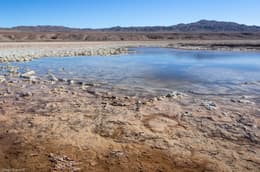
A laguna in the Atacama Desert that has almost run dry. Credit: Diego Bravo
“Lithium is a mineral found in different places on the planet, both in rocks and in aqueous environments such as salt flats. Therefore, there are different extraction methods, which entail different impacts,” explained Cristina Dorador, the microbial ecologist and researcher originally from northern Chile. “The Salar de Atacama, along with other salt flats in Bolivia, Argentina, and Chile, has high lithium concentrations. The main impacts relate to water evaporation, because obtaining lithium requires evaporating water.”
To give you an idea, lithium is extracted from brine—salt-rich water found in salt flats—that is pumped into large evaporation ponds, where it is then exposed to the intense solar radiation of the desert. Although estimates vary, one study calculated that producing one ton of lithium requires the evaporation of around 2 million liters of water from wells, which is equivalent to 2,000 tons of water that cannot be recirculated. This is not insignificant, considering that more than 50% of current lithium production takes place in areas under high water stress, such as northern Chile and Australia.
The disappearance of the flamingos
Surrounded by mountains and lagoons, with their pink plumage and calm gait, the flamingos— solor in Kunza, the language of the Lickanantay people—are among the most emblematic inhabitants of the Salar de Atacama. In the past, large numbers of these birds arrived at the salt flats in December to nest. Communities such as Peine organized collective egg harvesting. Some accounts say there were so many birds that, when they took flight, they cast shadows over parts of the lagoon. Not any more, though.
Over the last decade, flamingo populations in the Atacama Desert have sharply fallen. “There was a whole ritual, a connection, and also planning. It wasn’t just taking a thousand eggs. There was a permitted amount, and authorization was required. Breeding at that time was extraordinary. We had more than 5,000, some even said 7,000 parinas (flamingos) in the Salar de Atacama. Today it doesn’t even reach a thousand,” recalled a dejected Cubillos.
Something similar has happened to other traditional practices. Agriculture in the desert's oases has become increasingly difficult as water becomes scarcer, while the drying of high-Andean wetlands has reduced grazing areas for llamas and alpacas—animals that have long provided food, fiber, transport, and livelihoods for Lickanantay families. At the same time, many residents have shifted from farming and herding to other jobs (including mining), accelerating changes in community life and the transmission of ancestral knowledge.
“Chile does not manufacture a single battery or a single phone currently, despite this enormous lithium wealth. It’s being taken advantage of for its lithium”
Lithium mining—and other extractive industries such as copper—has been associated with declining water levels, reduced vegetation cover, and alterations to habitats such as lagoons and high-Andean wetlands. On the other hand, evidence on the health impacts of lithium mining in Chile remains extremely limited, underscoring the need for deeper epidemiological research. For now, the most visible impacts are observed in the desert ecosystem.
Dorador explained that "the exploitation of the Salar de Atacama has had both environmental and social consequences. Some species, particularly flamingos, are leaving the salt flat and are no longer nesting there. Vegetation cover has declined, water levels have dropped, parts of the salt flat are sinking, and the industry has also triggered multiple socio-environmental conflicts with Indigenous communities in the area."
A 2022 study published in Proceedings of the Royal Society B found that, of the three flamingo species inhabiting the Salar de Atacama, two—both endemic—have declined by 10 to 12% over just 11 years due to the various impacts of lithium extraction. But flamingos are only one part of the local biodiversity. The salt flats also host other birds, mammals, reptiles, amphibians, and fish, as well as an extraordinary diversity of microorganisms all essential to ecological cycles and to understanding biological adaptation in extreme conditions.
Another study published in 2024 in IEEE Transactions on Geoscience and Remote Sensing found that brine extraction is causing parts of the Salar de Atacama to sink at a rate of 1 to 2 cm per year. Groundwater levels have also fallen by more than 10 meters over a 15-year period, according to a 2019 study. “For us, ecosystems are part of a broader cultural and spiritual fabric. When a wetland, a lagoon, a spring, or a species that is part of our territory is affected, our memory and identity are also affected,” said Cubillos, the president of the Peine community.
A world hungry for lithium
According to the Global Critical Minerals Outlook report by the International Energy Agency (IEA), global lithium production increased by more than 35% in 2024, while demand rose by nearly 30% in the same year. Most demand came from the electric vehicle sector, but energy storage—currently accounting for 9% of demand—is growing rapidly. China represents more than three-quarters of global lithium demand, followed by South Korea and Japan.
However, projected supply from announced lithium projects is not expected to meet demand by 2035, with an implied shortfall of around 40%. While the market is well supplied in the short term, rapid demand growth is expected to create a structural imbalance. In other words, more mining projects will be needed to meet global consumption. This matters not only for electric vehicles but also for the Fast Tech economy, where the constant production and replacement of smartphones and other electronic devices continues to drive demand for lithium.
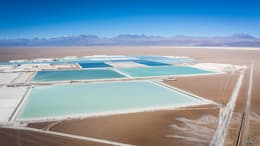
Evidence of lithium mining is all over Chile’s natural landscape. Credit: Paula Diaz Levi.
This is particularly relevant for Chile, the world’s second-largest lithium producer after Australia. However, Chile’s economy has long relied on raw material exports, raising concerns about limited innovation and domestic technological development. “In terms of lithium, Chile remains an extractivist country —it does not take advantage of a high-value natural resource to integrate into the industry. Chile does not manufacture a single battery or a single phone currently, despite this enormous lithium wealth,” says geologist José Cabello, who has extensive experience in mining and is a Qualified Person. That is, a certified professional who validates and signs technical reports on mineral resources and reserves.
In 2023, the government of then-President Gabriel Boric launched the National Lithium Strategy, which included the creation of a Network of Protected Salt Flats—with the goal of protecting at least 30% of these ecosystems by 2030—and the National Lithium and Salt Flats Institute (INLiSa), aimed at generating and applying knowledge, technology, and innovation to promote sustainable development of the lithium industry.
But uncertainty remains. On March 12, 2026, one day after the government of far-right president José Antonio Kast took office, the Ministry of the Environment withdrew 43 environmental decrees that were under review by the Office of the Comptroller General of the Republic. This is the body responsible for ensuring the legality of state administrative acts before they take effect. Among them were decrees that would have granted official protection to six salt flats, which were set to become the first protected under the Network of Protected Salt Flats.
“We are alarmed by the withdrawal of the decrees for the Protected Areas Network. Significant effort went into that process, and this government is showing no signs of reinstating them,” said Verónica Molina, director of INLiSa. She was appointed by the Ministry of the Environment and is also a professor at the University of Playa Ancha and director of the UPLA Environmental Hub.
Alternatives for a future with salt flats
Currently, companies operating in the Salar de Atacama— Albemarle and Novandino (owned by SQM and Codelco)—are exploring different options to reduce their impacts. One is Direct Lithium Extraction (DLE), a process that separates lithium from brine components so it can be extracted without large evaporation ponds. According to Cabello, who also founded the Center for Strategic and Critical Minerals Studies in Chile, “direct extraction could be a solution. Another option would be setting a maximum extraction limit for each salt flat, because these formations develop slowly, and extraction rates can lead to depletion. A more ecological form of exploitation could be designed.”
Yet limitations must be considered. An academic study published in Nature Reviews Earth & Environment highlights that DLE could in some cases require even more water than current methods, limiting its viability in arid regions. Reinjecting brine is also being explored, but research is still limited. Dorador noted that “it may seem beneficial because it helps restore water levels. But chemically it will never be the same: the reinjected fluid has lower salinity, which can affect the salt flat both physically and biologically.”
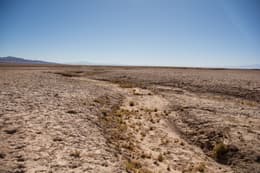
Chile’s Atacama Desert. Credit: Paula Diaz Levi
Cubillos is more cautious: “Communities cannot become testing grounds for experimental technologies whose long-term effects are still not fully understood.” Another way to reduce impacts is to promote circular economy approaches, including battery recycling, extending device lifespans, and developing technologies that require fewer raw materials. According to the IEA, expanding recycling could reduce the need for new lithium mines by more than 20% by 2050. Recovered lithium also has a significantly lower carbon footprint than mined lithium.
Recycling lithium-ion batteries from smartphones, laptops, and tablets will also reduce pressure on extraction. A Science Direct study estimates that, in China alone, around 900 million discarded mobile phone batteries and 2.1 billion laptop batteries will be generated by 2030. However, with current recycling technologies, only a fraction of that lithium can be recovered.
Molina argues that while battery recycling and refurbished technology helps, it does not address the root problem of overconsumption and overproduction: “Just as we talk about water footprints or carbon footprints, we should think in terms of a critical minerals footprint—tracing lithium from the salt flat where it is extracted to where it is ultimately used.”
This would require both collective and individual action. “The first step is recognizing that every phone has a territorial footprint. I also have a phone and a computer; everything we use has one. There is a tendency to present digital technologies as clean, but behind every device there are ecosystems, water, communities, and territories,” concluded Cubillos. “We were here before industrial mining, and we will continue living here. The question is what kind of territory our children, grandchildren, and great-grandchildren will inherit.”
Ultimately, the story of lithium does not begin in a battery factory or on a smartphone store shelf, but in places like the Salar de Atacama, in the Atacama Desert—one of the driest places on Earth and home to a unique yet fragile nature. The real challenge is not only to power the technologies of the future, but to do so without exhausting the landscapes, ecosystems, and communities that make that future possible.
The most sustainable phone is the one that already exists.
Back Market is fighting for a world where phones last for 10 years, through care, repair, reuse and refurbishment.
Related Stories
Why South America is at the heart of contemporary extractivism
With demand for raw materials growing, the Chilean scientist Cristina Dorador reflects on extractivism across South America, its environmental consequences, and the hidden footprint behind the technologies that shape our daily lives.