

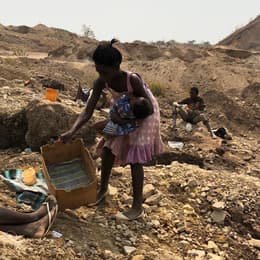
A mother balances her baby while working down an artisanal cobalt mine in the hills above Kambove. Credit: Siddharth Kara
There’s a passage in Siddarth Kara’s Cobalt Red – the 2023 book that became a New York Times best seller and a Pulitzer Prize finalist for general nonfiction – that’s difficult to stop thinking about. Reminiscing on his experience visiting an artisanal cobalt mine in the Haut-Katanga province of the Congo, Kara writes how underneath an “unremarkable hill” there was “something akin to an ant colony of humans who tunnelled, excavated, washed, packed, and fed valuable cobalt up the chain to the companies that produced the world’s rechargeable devices and cars.”
This parallel has proven controversial, with some critics accusing the author (who is also a professor of human trafficking and modern slavery at Nottingham University) of trivializing the suffering of the miners. However, Kara argues the “ant colony” phrase was intended purely to give readers the perspective of how miners are viewed by the Western businesses that Amnesty International claim “actively profit ” from their cheap (and often forced) labour.
His writing reflects the inequality that sits at the very core of the contemporary raw materials mining and extractivism movement, especially over in African countries, which are routinely taken advantage of in a way that - as Kara claimed in a new interview with Back Market - carried “echoes of colonialism.” Kara explained further: “It’s very easy to see that the stakeholders at the top of the supply chain just don’t see the miners in the Congo as human beings. The miners are expendable. They are invisible in so many ways. My phrasing was about this specific perception. Just to create consumer electronics, there’s companies willing to unleash inhumanity on some of the poorest people on our planet.”
The hard, shiny grey metal cobalt is crucial for the batteries that keep our smartphones pinging. This is because it stabilizes the lithium-ion, essentially preventing an iPhone from overheating and therefore maximizing its energy density. But despite one country handling 70% of global cobalt production, and subsequently influencing crucial markets like the global electric vehicle battery supply chain, the Congo is simply not redistributing this wealth to its citizens.
An estimated 74% of people in the Democratic Republic of the Congo (DRC) live in poverty today, while the Human Rights Research Centre (HRCC) has called on governments, corporations, and multilateral institutions “to urgently address the life-threatening and abusive conditions under which cobalt is extracted in the DRC, and to adopt binding standards for ethical cobalt sourcing”. Currently, because the Congo has limited ability to process the cobalt itself, China buys and controls as much as 80% of the final output.
“The environmental destruction, pollution and contamination going on in the Congo is literally like watching a horror story unfold.”
Meanwhile, armed military groups (including the Rwanda-backed M23) occupy many mining regions, utilising the illicit mineral trade to finance what the BBC have called their “ brutal” military operations. These militias have been accused of not providing adequate safety ( in March 2026, for example, 200 people - including 70 children - lost their lives in a Rubaya-based mine following a landslide) for their mining workers.
The uneven balance of Cobalt control has resulted in environmental devastation for the DRC, too, mostly seen in the form of water pollution, deforestation, and crop devastation. Many natives are also kicked out of their homes and displaced so that mining operations can begin. “There’s this enormous hypocrisy,” added Kara. “Governments want every citizen to drive an electric car for the good of the planet, right? But you can’t save one part of the planet at the expense of destroying another region. Where’s the sense in that!?”
The 2023 Global Slavery Index estimated up to 407,000 people were living in modern slavery in the DRC. Kara said this number included thousands of child labourers, sometimes forced at gunpoint to work down mines to carve out the cobalt crucial for keeping the West’s annual smartphone upgrade culture going. Another chapter of Cobalt Red has forced many of its readers, particularly parents, to reckon with their relationship to Fast Tech products linked to cobalt.
Here, Kara recalled seeing deep down one Congolese mine: “A body in the dirt. It was a child, lying motionless within a storm of dust and despair.” Yet when I bring up moments like this in conversation, he is keen to divert the attention away from himself. “In a way, it dishonours the people in the Congo by making it about me,” Kara explained. “Rather than my emotions, what matters most is the boundless grief and torment of the parents, spouses, and siblings of those cobalt miners.”
He passionately continued: “The cobalt miners suffer shattered bones; there’s toxic contamination; and many end up buried alive due to accidents. Of course, it was devastating for me to witness all this, but I see myself more as a conduit between the people of the Congo and the world that can’t function without their misery. It’s about making people aware of what’s going on and being their guide. The environmental destruction, pollution and contamination going on in the Congo is literally like watching a horror story unfold.”
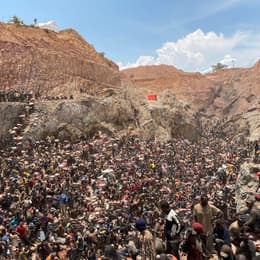
Workers at the Shabara Mine, Congo. Credit: Siddharth Kara
In an honest new conversation with Back Market’s Thomas Hobbs, Siddharth Kara discusses the impact of his book Cobalt Red, why the tech world “needs more empathy” for Cobalt miners, and goes into his own efforts to try to clean up the cobalt supply chain in the DRC. The following interview has been lightly edited and condensed for clarity.
I guess when some people hear the word “cobalt” they might think of Cobalt Blue being used by French Impressionist artists. Maybe they don’t even realise about its use in Fast Tech. I'm just curious, but what sparked your own interest in cobalt?
I’ve been doing research on modern slavery and child labor going back to the year 2000. This work has involved travelling to dozens of countries and various sectors. It was actually a Congolese colleague of mine back in 2016, who reached out and said terrible things were happening in the mining provinces due to the hunt for cobalt. At that point, I had no idea cobalt was even a part of smartphone batteries, or how essential it was to fuel our collective sort of rechargeable, gadget-driven lifestyle. I then took five trips to the Congo to investigate further, with my first back in 2018. A lot of my goal was about driving awareness. The subsequent book was a New York Times bestseller, so it succeeded in that way, but although there’s been a massive driver of awareness, this hasn’t necessarily translated yet into any real meaningful impact on the ground. There’s still so much work to do.
The smartphones many people will be using to read this article are likely to contain cobalt that was mined by what Human Trafficking Search described as “slave workers” in the Congo. Is what goes down in the mines there, and the supply chain itself, an extension of colonialism, particularly due to the way that bigger countries and corporations seem to be profiting from afar?
Yeah, it's the same logic of the colonial period and the colonial mentality, which is to extract and pillage resources; exploit cheap labor; and finally, siphon materials out of the global south and enrich the kings of industry over in the global north. I mean, it's exactly the same dynamic, while it's the same tactics used in terms of obfuscation and misrepresenting the truth of what's happening on the ground! And, when truth tellers speak out, the big corporations profiting from cobalt will all say in unison, “that’s not in my supply chain, though”. You know, their marketing teams do a good job of talking about maintaining human rights standards and the average person just takes their word for it, but the truth is not found in the marketing departments of Big Tech or EV companies. The truth, rather, is found on the ground floor of a cave and with the voices of the Congolese people.
What do you think is stopping the cobalt supply chain from being cleaned up?
The fact that mining companies dump toxic effluents into the rivers, lakes, and they've chopped down millions of trees. I mean, that doesn't even get spoken about as much! And then, of course, there's the human rights facet to all this. When you have thousands of children, hundreds of thousands of people, working in degrading, slave-like conditions, just to feed these metals up the supply chain; the truth is they're not doing it for sport! This cobalt they are mining is not just going to the moon [cobalt is at the core of the technology used in several NASA projects], either.
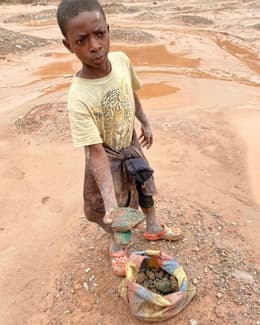
A child worker at an artisanal mining area in Kolwezi, which is next to the Kamoto Copper Company mine (KCC). Credit: Siddharth Kara
Most of it goes into the formal supply chain of consumer technology. There’s a lack of accountability, period. You can’t clean up a supply chain when big companies and world superpowers like China are still in denial about their involvement within cobalt. When I was a guest on the Joe Rogan show, I revealed a video behind-the-scenes at a so-called industrial cobalt production mine, where there were 15,000 people crammed into a pit without any heavy machinery in sight. What you are being told and the reality are often two very different things.
You touched on it briefly before, but the environmental issues triggered by this are huge. Water is contaminated with industrial runoff, while the air is often brown with the kind of noxious hazes that filter through. What does this do to the average life cycle?
Even if you're not involved in mining activity, you're still being poisoned every day by the mining sector and that’s because of the toxic contamination of rivers and general air pollution. Cobalt mining companies treat the environment like a toxic dumping ground. They wouldn't even treat their own backyards that way! The Congolese earth is not seen as real earth. Rather, it's just this land of plunder. There's a range of health consequences: from birth defects to cancers to neurological diseases to PTSD from experiencing so much death. In my academic report, Blood Batteries, I quantified some of the deforestation in the country, where I did water sampling and ultimately proved it was full of toxins.
Patrice Lumumba was a real icon of African liberation. I always remember this quote where he said: “Africa will have a history and it will be a history of dignity.” So often, the Western media presents the Congo as this tragic place, but it is important to show the dignity of the people there. Do you think the latter sometimes gets lost?
Africa is still mired in the toxic legacies of the slave trade, followed by the colonial period, and then followed by the postcolonial period of pillage and interference. Lumumba was barely prime minister for a few months, before he was dispatched by neocolonial powers, precisely because he wanted Africa to have its own resources, its own value, and its own dignity. The powers that be didn't want to play that game! So, they dispatched him and put a monster in his place in Mobutu.

Cobalt Red is a winner of the Frederick Douglass Book Prize. Credit: St. Martin’s Press.
Hopefully, one day Africa gets there, but when it comes to cobalt, the only way the dignity returns is through something homegrown. I am working on a couple of pilot projects around trying to run more human rights-oriented artisanal mining areas. It's early stages, but I want to demonstrate solutions that don’t put people at risk and can enrich the Congolese people. It is in its early phases in terms of identifying a mining area and getting it zoned and fenced and getting warehouses and trucks and things like that. But the good news is it's all Congo-led. Civil society-led, and putting Congo’s destiny back in the worker’s hands.
The dignity of the Congolese has been stripped away, but I hope with time it can return. Even if the world needed no cobalt tomorrow, all of the people who made a trillion dollars from it should go take a chunk, go to the Congo, clean it up, plant trees, build houses, and build public health facilities to treat people who have ongoing health consequences. Maybe then I would start to feel more hopeful about the future.
This interview presents the views, statements and personal experiences of Siddharth Kara, author of Cobalt Red. The views expressed are his own and do not necessarily reflect those of Back Market. Statements concerning companies, governments, organisations, products, supply chains, environmental impacts or human-rights conditions are attributed to Mr Kara or to the sources identified in the article, and should not be understood as independent findings or allegations made by Back Market.
The most sustainable phone is the one that already exists.
Back Market is fighting for a world where phones last for 10 years, through care, repair, reuse and refurbishment.