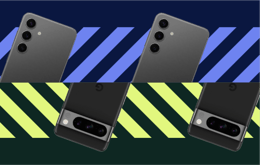


Compare models

Google Pixel 10 Pro Vs Google Pixel 8 Pro

  • 1-year minimum warranty
  • Free delivery on all items
  • Free 30-day returns
Google Pixel 10 Pro
Starting at

Refurbished price:£443.00

Versus £1,195.69 new

See options
Google Pixel 8 Pro
Starting at

Refurbished price:£248.00

Versus £960.91 new

See options

Differences at a glance

The Google Pixel 10 Pro (2025) and the Google Pixel 8 Pro (2023) represent consecutive generations of Google's flagship smartphone ecosystem. While both devices deliver premium Google software experiences, the Pixel 10 Pro introduces refined internal components, a more compact physical footprint, and advanced processing capabilities compared to its predecessor. Both handsets operate on the Android platform, ensuring a cohesive user interface and long-term feature support.

Available Models

Colour

Storage

Scores

Durability

The Pixel 10 Pro and Pixel 8 Pro differ significantly in release age and hardware generation, influencing their long-term viability and software support windows.

  • Release timeline and support: The Pixel 8 Pro launched in late 2023, whereas the Pixel 10 Pro arrived in late 2025, giving the newer model a two-year advantage in active update cycles. Both benefit from Google's extended multi-year commitment for operating system upgrades and security patches, though the Pixel 10 Pro extends that timeline further into the future.
  • Repairability and durability: Both models utilize robust aluminum frames and durable glass protection, featuring official water and dust resistance ratings. Component availability and repair pathways remain accessible for both generations through standard service channels.
  • Expected lifespan: Users selecting the Pixel 10 Pro secure a longer window of primary software feature drops, while the Pixel 8 Pro remains a viable, quality-assured refurbished option for those seeking extended software support within a mature device lifecycle.

Year of Release

2025

2023

Compatible with latest Update

Yes

Yes

Foldable

No

No

Performance

System responsiveness and everyday multitasking capabilities vary between these two generations due to hardware evolutions under the hood.

  • Memory and storage configurations: The Pixel 10 Pro is equipped with 16 GB of RAM, contrasting with the 12 GB of RAM found in the Pixel 8 Pro, which allows for slightly heavier background app retention on the newer device. Both models offer tiered internal storage capacities to suit different user archiving needs without expandable memory slots.
  • Everyday responsiveness: App loading speeds, heavy multitasking, and demanding mobile games run smoothly on both devices, though the current-generation processor in the Pixel 10 Pro handles complex computational tasks and background rendering with greater thermal efficiency.
  • Battery behavior: The Pixel 10 Pro features a 4,870 mAh battery, while the Pixel 8 Pro houses a 5,050 mAh cell. Both devices manage power efficiently enough to sustain a full day of typical mixed usage, supported by fast wired charging capabilities.

Screen quality

Display technology on both handsets delivers sharp resolutions and high refresh rates, though physical dimensions and panel brightness show distinct characteristics.

  • Display technology and size: The Pixel 10 Pro features a 6.3-inch OLED screen, offering a slightly more compact viewing area than the 6.7-inch panel on the Pixel 8 Pro. Both utilize adaptive refresh rates scaling up to 120 Hz for smooth scrolling and fluid animations.
  • Resolution and clarity: Both models provide high pixel densities that render text, images, and video content with sharp definition and deep contrast levels typical of advanced OLED panels.
  • Outdoor visibility: High peak brightness capabilities on both generations ensure that screens remain legible under direct sunlight, with the newer Pixel 10 Pro offering elevated brightness thresholds for challenging lighting environments.

Resolution

1280x2856

1344 x 2992

Screen type

LTPO OLED

LTPO OLED

Audiovisual

Imaging hardware and computational photography tools deliver versatile photo and video creation across both smartphone generations.

  • Rear camera systems: Both devices feature triple-lens rear arrays incorporating high-resolution main sensors, ultra-wide options, and telephoto lenses equipped with optical zoom capabilities for distant subjects.
  • Everyday and low-light photography: Google's image processing software enables both phones to capture detailed low-light shots, balanced HDR scenes, and crisp portraits, with the Pixel 10 Pro introducing expanded zoom ranges and refined computational detail.
  • Video and audio performance: Both models support stable high-resolution video recording modes alongside clear microphone pickup for voice calls and media capture, complemented by balanced stereo speaker outputs for playback.

Front camera

42 megapixels

10.5 megapixels

Miscellaneous

Physical handling, connectivity standards, and daily utility features highlight practical differences in everyday ergonomics.

  • Handling and ergonomics: The Pixel 10 Pro adopts a more compact 6.3-inch form factor weighing 207 grams, making it noticeably easier to hold with one hand compared to the larger 6.7-inch, 213-gram build of the Pixel 8 Pro.
  • Connectivity and ports: Both devices support 5G cellular networks, modern Wi-Fi standards, Bluetooth connectivity, and USB-C charging ports, alongside secure under-display fingerprint sensors and facial recognition capabilities.
  • Build materials: Each smartphone utilizes tough protective glass panels and aluminum frames designed to withstand daily wear, maintaining IP68 dust and water resistance ratings.

Weight

207 g

213 g

Screen size (in)

6.3

6.7

Mobile network

5G

5G

SIM card

Physical SIM + eSIM

Physical SIM + eSIM

Carrier compatibility

Unlocked

Unlocked

What the community thinks

User discussions and community feedback indicate that both devices excel in different areas depending on individual preferences. Owners of the Pixel 8 Pro frequently praise its expansive display estate, reliable daily performance, and robust camera output. Conversely, users often highlight the Pixel 10 Pro for its refined, pocket-friendly dimensions, increased RAM capacity, and extended software support timeline. Common discussions note that while the Pixel 8 Pro remains a capable powerhouse, its larger physical size may not suit all hands.

Users prioritizing a more compact physical build, maximum multitasking headroom, and the longest possible software lifecycle may prefer the Pixel 10 Pro. Meanwhile, users prioritizing a larger screen for media consumption while retaining high-end camera capabilities will find the Pixel 8 Pro well-suited to their needs, especially when exploring quality-assured refurbished options that offer a sustainable choice. Evaluating these practical differences ensures a device choice aligned with your daily usage patterns.