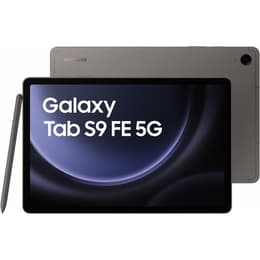
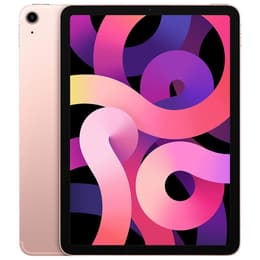

Galaxy Tab S9 FE (10.9", 2023) Vs iPad Air 4 (2020, A14 series)

Galaxy Tab S9 FE (10.9", 2023)
Starting at

Refurbished price:£227.00

Versus £606.86 new

See options
iPad Air 4 (2020, A14 series)
Starting at

Refurbished price:£215.00

Versus £579.00 new

See options

Ratings

The Samsung Galaxy Tab S9 FE, released in October 2023, and the Apple iPad Air (4th generation), launched in October 2020, represent distinct approaches to the tablet experience. While both offer a 10.9-inch display and aim to provide a versatile computing experience, they differ significantly in their operating systems, core processing power, and display technologies. The Galaxy Tab S9 FE operates on Android, offering a customizable interface, while the iPad Air runs on Apple's iPadOS, known for its streamlined ecosystem.

Scores

Durability

When considering the long-term usability of a tablet, factors like software support, physical resilience, and repairability are key. These two devices offer different timelines and features in these areas.

  • Release Timeline: The Galaxy Tab S9 FE was released in October 2023, making it a newer device compared to the iPad Air 2020, which launched in October 2020. This difference in release year typically translates to a longer period of software updates for the newer device.
  • Software Longevity: Samsung generally provides several years of Android and security updates for its tablets, with the Tab S9 FE expected to receive updates for a considerable duration, potentially including Android 16. Apple is known for its extended software support, and while the iPad Air 2020 has already received multiple iPadOS updates, its update cycle will naturally conclude sooner than the newer Galaxy Tab S9 FE.
  • Durability Features: The Galaxy Tab S9 FE features an IP68 rating for dust and water resistance, offering a notable level of protection against environmental elements. The iPad Air 2020 does not carry an official IP rating, though it features a robust aluminum unibody construction. Both devices are built with durable materials, including glass fronts and aluminum frames.

Year of Release

2023

2020

Compatible with latest Update

Yes

Yes

OS

Android

iPadOS

Performance

The performance of a tablet dictates its responsiveness and capability across various tasks, from everyday browsing to more demanding applications. Both tablets offer distinct performance profiles.

  • Processing Capabilities: The Galaxy Tab S9 FE is equipped with a processor that handles general use, web browsing, note-taking, and casual gaming smoothly. Users report it performs commendably for daily tasks, though it may show limitations with high-end gaming or advanced photo editing. The iPad Air 2020 features a powerful chip that delivers strong performance for demanding applications, including 4K video editing and immersive games, offering a significant boost in CPU and graphics performance for its release period.
  • Multitasking and Responsiveness: The Galaxy Tab S9 FE, with its available RAM configurations, handles running multiple apps without significant issues, though some users note occasional hiccups during intensive multitasking in modes like DeX. The iPad Air 2020, while powerful, runs iPadOS, which offers a different approach to multitasking compared to Android, with its own set of gestures and split-screen functionalities.
  • Storage Options: Both tablets offer various storage configurations to suit different user needs. The Galaxy Tab S9 FE comes with options including 128GB and 256GB, with expandable storage via a microSD card slot. The iPad Air 2020 is available with 64GB or 256GB of internal storage, without expandable storage.
  • Battery Behavior: The Galaxy Tab S9 FE houses an 8,000 mAh battery, providing multi-day potential for casual use and around 7 hours of screen-on time with mixed usage. The iPad Air 2020 features a 28.6 watt-hour battery, typically offering around 10 hours of web surfing or video playback over Wi-Fi.

Memory (GB)

6 GB

4 GB

Screen quality

The display is a primary interaction point for any tablet, influencing everything from media consumption to productivity. These devices present different display technologies and characteristics.

  • Display Technology and Resolution: The Galaxy Tab S9 FE features a 10.9-inch IPS LCD display with a resolution of 1440 x 2304 pixels. The iPad Air 2020 also has a 10.9-inch Liquid Retina IPS display, but with a higher resolution of 2360 x 1640 pixels, resulting in a slightly higher pixel density.
  • Refresh Rate and Smoothness: The Galaxy Tab S9 FE offers an adaptive refresh rate of up to 90Hz, contributing to smoother scrolling and a more fluid visual experience, particularly noticeable in games and general navigation. The iPad Air 2020 features a standard 60Hz refresh rate.
  • Brightness and Clarity: Both tablets offer vibrant colors and good clarity for typical viewing. The Galaxy Tab S9 FE includes a Vision Booster feature to enhance visibility in outdoor environments by optimizing color and contrast. The iPad Air 2020's display includes features like True Tone and wide color support for accurate color representation.

Resolution

1440 x 2304

2360 x 1640

Screen type

IPS LCD

Liquid Retina display

Pixel density

250ppp

264ppp

Audiovisual

While tablets are not typically primary photography tools, their camera systems are important for video calls, document scanning, and occasional photo capture. Audio quality also plays a role in media consumption and communication.

  • Camera System Capabilities: The Galaxy Tab S9 FE features an 8-megapixel rear camera and a 12-megapixel front-facing camera. The front camera is noted for being well-suited for online meetings. The iPad Air 2020 has a 12-megapixel rear camera capable of 4K video recording and a 7-megapixel front-facing FaceTime HD camera.
  • Photography Performance: The rear camera on the Galaxy Tab S9 FE is considered acceptable for basic tasks like scanning QR codes or snapping reference pictures, but not ideal for high-quality photography. The iPad Air 2020's rear camera is capable of good daylight shots and 4K video capture, with improved low-light performance compared to some earlier models.
  • Video Recording and Audio: The Galaxy Tab S9 FE's front camera can record at UHD and 30 FPS, while the rear camera records at FHD and 30 FPS. It features stereo speakers that are described as loud and clear. The iPad Air 2020's rear camera supports 4K video recording at up to 60 fps, and its front camera records 1080p video at 60 FPS. It also features stereo speakers, enhancing the audio experience for media.

Miscellaneous

Beyond core performance and display, several practical features contribute to the overall user experience and versatility of a tablet.

  • Connectivity and Ports: The Galaxy Tab S9 FE supports Wi-Fi 6 and Bluetooth 5.3, and includes a USB Type-C port. It also offers optional 5G connectivity. The iPad Air 2020 also features Wi-Fi 6 and Bluetooth 5.0, and was an early adopter of the USB-C port for data transfer and charging. It offers optional LTE connectivity.
  • Biometric Security: The Galaxy Tab S9 FE incorporates a side-mounted fingerprint sensor integrated into the power button. The iPad Air 2020 similarly features Touch ID integrated into its top button for secure authentication.
  • Design and Handling: The Galaxy Tab S9 FE has dimensions of 254.3 x 165.8 x 6.5 mm and weighs 524g. The iPad Air 2020 measures 247.6 x 178.5 x 6.1 mm and weighs 460g for the Wi-Fi model. Both devices feature an aluminum frame and back, contributing to a premium feel. The Galaxy Tab S9 FE includes an S Pen in the box, offering a natural writing and drawing experience. The iPad Air 2020 supports the second-generation Apple Pencil, which is sold separately.

Weight

129 g

458 g

Screen size (in)

10.9

10.9

Network

Wi-Fi + 5G

Wi-Fi

Carrier compatibility

Unlocked

Without SIM Port

The Samsung Galaxy Tab S9 FE and the iPad Air 2020 cater to users with differing priorities and ecosystem preferences. The Tab S9 FE is often praised for its vibrant display with a smoother refresh rate, the inclusion of the S Pen, and its IP68 water and dust resistance. Users appreciate its solid build quality and its performance for everyday tasks and content consumption. Some criticisms include its performance limitations for very demanding applications and the camera quality for serious photography.

The iPad Air 2020 is frequently lauded for its powerful processing capabilities, its high-resolution Liquid Retina display, and its integration within the Apple ecosystem, including support for the Apple Pencil 2 and Magic Keyboard. Its design, similar to the iPad Pro, also receives positive remarks. Common user concerns sometimes point to its standard 60Hz refresh rate and the fact that accessories are separate purchases.

Users prioritizing a newer device with a higher refresh rate display, expandable storage, and an included stylus, all within the Android ecosystem, may find the Galaxy Tab S9 FE well-suited to their needs. It is a strong option for students and professionals who value note-taking and media consumption with added durability. Conversely, users who prioritize robust performance for creative tasks, a higher resolution display, and seamless integration with Apple's software and services will likely lean towards the iPad Air 2020. It remains a capable device for those already invested in the Apple ecosystem or seeking a powerful tablet for productivity and content creation.

Both tablets offer compelling features, and considering a quality-assured refurbished option for either device can be a sustainable choice for extending their lifecycle.


See all articles

Our recent comparisons