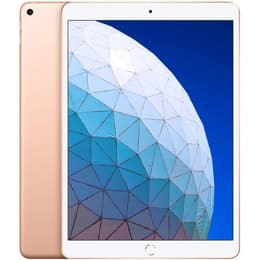

Galaxy Tab S8 (11.0", 2022) Vs iPad Air 3 (2019, A12 series)

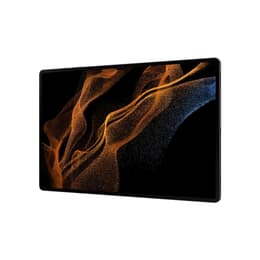
Galaxy Tab S8 (11.0", 2022)
Starting at

Refurbished price:£262.00

Versus £745.19 new

See options
iPad Air 3 (2019, A12 series)
Starting at

Refurbished price:£104.00

Versus £479.00 new

See options

Ratings

The Samsung Galaxy Tab S8, released in February 2022, and the Apple iPad Air (3rd generation), launched in March 2019, represent distinct approaches to the tablet experience. While both offer capable platforms for productivity and entertainment, they differ significantly in their operating systems, core hardware, and overall user ecosystems. The Galaxy Tab S8 runs on Android, providing a versatile and open environment, whereas the iPad Air operates on Apple's iPadOS, known for its streamlined interface and integration within the Apple ecosystem. Key differentiators include their release timelines, display technologies, and stylus integration.

Scores

Durability

When considering the long-term usability of a tablet, software support and physical resilience are important factors. The three-year difference in their release dates significantly impacts their expected practical lifespans, particularly concerning software updates.

  • Software Longevity: The Galaxy Tab S8, being a more recent device, benefits from Samsung's commitment to providing four major Android OS updates and five years of security updates from its release. This means it is expected to receive software support until at least 2026 for OS updates and 2027 for security patches. In contrast, the iPad Air (2019), powered by the A12 Bionic chip, has received iPadOS updates up to iPadOS 17. While Apple is known for extended software support, devices of this vintage typically see their major OS update cycle conclude around five to six years post-release, meaning its update window is nearing its end.
  • Physical Durability: Both tablets feature aluminum builds, contributing to a solid feel. The Galaxy Tab S8 incorporates Armor Aluminum, designed for enhanced resistance against drops and scratches. While the iPad Air (2019) also has a robust aluminum chassis, it lacks some of the newer protective technologies found in more recent devices. Both models are generally considered repairable, though the availability and cost of parts can vary depending on the region and specific repair needed.
  • Expected Practical Lifespan: Users can expect the Galaxy Tab S8 to remain fully functional and supported for a longer period due to its newer release and extended software commitment. The iPad Air (2019) remains a capable device for general use, but its diminishing software update cycle means it may eventually encounter compatibility issues with newer applications or features.

Year of Release

2022

2019

Compatible with latest Update

Yes

Yes

OS

Android

iPadOS

Performance

The performance of a tablet directly influences its responsiveness and ability to handle various tasks, from everyday browsing to more demanding applications. Both devices offer capable performance for their respective generations, but the newer Galaxy Tab S8 provides a more contemporary experience.

  • Processing Power: The Galaxy Tab S8 features a current-generation processor that allows for smooth multitasking, rapid app loading, and efficient handling of graphically intensive games and creative applications. Users will find it responsive even with multiple demanding apps running simultaneously. The iPad Air (2019) is equipped with a powerful chip for its release year, providing a fluid experience for web browsing, media consumption, and most productivity tasks. While still capable, it may exhibit slower performance with the latest, most resource-intensive applications compared to newer hardware.
  • Multitasking and Responsiveness: With higher RAM configurations available, the Galaxy Tab S8 is well-suited for users who frequently switch between numerous applications or work with large files, ensuring a consistently smooth workflow. The iPad Air (2019) offers sufficient RAM for typical multitasking scenarios, such as split-screen viewing for two applications, but may show limitations when managing a high number of active background processes or very large projects.
  • Storage Options: Both tablets offer various internal storage capacities. The Galaxy Tab S8 provides the added flexibility of expandable storage via a microSD card, allowing users to significantly increase their storage space for media, documents, and applications beyond the internal options. The iPad Air (2019) relies solely on its internal storage, with no option for expansion.

Memory (GB)

8 GB

3 GB

Screen quality

The display is a primary interface for any tablet, and both the Galaxy Tab S8 and iPad Air (2019) offer high-quality viewing experiences, though with notable differences in technology and features.

  • Display Technology and Clarity: The Galaxy Tab S8 features an 11-inch LTPS TFT LCD panel with a resolution of 2560x1600 pixels, providing clear and detailed visuals. The iPad Air (2019) comes with a 10.5-inch Retina IPS LCD display, offering a resolution of 2224x1668 pixels, known for its sharp text and accurate color reproduction. Both screens deliver excellent clarity for reading, browsing, and media consumption.
  • Refresh Rate and Smoothness: A significant difference lies in the refresh rate. The Galaxy Tab S8 boasts a 120Hz refresh rate, which results in noticeably smoother scrolling, more fluid animations, and a more responsive feel during interactions, particularly in supported apps and games. The iPad Air (2019) has a standard 60Hz refresh rate, which is perfectly adequate for most tasks but does not offer the same level of visual fluidity as the higher refresh rate display.
  • Brightness and Viewing Experience: The iPad Air (2019) offers a brightness of up to 500 nits, ensuring good visibility in various lighting conditions, including outdoors. The Galaxy Tab S8 also provides a bright and colorful viewing experience, suitable for diverse environments. Both displays are well-suited for media consumption, with the Tab S8's 16:10 aspect ratio often favored for widescreen content, while the iPad Air's 4:3 aspect ratio is well-regarded for productivity tasks like document viewing.

Resolution

1600 x 2560

2224 x 1668

Screen type

TFT LCD

Retina display

Pixel density

280ppp

264ppp

Audiovisual

While tablets are not typically primary photography devices, their camera systems are increasingly important for video calls, document scanning, and casual photography. Both tablets offer functional camera setups, with the Galaxy Tab S8 providing more advanced options.

  • Camera System Capabilities: The Galaxy Tab S8 features a dual-camera setup on the rear, including a 13MP wide lens and a 6MP ultrawide lens, along with a 12MP ultrawide front-facing camera. This allows for more versatile photography and improved video conferencing. The iPad Air (2019) has an 8MP rear camera and a 7MP front-facing camera.
  • Photography and Video Quality: The Galaxy Tab S8's cameras are capable of recording video in 4K resolution at 30 frames per second, and its front camera includes an auto-framing feature that adjusts to keep subjects in view during video calls. The iPad Air (2019) records 1080p video at 30 frames per second with both its front and rear cameras. For everyday photography and scanning documents, both perform adequately, but the Tab S8 offers higher resolution and more features.
  • Audio Experience: The Galaxy Tab S8 is equipped with quad stereo speakers tuned by AKG and supports Dolby Atmos, delivering a rich and immersive audio experience for media consumption. It also features three microphones with noise cancellation for clearer calls. The iPad Air (2019) provides stereo speakers and dual microphones, offering clear audio for video calls and general media playback.

Miscellaneous

Beyond core performance and display, several practical features contribute to the overall user experience and suitability for different needs.

  • Connectivity and Ports: The Galaxy Tab S8 supports Wi-Fi 6E and Bluetooth 5.2, offering faster and more stable wireless connections, and also has an optional 5G cellular variant. It uses a USB-C 3.2 port for charging and data transfer. The iPad Air (2019) supports Wi-Fi 5 (802.11ac) and Bluetooth 5.0, with an optional LTE cellular model. It features Apple's proprietary Lightning port for charging and data, and notably includes a 3.5mm headphone jack.
  • Stylus and Biometrics: A key advantage of the Galaxy Tab S8 is that it includes the S Pen stylus in the box, offering ultra-low latency for writing, drawing, and navigation. The iPad Air (2019) supports the first-generation Apple Pencil, which must be purchased separately. For security, the Tab S8 features a fingerprint sensor integrated into the power key. The iPad Air (2019) uses Touch ID, a fingerprint sensor embedded in its home button.
  • Design and Handling: The Galaxy Tab S8 measures 253.8 x 165.3 x 6.3 mm and weighs 503g (Wi-Fi model). The iPad Air (2019) is slightly more compact and lighter at 250.6 x 174.1 x 6.1 mm and 456g (Wi-Fi model). Both are designed for comfortable handling, with the Tab S8 offering a slightly larger screen in a comparable footprint.

Weight

507 g

456 g

Screen size (in)

11.0

10.5

Network

Wi-Fi

Wi-Fi

Carrier compatibility

Without SIM Port

Without SIM Port

Choosing between the Samsung Galaxy Tab S8 (2022) and the Apple iPad Air (2019) depends largely on individual priorities, ecosystem preference, and intended use. Both tablets have garnered praise from users for their respective strengths, but also face some common criticisms.

The Galaxy Tab S8 is frequently lauded for its vibrant 120Hz display, which provides a smooth and responsive visual experience. Users appreciate the inclusion of the S Pen, making it a ready-to-use tool for note-taking and creative tasks without additional purchases. Its robust performance for demanding applications and longer software support timeline are also strong points. Some users, however, have noted that while the LCD panel is excellent, it doesn't offer the deep blacks and contrast of OLED displays found in some other premium tablets. The Android tablet ecosystem, while improved, is sometimes mentioned as less optimized for tablets compared to iPadOS.

The iPad Air (2019) is praised for its reliable performance for everyday tasks, its integration within the Apple ecosystem, and the consistent, user-friendly experience of iPadOS. Its battery life is generally considered good, lasting through a full day of typical use. Common criticisms often revolve around its 60Hz display, which, while clear, lacks the fluidity of higher refresh rate screens. The need to purchase the Apple Pencil separately is also a point of consideration for users seeking stylus functionality.

Users prioritizing the latest Android experience, a high refresh rate display, and an included stylus for creative or productivity work may find the Galaxy Tab S8 better suited to their needs. Its longer software support also offers greater future-proofing. Conversely, individuals deeply embedded in the Apple ecosystem, who value the consistent iPadOS experience for general productivity and media consumption, and who are comfortable with a 60Hz display, may lean towards the iPad Air (2019). For those seeking a more sustainable choice, both models are available as quality-assured refurbished options, offering an eco-friendly alternative to purchasing new devices.
See all articles

Our recent comparisons