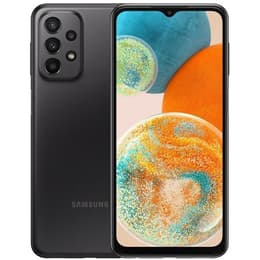
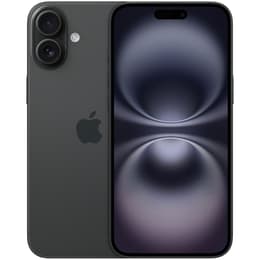

Galaxy A23 5G Vs iPhone 16 Plus

Galaxy A23 5G
Galaxy A23 5G
Starting at

Refurbished price:£100.00

Versus £300.00 new

See options
iPhone 16 Plus
iPhone 16 Plus
Starting at

Refurbished price:£503.46

Versus £799.00 new

See options

Ratings

The Samsung Galaxy A23 5G, released in August 2022, and the Apple iPhone 16 Plus, launched in September 2024, represent distinct approaches to smartphone design and functionality. While the Galaxy A23 5G offers a feature-rich Android experience at a more accessible point, the iPhone 16 Plus delivers Apple's premium iOS ecosystem with advanced performance and camera capabilities. These devices cater to different user preferences, primarily distinguished by their operating systems and overall hardware philosophy.

Scores

Durability

When considering the long-term usability of these devices, their respective release timelines and software support policies are key factors.

  • Software Longevity: The iPhone 16 Plus, having been released in September 2024, benefits from Apple's extended software support, typically receiving major iOS updates for 5 to 7 years, with security patches often continuing beyond that. This means users can expect updates well into the 2030s. In contrast, the Samsung Galaxy A23 5G, released in August 2022, generally receives around four years of Android operating system updates and five years of security patches, aligning with Samsung's policy for its A-series devices.
  • Build Durability: The iPhone 16 Plus features a more robust construction with an aluminum design, Ceramic Shield front, and color-infused glass back, offering enhanced resistance to drops and scratches. The Galaxy A23 5G utilizes a glass front with Gorilla Glass 5 protection, a plastic frame, and a plastic back, providing a sturdy yet more conventional build for its category.
  • Practical Lifespan: Users prioritizing the latest software features and security updates for the longest possible duration will find the iPhone 16 Plus more aligned with their needs. For those content with a slightly shorter update cycle and a durable build for everyday use, the Galaxy A23 5G offers a practical lifespan.

Year of Release

2022

2024

Compatible with latest Update

Yes

Yes

Foldable

No

No

Performance

The performance of a smartphone dictates its responsiveness and ability to handle various tasks, from everyday browsing to demanding applications.

  • Processing Power: The iPhone 16 Plus is equipped with Apple's A18 chip, which provides substantial processing power, enabling smooth multitasking, rapid app loading, and efficient handling of graphics-intensive games and advanced computational tasks. The Galaxy A23 5G features a Qualcomm Snapdragon 695 5G mobile platform, which delivers reliable performance for daily usage, including social media, web browsing, and moderately demanding applications.
  • Multitasking and Storage: The iPhone 16 Plus comes with 8GB of RAM, contributing to fluid transitions between applications and efficient background process management. It offers internal storage options of 128GB, 256GB, and 512GB. The Galaxy A23 5G is available with 4GB, 6GB, or 8GB of RAM, and 64GB or 128GB of internal storage, with the added flexibility of expanding storage up to 1TB via a microSD card.
  • Battery Behavior: The iPhone 16 Plus is designed for extended use, with its battery providing up to 27 hours of video playback and often lasting 1.5 to 2 days for heavy users. The Galaxy A23 5G, with its 5000 mAh battery, is also noted for its strong battery life, frequently lasting up to two days on a single charge for many users.

Memory (GB)

4 GB

8 GB

Screen quality

The visual experience is a primary interaction point for any smartphone, and both devices offer distinct display technologies.

  • Display Technology and Clarity: The iPhone 16 Plus features a 6.7-inch Super Retina XDR OLED display, delivering deep blacks, vibrant colors, and high contrast. Its resolution of 2796 x 1290 pixels results in a sharp 460 pixels per inch. The Galaxy A23 5G sports a 6.6-inch PLS LCD Infinity-V Display with a Full HD+ resolution of 1080 x 2408 pixels, offering clear visuals and good color reproduction.
  • Brightness and Refresh Rate: The iPhone 16 Plus's OLED panel can achieve a peak outdoor brightness of 2,000 nits, ensuring excellent visibility even in bright sunlight. It maintains a standard 60Hz refresh rate. The Galaxy A23 5G features a 120Hz refresh rate, which provides a smoother scrolling experience and more fluid animations, enhancing the perception of responsiveness.
  • Viewing Experience: Users prioritizing superior contrast, color accuracy, and high brightness for media consumption and outdoor use will find the iPhone 16 Plus's OLED display advantageous. Those who value a smoother visual experience during scrolling and navigation, along with a clear display for everyday tasks, will appreciate the Galaxy A23 5G's 120Hz LCD panel.

Resolution

1080 x 2408

1290 x 2796

Screen type

PLS LCD

Super Retina XDR OLED

Audiovisual

Camera capabilities are a significant consideration for many users, and these devices offer different photographic and videographic experiences.

  • Rear Camera Systems: The iPhone 16 Plus is equipped with an advanced dual-camera system, featuring a 48MP main sensor with optical image stabilization (OIS) that can capture super-high-resolution photos, and a 12MP ultra-wide camera with a 120-degree field of view. It also offers 2x optical zoom capabilities. The Samsung Galaxy A23 5G includes a quad-camera setup on the rear, comprising a 50MP main sensor with OIS, a 5MP ultrawide lens, a 2MP macro camera, and a 2MP depth sensor.
  • Photography Performance: The iPhone 16 Plus leverages computational photography features like Photonic Engine and Deep Fusion for enhanced detail and dynamic range, particularly in challenging lighting conditions. The Galaxy A23 5G's main camera performs well in good lighting, producing vibrant and well-exposed images, though its low-light performance and the utility of its 2MP sensors are more limited.
  • Video Recording and Audio: The iPhone 16 Plus supports 4K Dolby Vision video recording at up to 60 frames per second, Cinematic mode, Action mode, and spatial video recording, offering advanced video capabilities. The Galaxy A23 5G records video at Full HD (1920 x 1080) at 30 frames per second. For audio, the iPhone 16 Plus provides a rich media consumption experience, while the Galaxy A23 5G offers standard speaker output.

Main camera

50 megapixels

48 megapixels

Front camera

8 megapixels

12 megapixels

Miscellaneous

Beyond core specifications, several practical elements contribute to the overall user experience and daily utility of a smartphone.

  • Connectivity and Ports: Both devices support 5G connectivity for fast mobile data. The iPhone 16 Plus features Wi-Fi 6E and Bluetooth 5.3, along with a USB-C port for charging and data transfer. The Galaxy A23 5G includes Wi-Fi 802.11 a/b/g/n/ac (2.4G+5GHz) and Bluetooth v5.1, also utilizing a USB Type-C 2.0 port. A notable difference is the Galaxy A23 5G's inclusion of a 3.5mm headphone jack, which is absent on the iPhone 16 Plus.
  • Biometrics and Design: The iPhone 16 Plus relies on Face ID for secure authentication and features an Action button for customizable shortcuts. The Galaxy A23 5G incorporates a side-mounted fingerprint sensor for unlocking. In terms of physical design, the iPhone 16 Plus measures 160.9 x 77.8 x 7.8 mm and weighs 199g, offering a premium feel. The Galaxy A23 5G is slightly larger and lighter at 165.4 x 76.9 x 8.4 mm and 197g, with a design that balances aesthetics and practicality.
  • Expandability and Materials: The Galaxy A23 5G offers expandable storage via a microSD card slot, allowing users to add up to 1TB of additional space, a feature not present on the iPhone 16 Plus. The iPhone 16 Plus uses more premium materials like aluminum and Ceramic Shield, while the Galaxy A23 5G combines Gorilla Glass 5 with a plastic frame and back.

Weight

197 g

199 g

Screen size (in)

6.6

6.7

Mobile network

5G

5G

SIM card

Dual Physical SIM

Physical SIM + eSIM

Carrier compatibility

Unlocked

Unlocked

Connector

USB-C + Jack 3.5mm

USB-C (USB 2)

The Samsung Galaxy A23 5G and the iPhone 16 Plus cater to distinct user needs and preferences, reflecting their different market positions. Users often praise the Galaxy A23 5G for its impressive battery life, often extending to two days of use, and its smooth 120Hz display, which enhances daily interactions. The inclusion of a 3.5mm headphone jack and expandable storage are also frequently cited as practical advantages for many. However, some users note that its low-light camera performance can be limited, and the utility of its secondary 2MP cameras is often questioned.

The iPhone 16 Plus, on the other hand, is generally lauded for its powerful performance, capable of handling demanding applications and multitasking with ease, and its vibrant OLED display with high brightness levels. Its advanced camera system and long-term software support are also significant drawcards. Criticisms sometimes revolve around the continued use of a 60Hz refresh rate on its display, which some users find less fluid compared to higher refresh rate screens available on other devices.

Users prioritizing a long-lasting device with extensive software support, a premium build, and advanced camera and processing capabilities for a seamless and powerful experience will find the iPhone 16 Plus well-suited to their needs. Conversely, users who value a high refresh rate display, expandable storage, and the flexibility of the Android ecosystem, along with excellent battery life, may lean towards the Samsung Galaxy A23 5G. Both devices offer compelling features, and choosing between them often comes down to individual priorities regarding operating system preference, performance demands, and specific hardware requirements. For those considering either of these devices, exploring quality-assured refurbished options can provide an eco-friendly alternative.
See all articles

Our recent comparisons