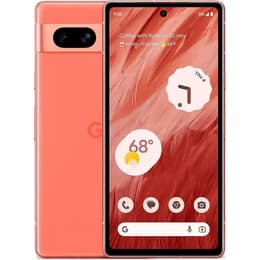

Galaxy A16 5G Vs Google Pixel 7A

Galaxy A16 5G
Galaxy A16 5G
Starting at

Refurbished price:£103.00

Versus £205.87 new

See options
Google Pixel 7A
Google Pixel 7A
Starting at

Refurbished price:£128.00

Versus £649.99 new

See options

Ratings

The Samsung Galaxy A16 5G, released in late 2024 and early 2025, and the Google Pixel 7a, launched in May 2023, are both Android smartphones designed to offer a balanced experience. While the Galaxy A16 5G emphasizes a larger display and extended software support, the Pixel 7a focuses on advanced camera capabilities and a more robust build. Both devices operate on the Android platform, providing access to a wide ecosystem of applications and services.

Scores

Durability

When considering the longevity of these devices, several factors come into play, including their release timelines, software support, and physical durability.

  • Release Timeline & Software Support: The Galaxy A16 5G, being a newer device with a release spanning late 2024 and early 2025, benefits from a longer software support window, promising six years of OS upgrades and security updates until October 2030. In contrast, the Google Pixel 7a, released in May 2023, is guaranteed five years of OS and security updates, extending until at least May 2028.
  • Durability Features: The Pixel 7a offers an IP67 rating for dust and water resistance, meaning it can withstand immersion in up to 1 meter of water for 30 minutes, and its display is protected by Corning Gorilla Glass 3. The Galaxy A16 5G features an IP54 rating, providing protection against dust and splashes. Its construction primarily uses a hard plastic frame and a material Samsung calls "Glastic" on the front and back, which mimics glass.
  • Expected Practical Lifespan: Users prioritizing the absolute longest software support will find the Galaxy A16 5G advantageous due to its more recent launch and Samsung's commitment to six years of updates. However, the Pixel 7a's higher IP rating and Gorilla Glass 3 offer a greater degree of physical protection against environmental elements and accidental damage.

Year of Release

2024

2023

Compatible with latest Update

Yes

Yes

OS

Android

Android

Foldable

No

No

Performance

The performance of a smartphone is largely determined by its internal components and how efficiently they handle daily tasks and demanding applications.

  • Processor Capabilities: The Galaxy A16 5G is powered by either a Samsung Exynos 1330 or a MediaTek Dimensity 6300 processor, depending on the region. These processors are designed to manage everyday tasks such as web browsing, email, and media consumption smoothly, though some users may experience minor delays when switching between multiple applications or taking burst photos. The Pixel 7a features Google's Tensor G2 chipset, which is optimized for artificial intelligence tasks and computational photography. While capable, some reports indicate that its overall performance might feel less responsive in certain scenarios compared to other devices in its category.
  • Multitasking and Storage: The Pixel 7a comes with 8GB of RAM and 128GB of internal storage, without an option for expandable storage. The Galaxy A16 5G offers various configurations, including 4GB, 6GB, or 8GB of RAM, and 128GB or 256GB of internal storage, with the added flexibility of microSD card support for expansion up to 1.5TB. This allows Galaxy A16 5G users to significantly increase their storage capacity for photos, videos, and applications.
  • Battery Behavior: The Galaxy A16 5G is equipped with a 5000mAh battery, which typically provides extensive usage, often lasting a full day even with heavy use, and potentially up to two days with moderate usage. The Pixel 7a has a 4385mAh battery and supports wireless charging, a feature absent on the Galaxy A16 5G. The Pixel 7a also includes an Extreme Battery Saver mode that can extend battery life significantly.

Memory (GB)

4 GB

8 GB

Screen quality

The visual experience on a smartphone is heavily influenced by its display technology, resolution, and brightness levels.

  • Display Technology and Size: The Galaxy A16 5G features a larger 6.7-inch Super AMOLED display, offering vibrant colors and deep blacks. The Pixel 7a comes with a 6.1-inch OLED display, also known for its rich colors and contrast. The larger screen on the Galaxy A16 5G provides more screen real estate for media consumption and productivity.
  • Resolution and Refresh Rate: Both devices offer a Full HD+ resolution (2340 x 1080 pixels for the A16 5G and 2400 x 1080 pixels for the Pixel 7a), ensuring sharp and clear visuals. Both also feature a 90Hz refresh rate, contributing to smoother scrolling and a more fluid visual experience compared to standard 60Hz displays.
  • Brightness and Outdoor Visibility: The Galaxy A16 5G's Super AMOLED display can reach a peak brightness of 800 nits in High Brightness Mode (HBM), which is generally sufficient for indoor use. However, its outdoor visibility can be challenging in direct sunlight due to screen reflections. The Pixel 7a's OLED display also supports HDR, which can enhance the viewing experience for compatible content.

Resolution

1080 x 2340

1080 x 2400

Screen type

Super AMOLED

OLED

Audiovisual

The camera systems on both smartphones are designed to capture everyday moments, but they approach image processing and feature sets differently.

  • Rear Camera Systems: The Galaxy A16 5G is equipped with a triple-camera setup on the rear, consisting of a 50MP main sensor, a 5MP ultra-wide lens, and a 2MP macro lens. The main camera typically produces 12MP images through pixel binning. The Pixel 7a features a dual-camera system with a 64MP main sensor with optical image stabilization (OIS) and a 13MP ultra-wide lens with a 120-degree field of view. The Pixel 7a's main camera outputs 16MP pixel-binned images.
  • Photography Performance: The Pixel 7a is recognized for its strong computational photography, delivering excellent photo quality and color reproduction, even in challenging high-contrast scenes. It includes features like faster night mode, long exposure, Magic Eraser, and Photo Unblur. The Galaxy A16 5G's camera performs well for its category, but night images may exhibit some muddiness or blurriness.
  • Video Recording and Front Camera: For video, the Pixel 7a offers 4K recording at 30 or 60 frames per second (fps) on its main camera, and 4K at 30fps on both its ultra-wide and front-facing cameras. The Galaxy A16 5G supports video recording up to Full HD (1080p) at 30fps, lacking 4K capabilities. Both devices feature a 13MP front-facing camera, with the Pixel 7a's offering a wider 95-degree field of view.

Main camera

50 megapixels

64 megapixels

Front camera

13 megapixels

13 megapixels

Miscellaneous

Beyond core specifications, several practical elements contribute to the overall user experience and daily convenience of a smartphone.

  • Connectivity Options: Both devices support 5G connectivity, enabling faster download and upload speeds. The Pixel 7a includes Wi-Fi 6E, offering enhanced wireless performance, while the Galaxy A16 5G supports Wi-Fi 5. Both also feature Bluetooth 5.3 and NFC for wireless accessories and contactless payments.
  • Ports and Sensors: The Pixel 7a is equipped with a USB-C 3.2 port, which provides faster data transfer speeds compared to the USB-C 2.0 port found on the Galaxy A16 5G. Neither phone includes a 3.5mm headphone jack. For security, the Pixel 7a uses an under-display optical fingerprint sensor, while the Galaxy A16 5G has a side-mounted fingerprint sensor.
  • Design and Handling: The Galaxy A16 5G is a larger device, measuring 164.4 x 77.9 x 7.9 mm and weighing 200g, which might appeal to users who prefer a bigger screen. The Pixel 7a is more compact at 152 x 72.9 x 9 mm and weighs 193.5g, potentially making it easier for one-handed use. The Galaxy A16 5G's plastic build contributes to its durability, while the Pixel 7a's Gorilla Glass 3 offers additional screen protection.

Weight

200 g

193 g

Screen size (in)

6.7

6.1

Mobile network

5G

5G

SIM card

Dual Physical SIM

Physical SIM + eSIM

Carrier compatibility

Unlocked

Unlocked

User feedback for the Samsung Galaxy A16 5G often highlights its strong battery life, large and vibrant display, and Samsung's commitment to extended software updates as key advantages. Some users have noted that while it handles everyday tasks adequately, performance can occasionally feel sluggish, particularly during app switching or demanding use. The absence of 4K video recording and a 3.5mm headphone jack are also points of consideration for some.

For the Google Pixel 7a, common praise centers on its exceptional camera performance, especially its computational photography features that deliver high-quality photos and advanced video capabilities, including 4K recording across all cameras. Its more compact size and robust IP67 water and dust resistance are also appreciated. However, some users have expressed that its processor performance can feel less optimized in certain situations, and the lack of expandable storage is a limitation.

Users prioritizing a larger display, longer software support, and expandable storage for media and applications may find the Samsung Galaxy A16 5G well-suited to their needs. Its extensive battery life also makes it a strong contender for those who require prolonged usage between charges. Conversely, individuals who place a high value on advanced camera capabilities, superior water and dust resistance, and a more compact form factor will likely lean towards the Google Pixel 7a. Its Tensor G2 chip also offers a distinct advantage in AI-driven features.

Both devices represent compelling options within the Android ecosystem, and choosing between them often comes down to these specific priorities. For those considering either model, exploring quality-assured refurbished options can provide an eco-friendly alternative, offering a sustainable choice without compromising on functionality.


See all articles

Our recent comparisons