
Galaxy A14 5G Vs iPhone 15

Galaxy A14 5G
Galaxy A14 5G
Starting at

Refurbished price:£80.00

Versus £289.00 new

See options
iPhone 15
iPhone 15
Starting at

Refurbished price:£326.00

Versus £699.00 new

See options

Ratings

The Samsung Galaxy A14 5G, released in January 2023, and the iPhone 15, launched in September 2023, represent distinct approaches to smartphone design and functionality. While both offer 5G connectivity, they cater to different user expectations regarding operating system experience, performance capabilities, and camera features. The Galaxy A14 5G runs on Android, providing a customizable interface, whereas the iPhone 15 operates on Apple's iOS, known for its integrated ecosystem and streamlined user experience.

Scores

Durability

When considering the long-term usability of these devices, their release timelines and software support policies are key factors.

  • Release Timeline and OS Support: The Galaxy A14 5G was released in early 2023, typically receiving two years of major Android software updates and five years of security updates from Samsung. The iPhone 15, released later in 2023, benefits from Apple's reputation for providing longer software support, often extending to five or six years of major iOS updates. This difference means the iPhone 15 is likely to receive new features and security patches for a longer duration.
  • Repairability and Lifespan: Both devices are designed with modern smartphone construction, which can present challenges for user-level repairs. While specific repairability scores vary, the practical lifespan of either device can be extended through careful handling and, when necessary, professional refurbishment. The iPhone 15 features Ceramic Shield front cover and IP68 water and dust resistance, offering a degree of protection against everyday accidents. The Galaxy A14 5G does not carry an official IP rating for water and dust resistance.
  • Software Longevity: Users prioritizing the latest software features and security updates for the longest possible period may find the iPhone 15's extended support timeline more appealing. For those content with a stable, secure experience over a slightly shorter period, the Galaxy A14 5G's update policy remains robust for its category.

Year of Release

2023

2023

Compatible with latest Update

Yes

Yes

OS

Android

iOS

Foldable

No

No

Performance

The performance of a smartphone is crucial for daily tasks, from browsing to demanding applications. These two devices offer different levels of processing power and storage configurations.

  • Processor Capabilities: The iPhone 15 is equipped with a powerful current-generation chip, enabling smooth handling of demanding applications, complex multitasking, and graphically intensive games without noticeable delays. The Galaxy A14 5G features a processor that provides solid everyday performance for general use like web browsing, messaging, and video streaming. However, some users may experience minor stutters when rapidly switching between multiple apps or during more intensive gaming sessions.
  • Storage and RAM: The iPhone 15 offers internal storage options starting from 128GB, with 6GB of RAM, providing ample space and efficient multitasking capabilities for most users. The Galaxy A14 5G comes with 64GB or 128GB of internal storage and 4GB, 6GB, or 8GB of RAM, with the added flexibility of expandable storage via a microSD card up to 1TB. This expandable storage is a notable advantage for users who require significant space for photos, videos, and other files.
  • Battery Behavior: The Galaxy A14 5G houses a large 5000mAh battery, often lasting through a full day of moderate to heavy use, and potentially up to two days with lighter usage. Video playback tests show it can last for nearly 10 hours. The iPhone 15, with its 3349mAh battery, offers up to 20 hours of video playback and 80 hours of audio playback, indicating strong endurance for typical daily use. Both support fast wired charging, though the Galaxy A14 5G's 15W charging is slower than the iPhone 15's capability to reach 50% charge in about 30 minutes with a 20W adapter. The iPhone 15 also supports wireless charging.

Memory (GB)

4 GB

6 GB

Screen quality

The visual experience is a primary interaction point for any smartphone, and these devices present different display technologies and characteristics.

  • Display Technology and Clarity: The iPhone 15 features a 6.1-inch Super Retina XDR OLED display, delivering deep blacks, vibrant colors, and excellent contrast. Its resolution of 2556x1179 pixels results in a sharp 460 pixels per inch (ppi). The Galaxy A14 5G has a larger 6.6-inch PLS LCD display with a Full HD+ resolution of 1080x2408 pixels, offering decent sharpness and clarity for its category.
  • Brightness and Refresh Rate: The iPhone 15 boasts impressive brightness levels, reaching up to 1000 nits typical, 1600 nits for HDR content, and a peak of 2000 nits for outdoor visibility, making it highly readable even in bright sunlight. It maintains a standard 60Hz refresh rate. The Galaxy A14 5G's display peaks at around 500-520 nits, which can make outdoor viewing challenging in direct sunlight. However, it offers a smoother 90Hz refresh rate, which enhances the fluidity of scrolling and animations compared to a 60Hz panel.
  • Viewing Experience: The iPhone 15 includes the Dynamic Island, an interactive area around the front camera that displays alerts and live activities. The Galaxy A14 5G has a more traditional teardrop notch for its front camera and thicker bezels.

Resolution

1080 x 2408

1179 x 2556

Screen type

PLS LCD

Super Retina XDR OLED

Audiovisual

For many users, the camera system is a primary consideration, and both devices offer capabilities for capturing photos and videos, albeit with different strengths.

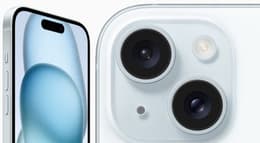
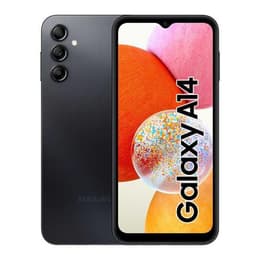
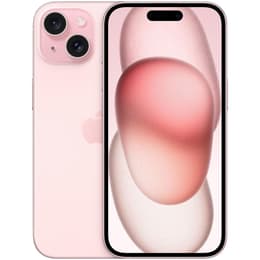
  • Rear Camera Systems: The iPhone 15 features an advanced dual-camera system with a 48MP main sensor (f/1.6) that uses sensor-shift optical image stabilization and can capture super-high-resolution photos, alongside a 12MP ultra-wide camera. This setup is designed for improved detail and low-light performance. The Galaxy A14 5G comes with a triple-camera setup, including a 50MP main sensor (f/1.8), a 2MP macro lens, and a 2MP depth sensor. It lacks an ultra-wide camera.
  • Photography Performance: The iPhone 15 excels in various lighting conditions, producing sharp images with good dynamic range. Its low-light performance is also enhanced. The Galaxy A14 5G performs well in ample light, capturing decent details and true-to-life colors. However, it struggles in low-light environments and with capturing fast-moving subjects, where noise can appear and details may soften.
  • Video Recording and Audio: The iPhone 15 supports 4K Dolby Vision video recording at various frame rates, offering high-quality video capture. The Galaxy A14 5G records video at 1080p at 30 frames per second for both its rear and front cameras. For audio, the iPhone 15 provides a clear and balanced output, suitable for media consumption and calls. The Galaxy A14 5G has a single downward-firing speaker, which some users describe as passable but lacking in bass and sometimes tinny. It does, however, include a 3.5mm headphone jack and supports Dolby Atmos.

Main camera

50 megapixels

48 megapixels

Front camera

13 megapixels

12 megapixels

Miscellaneous

Beyond core features, several practical elements contribute to the overall user experience and device utility.

  • Connectivity and Ports: Both devices support 5G connectivity. The iPhone 15 features Wi-Fi 6 and Bluetooth 5.3, along with a second-generation Ultra Wideband chip for enhanced spatial awareness. It has transitioned to a USB-C port, though with USB 2.0 transfer speeds. The Galaxy A14 5G supports Wi-Fi 5 and Bluetooth 5.2. It also uses a USB-C port (USB 2.0) and notably retains a 3.5mm headphone jack.
  • Security and Sensors: The iPhone 15 relies on Face ID for secure facial recognition and authentication. The Galaxy A14 5G incorporates a side-mounted fingerprint sensor for biometric security. Both include standard sensors like accelerometers and proximity sensors.
  • Design and Durability: The iPhone 15 features an aluminum design with a Ceramic Shield front and color-infused glass back, offering IP68 water and dust resistance. It weighs 171 grams and measures 147.6 x 71.6 x 7.8 mm. The Galaxy A14 5G has a plastic back with a textured finish for grip and weighs between 202-205 grams, with dimensions of 167.7 x 78 x 9.1 mm.

Weight

201 g

171 g

Screen size (in)

6.6

6.1

Mobile network

5G

5G

SIM card

Dual Physical SIM

Physical SIM + eSIM

Carrier compatibility

Unlocked

Unlocked

Connector

USB-C + Jack 3.5mm

USB-C (USB 2)

The Samsung Galaxy A14 5G and the iPhone 15 cater to different user priorities, offering distinct experiences in terms of operating system, performance, and features.

User feedback for the Galaxy A14 5G often praises its long-lasting battery and decent camera performance in good lighting conditions. However, some users note that its performance can be mediocre for demanding tasks, with occasional lags, and the single speaker audio quality is not its strongest point. The iPhone 15 is frequently lauded for its powerful performance, the intuitive iOS ecosystem, the versatile camera system, and the innovative Dynamic Island feature. Criticisms are less common but sometimes point to the 60Hz refresh rate as a potential area for improvement compared to some Android counterparts.

Users prioritizing a highly fluid and powerful experience for demanding applications, advanced photography, and a long software support window may find the iPhone 15 well-suited to their needs. Its robust build and integrated ecosystem offer a premium experience. Conversely, users who value a larger display, expandable storage, a 90Hz refresh rate for smoother scrolling, and the flexibility of the Android operating system may lean toward the Galaxy A14 5G. It provides a solid foundation for everyday tasks and offers excellent battery life.

For those considering either device, exploring quality-assured refurbished options can be an eco-friendly alternative to purchasing new, providing access to these technologies sustainably.

See all articles

Our recent comparisons