
Compare models

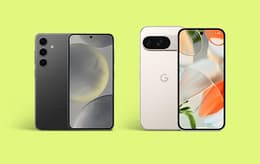
Google Pixel 9 Pro Vs iPhone 17 Pro Max

  • 1-year minimum warranty
  • Free delivery on all items
  • Free 30-day returns
Google Pixel 9 Pro
Starting at

Refurbished price:£374.00

Versus £1,093.99 new

See options
iPhone 17 Pro Max
Starting at

Refurbished price:£924.00

Versus £1,199.00 new

See options

Differences at a glance

The Google Pixel 9 Pro (2024) and the iPhone 17 Pro Max (2025) represent advanced tiers in smartphone design, offering refined hardware and distinct operating system ecosystems. While both devices target users seeking high-end mobile capabilities, they differ significantly in their approach to software environments, form factors, and daily user interaction. The Google Pixel 9 Pro runs on the Android operating system, emphasizing customization and integrated digital assistance, whereas the iPhone 17 Pro Max utilizes Apple's iOS ecosystem, known for streamlined device integration.

Choosing between these two smartphones depends heavily on personal ecosystem preferences, handling comfort, and specific software features, as both models deliver capable performance for modern mobile tasks.

Available Models

Colour

Storage

Scores

Durability

When examining hardware longevity and software support, both the Google Pixel 9 Pro and the iPhone 17 Pro Max are built to receive extended updates, though their specific timelines and repair ecosystems differ.

  • Software support timelines: Google provides multi-year operating system and security updates starting from the 2024 release year, while Apple extends a similarly long support window matching the 2025 launch cycle, ensuring both devices remain current for years.
  • Repair infrastructure: Both manufacturers offer official repair programs and parts availability, though independent service availability and component accessibility vary depending on regional service networks.
  • Expected practical lifespan: Built with durable glass and metal frames, both smartphones handle daily wear reliably, though battery degradation over several years is a natural factor for both models.

Year of Release

2024

2025

Compatible with latest Update

Yes

Yes

OS

Android

iOS

Foldable

No

No

Performance

Both devices handle intensive everyday tasks, demanding applications, and multitasking smoothly, though they utilize different internal architectures and storage configurations.

  • Multitasking and system responsiveness: App loading, swift switching between heavy programs, and sustained gaming run smoothly on both models thanks to ample system memory and optimized background processing.
  • Storage capacity options: Both smartphones offer various internal storage tiers to accommodate large photo libraries, downloaded media, and offline applications without expandable storage slots.
  • Battery behavior in typical use: The Google Pixel 9 Pro manages daily tasks efficiently for typical usage, while the larger physical frame of the iPhone 17 Pro Max houses a high-capacity battery that frequently endures heavy full-day workflows with power to spare.

Screen quality

Display technology on both smartphones utilizes advanced OLED panels that deliver sharp detail, deep contrast levels, and smooth visual refresh rates.

  • Display technology and clarity: Both models feature high-resolution panels with vibrant color reproduction and deep black levels, ensuring text and images appear crisp under various conditions.
  • Outdoor visibility: High peak brightness capabilities on both screens allow content to remain legible under direct sunlight, automatically adjusting based on ambient lighting.
  • Refresh rate and smoothness: High refresh rate support enables fluid scrolling through web pages and animations, while adaptive technology scales the refresh rate down during static tasks to conserve energy.

Resolution

1280 x 2856

2868x1320

Screen type

LTPO OLED

Super Retina XDR

Audiovisual

Photography and video recording capabilities are major focal points for both devices, offering versatile lens arrays and sophisticated computational processing.

  • Camera hardware array: Both smartphones feature multi-lens configurations including main, ultra-wide, and telephoto options, supporting flexible framing from wide landscapes to distant subjects.
  • Low-light performance: Advanced sensor hardware and image processing combine to capture clear, detailed photos in dim environments with minimal noise and balanced highlights.
  • Video and audio recording: Both models provide stable video recording options with high dynamic range and clear directional microphone input, making them well-suited for capturing high-definition video content and media consumption. Choosing a quality-assured refurbished option for either device can also represent a sustainable choice for environmentally conscious consumers looking to reduce electronic waste.

Main camera

50 megapixels

48 megapixels

Front camera

42 megapixels

18 megapixels

Miscellaneous

Practical daily usability is shaped by connectivity standards, physical dimensions, security features, and build materials across both devices.

  • Connectivity and ports: Both smartphones support modern 5G networks, fast Wi-Fi standards, and Bluetooth, utilizing a reversible connector port for charging and wired data transfer.
  • Biometric security: The Google Pixel 9 Pro offers both facial recognition and an in-display fingerprint sensor, whereas the iPhone 17 Pro Max relies exclusively on advanced facial recognition technology.
  • Physical handling and build: The Google Pixel 9 Pro features a more compact form factor that is easier to handle with one hand, while the iPhone 17 Pro Max provides a larger screen workspace at the expense of a heavier, wider footprint.

Weight

280 g

233 g

Screen size (in)

6.8

6.9

Mobile network

5G

5G

SIM card

Physical SIM + eSIM

Physical SIM + eSIM

Carrier compatibility

Unlocked

Unlocked

Connector

USB-C

USB-C

What the community thinks

User feedback from online communities highlights distinct preferences for each device. Owners of the Google Pixel 9 Pro frequently praise the intuitive software experience, integration of digital assistant features, and comfortable one-handed ergonomics. Conversely, users often commend the iPhone 17 Pro Max for its reliable battery longevity, powerful video recording tools, and seamless connectivity within the broader Apple ecosystem. Common criticisms for both models generally focus on their high initial retail costs and the slippery nature of glass-backed designs without protective cases.

Users prioritizing a compact physical footprint, customizable software environment, and flexible biometric options may prefer the Google Pixel 9 Pro. Meanwhile, users prioritizing maximum battery longevity, expansive screen workspace, and video-centric production tools will lean toward the iPhone 17 Pro Max. Evaluating these practical factors against personal daily routines helps clarify which device fits individual requirements best, keeping sustainable acquisition methods like quality-assured refurbished models in mind.