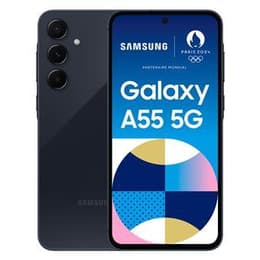


Galaxy A55 Vs Google Pixel 9a

Galaxy A55
Galaxy A55
Starting at

Refurbished price:£193.21

Versus £479.00 new

See options
Google Pixel 9a
Google Pixel 9a
Starting at

Refurbished price:£319.00

Versus £499.00 new

See options

Ratings

The Samsung Galaxy A55, released in March 2024, and the Google Pixel 9A, launched in April 2025, are both prominent smartphones designed to offer a balanced experience for everyday users. While the Galaxy A55 emphasizes a refined design and a versatile camera system, the Pixel 9A focuses on advanced computational photography and extended software support. Both devices operate on the Android platform, providing access to a wide ecosystem of applications and services.

Scores

Durability

When considering the long-term usability of these devices, their release timelines and software support policies are key factors.

  • Release Timeline and Age: The Samsung Galaxy A55 was released in March 2024, making it approximately one year older than the Google Pixel 9A, which launched in April 2025. This difference in release date can influence the practical lifespan, particularly regarding software updates.
  • OS Support Duration: The Google Pixel 9A offers an extensive software commitment, promising seven years of operating system and security updates from its release date [4, 10, 11, 14, 21, 23, 25, 38, 39]. In contrast, the Samsung Galaxy A55 is slated to receive four major Android OS upgrades and five years of security updates [3, 17, 20, 24]. This means the Pixel 9A is designed to remain current with the latest Android features and security patches for a significantly longer period.
  • Durability and Repairability: The Galaxy A55 features Corning Gorilla Glass Victus+ on its front, paired with an aluminum frame and a glass back, contributing to a robust feel [7, 13, 15, 28]. It carries an IP67 rating for dust and water resistance, indicating protection against immersion in up to 1 meter of fresh water for 30 minutes [12, 16]. The Pixel 9A, while also featuring an aluminum frame, uses Corning Gorilla Glass 3 for its display and has a plastic back [1, 2, 4, 14, 22]. It boasts a higher IP68 rating, offering protection against dust and submersion in up to 1.5 meters of fresh water for 30 minutes [1, 2, 8, 14, 26]. Users report the Pixel 9A feels solid despite its plastic back [1].

Year of Release

2024

2025

Compatible with latest Update

Yes

Yes

OS

Android

Android

Foldable

No

No

Performance

Both smartphones are equipped with processors designed for efficient daily operation, though their approaches to performance differ.

  • Processor Capabilities: The Samsung Galaxy A55 is powered by a processor that handles everyday tasks smoothly, including app launching and multitasking [27, 28]. It is capable of running most applications without significant issues, though some users have noted occasional stutters during demanding gaming sessions [28, 32]. The Google Pixel 9A features a processor known for its integration with Google's artificial intelligence features, providing a responsive experience for general use and AI-driven tasks [10, 14, 29]. While it performs well for a mid-range device, it may experience throttling under heavy load, and some games might not consistently achieve the highest frame rates [1, 14].
  • Storage and RAM: The Galaxy A55 offers configurations with 8GB or 12GB of RAM and 128GB or 256GB of internal storage, with the added flexibility of a microSD card slot for expandable storage up to 1TB [5, 7, 9, 15, 18]. The Pixel 9A comes with 8GB of RAM and storage options of 128GB or 256GB, but it does not support expandable storage via a microSD card [4, 6, 10, 11, 21, 22].
  • Overall Responsiveness: Users generally find both devices responsive for typical smartphone activities. The Galaxy A55 provides a smooth user interface experience [28]. The Pixel 9A's performance is often described as adequate for its segment, with daily use feeling comparable to more expensive Pixel models [14].

Memory (GB)

8 GB

8 GB

Screen quality

The display is a primary interaction point, and both devices offer vibrant viewing experiences with distinct characteristics.

  • Display Technology and Clarity: The Samsung Galaxy A55 features a 6.6-inch Super AMOLED display, known for its deep blacks and vibrant colors, offering a Full HD+ resolution (1080x2340 pixels) [5, 7, 9, 13, 15, 28]. The Google Pixel 9A comes with a slightly smaller 6.3-inch pOLED display, also providing a Full HD+ resolution (1080x2424 pixels) [4, 10, 14, 21]. Both technologies deliver clear and sharp visuals for media consumption and daily tasks.
  • Brightness and Outdoor Visibility: The Galaxy A55's display can reach a peak brightness of 1000 nits, ensuring good visibility in various lighting conditions, including outdoors [9, 13, 34]. The Pixel 9A offers higher brightness levels, with up to 1800 nits for HDR content and a peak brightness of 2700 nits, which can be beneficial for outdoor use and HDR viewing [14, 21].
  • Refresh Rate and Smoothness: Both smartphones feature a 120Hz refresh rate, contributing to smoother scrolling and a more fluid visual experience when navigating interfaces or playing compatible content [5, 9, 14, 21].

Resolution

1080 x 2340

2424 x 1080

Audiovisual

Photography is a significant aspect of modern smartphones, and both the Galaxy A55 and Pixel 9A offer capable camera systems with different strengths.

  • Camera System Capabilities: The Samsung Galaxy A55 is equipped with a triple rear camera setup, including a 50-megapixel main sensor with optical image stabilization, a 12-megapixel ultrawide lens, and a 5-megapixel macro lens [7, 13, 15]. Its front camera is a 32-megapixel sensor [7, 9, 15]. The Google Pixel 9A features a dual rear camera system with a 48-megapixel main sensor and a 13-megapixel ultrawide lens, complemented by a 13-megapixel front camera [4, 10, 14, 19].
  • Photography Performance: The Galaxy A55 delivers good photo clarity and vibrant colors in well-lit conditions, with decent performance in low-light scenarios, aided by AI image processing [13, 27, 28, 30, 34]. The Pixel 9A is highly regarded for its computational photography, producing strong photos in most situations, particularly in daylight [1, 14, 19, 29]. While its main sensor is technically smaller than some predecessors, its larger aperture contributes to better low-light capture [19, 29]. However, some users have noted that low-light processing can be slower, and digital zoom performance may be limited [22, 31].
  • Video Recording and Audio: Both devices are capable of recording 4K video at 30 frames per second [15, 28]. User feedback for the Pixel 9A suggests that while its still photography is strong, video quality is considered average, with some reports of shuttering issues at 30fps and stabilization needing improvement in low light [31]. The Galaxy A55's video capabilities are generally considered solid for its segment [28].

Front camera

32 megapixels

13 megapixels

Miscellaneous

Beyond core features, several practical elements contribute to the overall user experience of these smartphones.

  • Connectivity Options: Both the Galaxy A55 and Pixel 9A support 5G connectivity, enabling faster mobile data speeds [4, 9, 11, 15, 33]. The Galaxy A55 includes Wi-Fi 6 and Bluetooth 5.3 [9, 15]. The Pixel 9A offers Wi-Fi 6E, which provides access to the 6GHz band for potentially faster and less congested wireless connections, and Bluetooth 5.3 or 5.4 [4, 11, 21].
  • Ports and Sensors: Both devices utilize a USB Type-C port for charging and data transfer [4, 9, 11, 15]. Neither phone includes a traditional 3.5mm headphone jack. For biometric security, both feature an under-display fingerprint sensor [9, 11, 21]. The Pixel 9A also includes face recognition [2].
  • Dimensions, Weight, and Handling: The Samsung Galaxy A55 measures 161.1 x 77.4 x 8.2 mm and weighs 213g [15]. It features a metal frame and glass back, which users describe as feeling premium and solid [28, 32]. The Google Pixel 9A measures 154.7 x 73.3 x 8.9 mm and weighs 185.9g [4, 14, 21]. Its design includes a matte aluminum frame and a plastic back, which some users find comfortable to hold and resistant to fingerprints [1, 14, 22]. The Pixel 9A's camera module is flatter compared to previous Pixel designs, contributing to a more stable experience when placed on a flat surface [14, 29].

Weight

213 g

186 g

Screen size (in)

6.6

6.3

Mobile network

5G

5G

SIM card

Dual Physical SIM

Physical SIM + eSIM

Carrier compatibility

Unlocked

Unlocked

Connector

USB-C

USB-C

The Samsung Galaxy A55 and Google Pixel 9A each present a compelling package for users seeking a capable smartphone, with distinct strengths catering to different priorities.

For the Galaxy A55, common praise points include its premium design with a glass back and aluminum frame, a vibrant Super AMOLED display, and consistently strong battery life that often lasts over a day of average use [27, 28, 32]. Users also appreciate its versatile camera system, which performs well in various lighting conditions, and the option for expandable storage via microSD [13, 27, 30]. Criticisms sometimes point to occasional performance stutters during intensive gaming and a software update policy that, while good, is not as extended as some competitors [28, 32].

The Google Pixel 9A is frequently lauded for its exceptional battery life, often exceeding a full day of heavy use, and its robust software support, offering seven years of updates [1, 14, 19, 29, 31]. Its computational photography capabilities are a significant highlight, consistently producing high-quality photos, especially in daylight [1, 14, 19]. However, some users note that its video recording quality is not as strong as its still photography, and the use of Gorilla Glass 3 for the display, combined with a plastic back, might be perceived as less premium than the A55's materials [1, 2, 14, 31].

Users prioritizing a device with a premium build, a slightly larger and vibrant display, and the flexibility of expandable storage may find the Samsung Galaxy A55 well-suited to their needs. Conversely, individuals who value an extended software lifespan, superior computational photography, and excellent battery endurance, along with wireless charging, may lean towards the Google Pixel 9A. Both devices offer a solid foundation for daily use, and choosing a quality-assured refurbished option can provide an eco-friendly alternative for either model.


See all articles

Our recent comparisons