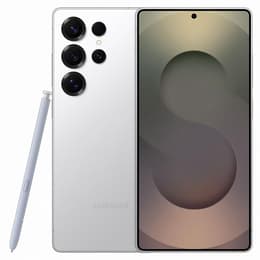
Galaxy A16 5G Vs Galaxy S25 Ultra

Galaxy A16 5G
Galaxy A16 5G
Starting at

Refurbished price:£103.00

Versus £205.87 new

See options
Galaxy S25 Ultra
Galaxy S25 Ultra
Starting at

Refurbished price:£654.00

Versus £1,249.00 new

See options

Ratings

The Samsung Galaxy A16 5G, released in late 2024, and the Samsung Galaxy S25 Ultra, launched in early 2025, represent distinct tiers within Samsung's smartphone lineup. While both operate on the Android platform, the A16 5G is designed for everyday functionality and extended software support, whereas the S25 Ultra is engineered for advanced performance, premium features, and cutting-edge camera capabilities. This comparison will highlight their core differences to help users identify which device best suits their needs, considering quality-assured refurbished options as a sustainable choice.

Scores

Durability

When evaluating the longevity of these devices, several factors come into play, including their release timelines, software support, and physical durability.

  • Release Timeline and Software Support: The Galaxy A16 5G, released in late 2024, is promised six years of major operating system and security updates, extending its support until October 2030. The Galaxy S25 Ultra, launched in early 2025, offers an even longer commitment with seven years of OS and security updates, ensuring support well into 2032. This difference means the S25 Ultra will receive software enhancements for an additional year compared to the A16 5G.
  • Physical Durability: The Galaxy A16 5G features an IP54 rating, providing protection against dust and splashes of water, and is constructed with a plastic back and frame. In contrast, the Galaxy S25 Ultra boasts an IP68 rating, signifying higher resistance to dust and water immersion, and incorporates a titanium frame and Corning Gorilla Armor 2 for enhanced screen protection.
  • Repairability: The Galaxy A16 5G generally receives an average repairability assessment, with some sources giving it an 8.0 out of 10, noting accessible battery with pull tabs. The Galaxy S25 Ultra, while a flagship, has improved repairability over previous generations, earning a provisional iFixit score of 5 out of 10, or 8.5 out of 10 from another source, partly due to easier battery replacement and modular camera components.

Year of Release

2024

2025

Compatible with latest Update

Yes

Yes

OS

Android

Android

Foldable

No

No

Performance

The performance capabilities of these two smartphones cater to different user demands, primarily influenced by their internal processing power and memory configurations.

  • Processing Power: The Galaxy A16 5G is equipped with an octa-core processor, such as the Exynos 1330 or MediaTek Dimensity 6300, which capably handles everyday tasks like web browsing, social media, and light multitasking. The Galaxy S25 Ultra, on the other hand, integrates a high-end processor, such as the Qualcomm Snapdragon 8 Elite, designed for demanding applications, intensive gaming, and advanced AI features, ensuring smooth operation even under heavy loads.
  • Memory and Storage: The A16 5G typically comes with 4GB, 6GB, or 8GB of RAM and offers 128GB or 256GB of internal storage, expandable up to 1.5TB via microSD, providing ample space for most users. The S25 Ultra features more substantial RAM options, including 12GB or 16GB, paired with faster UFS 4.0 storage ranging from 256GB to 1TB, which supports seamless multitasking and rapid data access for professional use cases.
  • Battery Behavior: Both devices house a 5000mAh battery. The A16 5G provides reliable power for a full day of moderate use, with a streaming test showing nearly 14 hours of video playback. The S25 Ultra, despite its powerful components, is optimized for efficient power consumption, offering extended usage for its class and supporting faster 45W wired and 25W wireless charging.

Memory (GB)

4 GB

12 GB

Screen quality

The visual experience on these two Samsung smartphones differs significantly, primarily due to their display technologies and specifications.

  • Display Technology and Clarity: The Galaxy A16 5G features a 6.7-inch Super AMOLED display with Full HD+ resolution (1080 x 2340 pixels), offering vibrant colors and good contrast for everyday viewing. The Galaxy S25 Ultra sports a larger 6.9-inch Dynamic LTPO AMOLED 2X display with a sharper Quad HD+ resolution (3120 x 1440 pixels), providing exceptional detail and clarity, making individual pixels virtually indistinguishable.
  • Brightness and Refresh Rate: The A16 5G has a 90Hz refresh rate for smoother scrolling and a peak brightness of around 800 nits, which performs well indoors but can be challenging in direct sunlight. The S25 Ultra offers an adaptive refresh rate that dynamically adjusts from 1Hz to 120Hz for optimal smoothness and power efficiency, alongside an impressive peak brightness of up to 2600 nits, ensuring excellent visibility even in bright outdoor conditions.
  • Protection and Features: The S25 Ultra's display is protected by Corning Gorilla Armor 2, which also features an anti-reflective coating to reduce glare, enhancing the viewing experience. It also boasts thinner bezels and supports HDR10+ for a more immersive media consumption experience.

Resolution

1080 x 2340

1440x3120

Audiovisual

The camera systems on the Galaxy A16 5G and Galaxy S25 Ultra are designed for different levels of photographic ambition and capability.

  • Rear Camera Systems: The Galaxy A16 5G includes a triple-camera setup with a 50MP main sensor, a 5MP ultrawide lens, and a 2MP macro lens, suitable for capturing basic photos in good lighting conditions. The Galaxy S25 Ultra features a comprehensive quad-camera system, highlighted by a 200MP main sensor with optical image stabilization (OIS), a 50MP ultrawide lens, a 10MP telephoto lens with 3x optical zoom, and a 50MP periscope telephoto lens offering 5x optical zoom and up to 100x space zoom.
  • Photography and Video Features: The A16 5G records video at Full HD (1080p) at 30 frames per second, utilizing electronic image stabilization (EIS) for video, but lacks OIS on its main camera, which can affect low-light performance. The S25 Ultra supports 8K video recording at 30 frames per second across multiple lenses, features advanced OIS on its main and telephoto lenses, and incorporates a ProVisual Engine with AI enhancements for superior image processing, especially in challenging lighting.
  • Front Camera and Audio: For selfies, the A16 5G has a 13MP front camera, capable of 1080p video recording. The S25 Ultra offers a 12MP front camera with advanced features like Dual-Pixel autofocus and 4K video recording. The S25 Ultra also provides stereo speakers tuned by AKG for a richer audio experience, while the A16 5G typically features a single bottom-firing speaker.

Front camera

13 megapixels

12

Miscellaneous

Beyond the core specifications, several practical elements differentiate the user experience between these two Samsung smartphones.

  • Connectivity and Ports: Both devices support 5G connectivity. The Galaxy A16 5G includes Wi-Fi 5 (802.11ac) and Bluetooth 5.3, with a USB Type-C port for charging and data transfer. The Galaxy S25 Ultra steps up with Wi-Fi 7 and Bluetooth 5.4, along with Ultra-Wideband (UWB) support, and a high-speed USB-C port.
  • Biometric Security and Design: The A16 5G features a side-mounted fingerprint sensor for convenient unlocking. The S25 Ultra incorporates an ultrasonic in-display fingerprint sensor, offering a more integrated and advanced security solution. The S25 Ultra also includes the signature S Pen stylus, housed within the device, though its Bluetooth capabilities have been removed in this iteration.
  • Build Materials and Dimensions: The Galaxy A16 5G has a plastic construction, measuring 164.4 x 77.9 x 7.9mm and weighing 200g. The S25 Ultra features a more premium build with a titanium frame and Gorilla Armor 2 glass, with dimensions of 162.8 x 77.6 x 8.2mm and a weight of 218g, offering a more robust and refined feel.

Weight

200 g

233 g

Screen size (in)

6.7

6.9

Mobile network

5G

5G

SIM card

Dual Physical SIM

Dual Physical SIM + eSIM

Carrier compatibility

Unlocked

Unlocked

Connector

USB-C

USB-C

User feedback for the Galaxy A16 5G often praises its long software support, reliable battery life, and vibrant Super AMOLED display for its category. Common criticisms point to its modest processor performance for demanding tasks and limited camera capabilities, especially in low light. Users generally find it a practical device for essential smartphone functions and extended use without frequent charging.

The Galaxy S25 Ultra receives acclaim for its exceptional display brightness and clarity, powerful performance for any task, and its versatile, high-resolution camera system. The integrated S Pen and advanced AI features are also frequently highlighted as significant advantages. Some users note that while repairability has improved, it still presents challenges compared to some competitors.

Users prioritizing extended software longevity, robust battery life, and a clear display for everyday communication and media consumption will find the Galaxy A16 5G a suitable option. It caters well to those who value practicality and long-term usability without needing top-tier performance or advanced photographic features. Conversely, users who require cutting-edge performance for intensive applications, professional-grade photography and videography, and a premium viewing experience will find the Galaxy S25 Ultra better aligned with their needs. Its advanced features and superior build quality are designed for power users and creative professionals.

For those seeking either of these devices, exploring quality-assured refurbished options can provide a sustainable and informed purchasing decision.

See all articles

Our recent comparisons