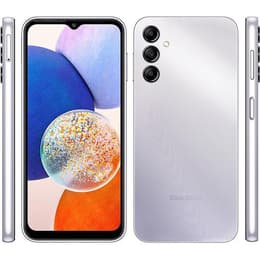
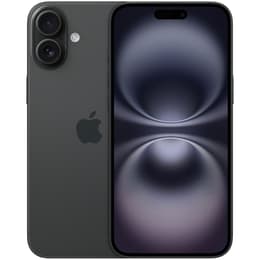

Galaxy A14 Vs iPhone 16 Plus

Galaxy A14
Galaxy A14
Starting at

Refurbished price:£81.00

Versus £269.00 new

See options
iPhone 16 Plus
iPhone 16 Plus
Starting at

Refurbished price:£503.46

Versus £799.00 new

See options

Ratings

The Samsung Galaxy A14, released in early 2023, and the Apple iPhone 16 Plus, launched in late 2024, represent distinct approaches to smartphone design and functionality. While both devices offer a comprehensive mobile experience, they cater to different user expectations through their operating systems, core capabilities, and overall feature sets. The Galaxy A14 operates on Android, emphasizing user customization and expandable storage, whereas the iPhone 16 Plus runs on iOS, focusing on integrated performance and a streamlined ecosystem.

Scores

Durability

When considering the long-term usability of these devices, their respective release timelines and software support policies are key differentiators.

  • Software Longevity: The Samsung Galaxy A14, launched with Android 13, is expected to receive two major Android OS updates, extending its software support to Android 15, along with four years of security updates until 2027. In contrast, the iPhone 16 Plus, running on iOS 18, benefits from Apple's typically longer software support, with users anticipating updates for 5-7 years, potentially until 2031.
  • Repairability: The Galaxy A14 has a notable repairability score of 8 out of 10, attributed to its relatively easy disassembly, battery with adhesive pull tabs, and camera lenses that can be replaced without extensive teardown. The iPhone 16 Plus has also seen significant improvements in repairability, earning an iFixit score of 7 out of 10, thanks to a new battery adhesive that debonds with an electrical current, a hard-cased battery, and easier access to internal components from both the front and back.
  • Practical Lifespan: Both devices are designed for durability, but the iPhone 16 Plus's extended software support and premium build materials, including a Ceramic Shield front, suggest a slightly longer practical lifespan for users who prioritize the latest software features and robust construction. The Galaxy A14 offers a solid lifespan for its segment, particularly for those who value user-serviceability.

Year of Release

2023

2024

Compatible with latest Update

No

Yes

Foldable

No

No

Performance

The performance capabilities of the Galaxy A14 and iPhone 16 Plus reflect their different design philosophies, impacting how smoothly they handle various tasks.

  • Everyday Responsiveness: The Samsung Galaxy A14 provides solid performance for daily tasks such as browsing, social media, and light applications. However, users may notice occasional lags or stutters when navigating the interface or running more demanding applications and games. The iPhone 16 Plus, powered by its advanced A18 chipset, delivers consistently fluid performance across all applications, handling intensive multitasking, graphic-heavy games, and complex AI features with ease and efficiency.
  • Multitasking and Storage: With RAM options typically ranging from 4GB to 8GB, the Galaxy A14 is suitable for moderate multitasking, though keeping many apps open simultaneously might lead to slower transitions. It offers 64GB or 128GB of internal storage, significantly expandable via a microSD card up to 1TB, providing ample space for media and documents. The iPhone 16 Plus comes with 8GB of RAM, ensuring seamless multitasking and quick app switching. Its storage options range from 128GB to 512GB, but it does not offer expandable storage.
  • Battery Behavior: The Galaxy A14 features a 5000 mAh battery, which generally provides good endurance, often lasting a full day or more with moderate usage. The iPhone 16 Plus, with its 4674 mAh battery and efficient A18 chip, offers excellent battery life, rated for up to 27 hours of video playback and 100 hours of audio, often exceeding a full day of heavy use.

Memory (GB)

4 GB

8 GB

Screen quality

The visual experience on both devices is shaped by their display technologies and specifications, influencing clarity, brightness, and overall viewing pleasure.

  • Display Technology and Clarity: The Samsung Galaxy A14 features a 6.6-inch PLS LCD display with a Full HD+ resolution of 1080 x 2408 pixels. This provides clear visuals for everyday content consumption. The iPhone 16 Plus boasts a 6.7-inch Super Retina XDR OLED display with a resolution of 2796 x 1290 pixels, resulting in sharp images, deep blacks, and vibrant colors due to its OLED technology.
  • Brightness and Refresh Rate: The Galaxy A14's LCD panel offers adequate brightness for indoor use, though it can be challenging to view comfortably in direct sunlight. The 5G variant supports a 90Hz refresh rate for smoother scrolling, while the 4G model is limited to 60Hz. The iPhone 16 Plus provides high brightness levels, reaching 1000 nits typical and up to 2000 nits peak for outdoor viewing, ensuring excellent visibility even in bright conditions. However, its display maintains a standard 60Hz refresh rate.
  • Viewing Experience: Users prioritizing a larger, more immersive screen for general media consumption and a smoother scrolling experience (on the 5G model) might find the Galaxy A14 suitable. For those who value superior contrast, color accuracy, and exceptional outdoor visibility, the iPhone 16 Plus offers a more premium viewing experience.

Resolution

1080 x 2408

1290 x 2796

Screen type

PLS LCD

Super Retina XDR OLED

Audiovisual

The camera systems on the Galaxy A14 and iPhone 16 Plus offer different capabilities for capturing photos and videos, catering to varying photography needs.

  • Photography Performance: The Samsung Galaxy A14 is equipped with a triple rear camera setup, featuring a 50-megapixel main sensor, complemented by 2-megapixel macro and depth sensors. Some models also include a 5-megapixel ultrawide lens. It performs well in bright daylight, capturing decent detail, but struggles in low-light conditions due to the absence of optical image stabilization and a dedicated night mode. The iPhone 16 Plus features an advanced dual-camera system with a 48-megapixel Fusion Main camera (with sensor-shift optical image stabilization and a 2x telephoto effect through cropping) and a 12-megapixel Ultra Wide camera. It excels in various lighting conditions, including low light, and offers advanced computational photography features.
  • Video Recording: The Galaxy A14 supports video recording up to 1080p at 30 frames per second from both its front and rear cameras, lacking advanced stabilization features. The iPhone 16 Plus offers high-quality video recording up to 4K with Dolby Vision at various frame rates, along with features like Cinematic mode and Action mode, providing superior stability and detail. Its vertical camera alignment also enables Spatial Video recording.
  • Audio Quality: For calls and media, the Galaxy A14 provides functional microphone quality and a mono speaker output. The iPhone 16 Plus offers clear microphone quality for calls and recordings, coupled with a more robust stereo speaker setup for an enhanced media consumption experience.

Main camera

50 megapixels

48 megapixels

Front camera

13 megapixels

12 megapixels

Miscellaneous

Beyond core features, several practical elements distinguish the Galaxy A14 and iPhone 16 Plus, impacting daily convenience and user interaction.

  • Connectivity and Ports: The Samsung Galaxy A14 supports 5G connectivity (on its 5G variant), Wi-Fi 5 (802.11 a/b/g/n/ac), and Bluetooth 5.1 or 5.2. It includes a USB-C port for charging and data transfer, notably retaining a 3.5mm headphone jack. The iPhone 16 Plus offers advanced connectivity with 5G (sub-6 GHz and mmWave), Wi-Fi 7 (802.11be), and Bluetooth 5.3. It features a USB-C port but omits the traditional 3.5mm headphone jack.
  • Security and Interaction: The Galaxy A14 incorporates a side-mounted fingerprint sensor for secure unlocking. The iPhone 16 Plus relies on Face ID for biometric authentication and introduces an Action button, which can be customized for quick access to various functions.
  • Design and Build: The Galaxy A14 features a plastic build, contributing to its lighter feel and generally larger dimensions (167.7 x 78 x 9.1 mm, 201g). The iPhone 16 Plus, with its premium materials and Ceramic Shield front, has dimensions of 160.9 x 77.8 x 7.8 mm and weighs 199g, offering a more compact and dense feel.

Weight

201 g

199 g

Screen size (in)

6.6

6.7

Mobile network

4G

5G

SIM card

Dual Physical SIM

Physical SIM + eSIM

Carrier compatibility

Unlocked

Unlocked

The Samsung Galaxy A14 and iPhone 16 Plus cater to distinct user preferences, each excelling in different areas based on common user feedback and design intentions. Users often praise the Galaxy A14 for its exceptional battery life, large display, and the practical inclusion of a 3.5mm headphone jack and expandable storage. Criticisms frequently point to its LCD screen being less vibrant and sometimes dim outdoors, as well as performance that can occasionally stutter with demanding applications.

Conversely, the iPhone 16 Plus receives acclaim for its powerful performance, outstanding camera capabilities, and the premium feel of its design. Its long-term software support is also a significant advantage. However, some users note the absence of a high refresh rate display, the lack of expandable storage, and the omission of a headphone jack as areas for improvement.

Users prioritizing extensive battery life, a large screen for media, and the flexibility of expandable storage and a headphone jack may find the Samsung Galaxy A14 well-suited to their needs. It represents a practical and accessible choice for everyday communication and content consumption. On the other hand, users who value top-tier performance, a highly capable camera system, a vibrant OLED display, and a longer software support lifespan will likely lean towards the iPhone 16 Plus. This device is ideal for those seeking a premium, integrated experience with robust security and advanced features.

For those considering either device, exploring quality-assured refurbished options can provide an eco-friendly alternative, offering access to these technologies while supporting sustainable consumption.

See all articles

Our recent comparisons