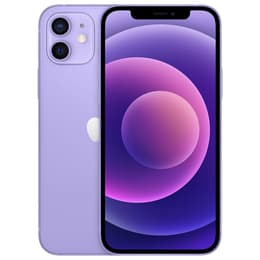
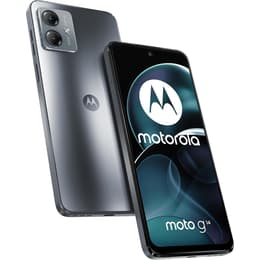
iPhone 12 Vs Motorola Moto G14

iPhone 12
iPhone 12
Starting at

Refurbished price:£139.00

Versus £649.00 new

See options
Motorola Moto G14
Motorola Moto G14
Starting at

Refurbished price:£91.24

Versus £139.99 new

See options

Ratings

The iPhone 12, released in October 2020, and the Motorola Moto G14, launched in August 2023, represent distinct approaches to smartphone design and functionality. While the iPhone 12 operates on Apple's iOS ecosystem, the Moto G14 runs on Android, offering users different software experiences. Key differentiators between these two devices include their display technologies, camera capabilities, and overall performance profiles, catering to varied user preferences.

Scores

Durability

When considering the long-term usability of these devices, their release timelines and software support are significant factors. The iPhone 12, being an older model, has already received several major iOS updates, while the Moto G14, a more recent release, benefits from newer Android versions.

  • Software Longevity: The iPhone 12, originally shipping with iOS 14, has continued to receive updates, with support extending to iOS 26.3.1 (a) as of March 2026, indicating a long software support cycle typical for Apple devices. The Motorola Moto G14 launched with Android 13 and is expected to receive one major Android update to Android 14, along with three years of security updates.
  • Physical Durability: The iPhone 12 features a Ceramic Shield front cover, designed to offer enhanced drop performance, and boasts an IP68 rating for water and dust resistance, allowing submersion up to 6 meters for 30 minutes. The Moto G14 has a water-repellent design, with some sources indicating an IP52 rating for splash resistance, offering protection against light splashes but not full submersion.
  • Expected Lifespan: Users prioritizing extended software support and robust water and dust protection may find the iPhone 12 offers a longer practical lifespan in terms of feature updates and resilience to environmental factors. The Moto G14, while newer, has a more limited commitment to major OS updates.

Year of Release

2020

2023

Compatible with latest Update

Yes

Yes

OS

iOS

Android

Foldable

No

No

Performance

The performance of a smartphone is central to its daily user experience, encompassing everything from app responsiveness to multitasking efficiency and battery endurance. These two devices offer different performance characteristics based on their internal components.

  • Processing Power: The iPhone 12 is equipped with a powerful processor that handles demanding applications and multitasking smoothly, providing a responsive user experience for gaming, video editing, and complex tasks. The Moto G14 features a processor that delivers acceptable performance for general app usage and casual gaming, though it may show limitations with more intensive applications or heavy multitasking.
  • Battery Behavior: The Moto G14 is known for its substantial 5000 mAh battery, which typically provides extended usage, often lasting through a full day or more for many users. The iPhone 12, while having a smaller battery capacity, is optimized for efficient power consumption within its ecosystem, offering reliable daily battery life for typical usage patterns.
  • Storage and Responsiveness: The iPhone 12 is available with storage options of 64GB, 128GB, and 256GB, impacting how much content can be stored directly on the device. The Moto G14 comes with 128GB of internal storage and offers the flexibility of expandable storage via a microSD card, which can be beneficial for users with large media libraries.

Memory (GB)

4 GB

4 GB

Screen quality

The display is a primary interface for smartphone interaction, and the quality of the screen significantly influences the viewing experience for media consumption, browsing, and daily tasks. Both devices offer different display technologies and characteristics.

  • Display Technology and Clarity: The iPhone 12 features a 6.1-inch Super Retina XDR OLED display, known for its deep blacks, vibrant colors, and high contrast ratio, providing an immersive visual experience. The Moto G14 utilizes a 6.5-inch IPS LCD display, which offers good color reproduction and viewing angles, suitable for everyday content consumption.
  • Resolution and Brightness: The iPhone 12's OLED panel has a resolution of 2532 x 1170 pixels at 460 ppi, delivering sharp images and text, with a typical brightness of 625 nits and peak brightness of 1200 nits for HDR content. The Moto G14 offers a Full HD+ resolution of 2400 x 1080 pixels at 405 ppi, providing clear visuals, though its brightness levels are generally lower than the iPhone 12's OLED panel.
  • Refresh Rate and Viewing Experience: Both devices feature a standard 60Hz refresh rate, which provides a smooth experience for most daily interactions. The iPhone 12's OLED display, with its superior contrast and color accuracy, enhances the viewing of photos and videos, especially those with HDR. The Moto G14's larger screen size offers a more expansive canvas for media, which can be appealing for users who prioritize screen real estate.

Resolution

1170 x 2532

1080 x 2400

Screen type

Super Retina XDR OLED

IPS LCD

Audiovisual

Camera capabilities are a significant consideration for many smartphone users, influencing how they capture memories and interact with their surroundings. These two phones offer different camera setups and features.

  • Rear Camera Systems: The iPhone 12 is equipped with a dual 12MP camera system, including a wide-angle lens with a f/1.6 aperture and an ultra-wide lens with a f/2.4 aperture. It excels in various lighting conditions, offering features like Night mode, Deep Fusion, and Smart HDR 3 for detailed and well-exposed photos. The Moto G14 features a dual-camera setup with a 50MP main sensor (f/1.8) and a 2MP macro lens (f/2.4). The 50MP main sensor can capture detailed images in good lighting, utilizing Quad Pixel technology for improved light sensitivity.
  • Photography Features: The iPhone 12 offers advanced computational photography, including Portrait mode with Depth Control and Portrait Lighting, enhancing creative control over images. Its low-light performance is strong across both rear lenses. The Moto G14 includes features like Night Vision and Portrait mode, providing options for various shooting scenarios, though its low-light performance may not match the iPhone 12.
  • Video Recording and Audio: The iPhone 12 supports HDR video recording with Dolby Vision up to 4K at 30 frames per second, and standard 4K video at 60 frames per second, offering high-quality video capture with cinematic stabilization. The Moto G14 records video at Full HD (1080p) at 30 frames per second. For audio, the Moto G14 features stereo speakers with Dolby Atmos support, providing an enhanced audio experience for media consumption. The iPhone 12 also offers quality audio output and recording.

Main camera

12 megapixels

50 megapixels

Front camera

12 megapixels

8 megapixels

Miscellaneous

Beyond core specifications, various practical elements contribute to the overall user experience, including connectivity, physical design, and additional features.

  • Connectivity and Ports: The iPhone 12 supports 5G cellular connectivity, Wi-Fi 6 (802.11ax), and Bluetooth 5.0, offering fast wireless speeds and efficient connections. It uses a Lightning port for charging and data transfer. The Moto G14 supports 4G LTE, Wi-Fi 5 (802.11ac), and Bluetooth 5.0. It features a USB-C port for charging and data, and notably includes a 3.5mm headphone jack, which is absent on the iPhone 12.
  • Biometric Security and Sensors: The iPhone 12 relies on Face ID for secure facial recognition and authentication. The Moto G14 incorporates a side-mounted fingerprint sensor for convenient unlocking. Both devices include standard sensors like accelerometers, gyroscopes, and ambient light sensors for various functionalities.
  • Design and Handling: The iPhone 12 features a compact design with flat edges, an aerospace-grade aluminum frame, and a glass back, weighing 164 grams. The Moto G14 has a slightly larger form factor, weighing 177 grams, with a plastic frame and a choice of plastic or vegan leather back, offering a different in-hand feel.

Weight

164 g

177 g

Width

7.15 cm

7,38 cm

Height

14.67 cm

16,15 cm

Depth

0.74 cm

0,8 cm

Screen size (in)

6.1

6.5

Mobile network

5G

4G

SIM card

Physical SIM + eSIM

Dual Physical SIM

Carrier compatibility

Unlocked

Unlocked

Connector

Lightning

USB-C + Jack 3.5mm

The iPhone 12 and Motorola Moto G14 cater to different user priorities, reflecting their respective ecosystems and design philosophies. User feedback for the iPhone 12 often praises its consistent performance, high-quality OLED display, and advanced camera capabilities, particularly its video recording features and low-light photography. Common criticisms sometimes point to its battery life compared to some Android counterparts, though it generally provides a full day of use. For the Moto G14, users frequently commend its long-lasting battery, large display, and the inclusion of a 3.5mm headphone jack. Some feedback suggests that its performance can be modest for demanding tasks, and its camera performance in challenging lighting conditions may not be as refined as higher-end devices.

Users prioritizing a premium build, a compact form factor, a vibrant OLED display, and advanced camera features with extensive software support will find the iPhone 12 well-suited to their needs. Its robust ecosystem and strong performance make it a reliable choice for those invested in Apple's services. Conversely, individuals who value a larger screen, exceptional battery life, expandable storage, and the flexibility of the Android operating system, along with a traditional headphone jack, may lean towards the Motorola Moto G14. This device is a practical option for everyday communication and media consumption. Both models are available as quality-assured refurbished options, providing an eco-friendly alternative for consumers.
See all articles

Our recent comparisons