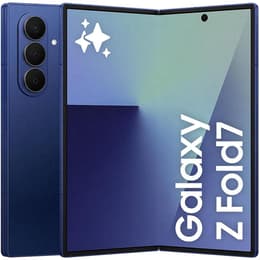

Galaxy Z Fold4 Vs Galaxy Z Fold7

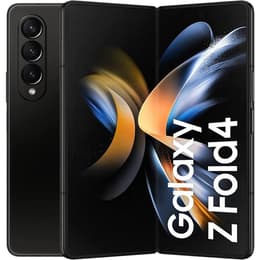
Galaxy Z Fold4
Galaxy Z Fold4
Starting at

Refurbished price:£352.00

Versus £1,889.00 new

See options
Galaxy Z Fold7
Galaxy Z Fold7
Starting at

Refurbished price:£916.00

Versus £1,799.00 new

See options

Ratings

The Samsung Galaxy Z Fold4 (released in August 2022) and the Samsung Galaxy Z Fold7 (released in July 2025) represent different generations of Samsung's foldable smartphone line. While both offer the unique book-style folding design, the Z Fold7 introduces significant advancements in durability, display technology, and internal performance, building upon the foundation laid by its predecessor. Both devices operate on the Android platform, offering a consistent software experience with Samsung's One UI.

Scores

Durability

The longevity of a foldable device is a key consideration, encompassing both physical resilience and software support. The Galaxy Z Fold7 marks a substantial leap in expected lifespan compared to the Z Fold4.

  • Software Support: The Galaxy Z Fold4, launched with Android 12L, was eligible for four major Android OS updates and five years of security patches. In contrast, the Galaxy Z Fold7, shipping with Android 16, benefits from Samsung's extended policy, promising seven years of Android OS upgrades and security updates, extending its practical software lifespan significantly.
  • Physical Durability: The Z Fold4 featured an IPX8 water resistance rating, but lacked official dust resistance. Its hinge was rated for approximately 200,000 folds. The Z Fold7 introduces an IP48 rating, adding a degree of dust protection, and boasts a redesigned Armor FlexHinge with dust-protective brushes. Its foldable display is rated for up to 500,000 folds, a 2.5x improvement, achieved through a 50% thicker Ultra Thin Glass and a new shock-resistant structure.
  • Repairability: While specific repairability scores can vary, the Z Fold7's enhanced hinge and display construction aim to reduce common points of failure seen in earlier foldable generations, potentially leading to fewer hardware-related issues over its extended lifespan. Users of the Z Fold4 occasionally reported issues with the inner screen or hinge over time.

Year of Release

2022

2025

Compatible with latest Update

Yes

Yes

OS

Android

Android

Foldable

Yes

Yes

Performance

Performance is a critical aspect for devices designed for multitasking and demanding applications. The three-year gap between these models brings notable generational improvements in processing power and system responsiveness.

  • Processing Power: The Galaxy Z Fold4 is powered by a capable processor that handles everyday tasks, demanding applications, and gaming smoothly. The Galaxy Z Fold7 features a newer, custom-tuned processor designed for Galaxy devices, offering a significant boost in raw performance. This translates to faster app loading, more fluid multitasking, and enhanced capabilities for intensive tasks like advanced gaming and on-device AI features.
  • Multitasking and Responsiveness: Both devices are designed for efficient multitasking, leveraging their large internal displays. The Z Fold7's more advanced processor and potentially optimized software contribute to a more responsive overall user experience, especially when running multiple applications simultaneously or switching between them frequently.
  • Storage and Memory: Both models offer 12GB of RAM in their standard configurations, with the Z Fold7 also providing a 16GB RAM option for its highest storage variant, which can benefit users who frequently engage in very heavy multitasking or run memory-intensive applications. Both come with various storage options, typically starting from 256GB.

Memory (GB)

12 GB

12 GB

Screen quality

The display experience is central to a foldable phone, and both the Z Fold4 and Z Fold7 offer expansive, high-quality screens, though the newer model brings refinements.

  • Display Technology and Size: Both devices feature Dynamic AMOLED 2X displays for vibrant colors and deep blacks. The Z Fold4 has a 7.6-inch main foldable display and a 6.2-inch cover screen. The Z Fold7 expands on this with an 8.0-inch main display and a larger 6.5-inch cover screen, offering a more expansive viewing area.
  • Resolution and Brightness: The Z Fold4's main display has a resolution of 2176 x 1812 pixels, while its cover screen is 2316 x 904 pixels. The Z Fold7 features a main display resolution of 2184 x 1968 pixels and a cover screen of 2520 x 1080 pixels, providing sharper visuals. The Z Fold7 also boasts a significantly higher peak brightness of 2,600 nits on both screens, compared to the Z Fold4's peak brightness, improving outdoor visibility.
  • Refresh Rate and Aspect Ratio: Both models offer a 120Hz adaptive refresh rate on both their main and cover displays for smooth scrolling and responsive interactions. The Z Fold7's cover screen adopts a wider 21:9 aspect ratio, making it feel more like a traditional smartphone when folded, a notable change from the Z Fold4's narrower cover display.

Resolution

1812 x 2176

1968 x 2184

Audiovisual

Camera capabilities have seen substantial upgrades across generations of Samsung's foldable devices, with the Z Fold7 featuring a more advanced system.

  • Rear Camera System: The Galaxy Z Fold4 features a triple rear camera setup with a 50MP main sensor, a 12MP ultrawide lens, and a 10MP telephoto lens with 3x optical zoom. The Galaxy Z Fold7 significantly upgrades the main sensor to 200MP with a wider aperture, alongside a 12MP ultrawide and a 10MP telephoto lens with 3x optical zoom. This higher resolution main sensor on the Z Fold7 allows for greater detail and flexibility in cropping.
  • Low-Light and Video Performance: Both devices offer good low-light performance, with the Z Fold7 benefiting from its larger main sensor and advanced image processing (ProVisual Engine) for improved clarity and detail in challenging lighting conditions. Both can record video at up to 8K resolution at 24 frames per second.
  • Front and Under-Display Cameras: The Z Fold4 includes a 10MP cover camera and a 4MP under-display camera (UDC) on the main screen, which is primarily suited for video calls. The Z Fold7 replaces the UDC with a 10MP hole-punch camera on the main display and retains a 10MP cover camera, offering more consistent selfie quality across both front-facing options.

Miscellaneous

Beyond core specifications, several practical elements differentiate these two foldable smartphones, impacting daily usability and connectivity.

  • Design and Handling: The Galaxy Z Fold4 weighs 263g and has a folded thickness of 15.8-14.2mm. The Galaxy Z Fold7 is noticeably lighter at 215g and significantly thinner, measuring 8.9mm when folded and 4.2mm when unfolded. This reduction in weight and thickness makes the Z Fold7 more comfortable to hold and carry, feeling more like a traditional smartphone when closed.
  • Connectivity Standards: Both devices support 5G connectivity. The Z Fold4 features Wi-Fi 6 (802.11ax) and Bluetooth 5.2. The Z Fold7 upgrades to Wi-Fi 6E (802.11ax/be) and Bluetooth 5.4, offering potentially faster and more stable wireless connections. Both utilize a USB Type-C port for charging and data transfer.
  • Sensors and Features: Both include essential sensors like fingerprint scanners (side-mounted), accelerometers, and gyroscopes. The Z Fold7, however, has removed S Pen support, which was a feature on the Z Fold4, a point of contention for some users who valued the stylus functionality on the large inner display.

Weight

263 g

187 g

Screen size (in)

7.6

8

Mobile network

5G

5G

SIM card

Dual Physical SIM + eSIM

Dual Physical SIM + eSIM

Carrier compatibility

Unlocked

Unlocked

The Samsung Galaxy Z Fold4 and Z Fold7 both offer a compelling foldable experience, but the Z Fold7 represents a significant evolution in the series. Users generally praised the Z Fold4 for its innovative form factor, robust multitasking capabilities, and improved camera system compared to its direct predecessor. However, common criticisms included its weight, thickness, and concerns about the long-term durability of the inner screen and hinge, with some users experiencing issues over time.

The Z Fold7 addresses many of these points, earning praise for its much thinner and lighter design, substantially enhanced physical durability with a higher fold rating and dust resistance, and a significantly upgraded main camera. The extended software support policy also makes it a more future-proof device. However, some users have noted that despite the same battery capacity, the Z Fold7's battery life can be merely adequate for heavy use, and the removal of S Pen support was a drawback for some.

For users prioritizing the latest advancements in foldable technology, including a more refined design, superior camera performance, and extended software longevity, the Galaxy Z Fold7 is the more suitable choice. Its enhanced durability features also make it a more robust option for daily use. Conversely, individuals who value S Pen functionality and are content with slightly older, yet still capable, hardware might find the Galaxy Z Fold4 sufficient for their needs. Both models offer the unique productivity and entertainment benefits of a foldable, and considering a quality-assured refurbished option for either device can be an eco-friendly alternative.


See all articles

Our recent comparisons