
Compare models
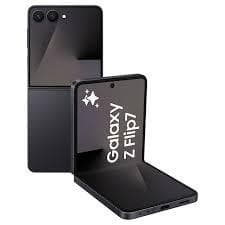
Galaxy A56 Vs Galaxy Z Flip7
- 1-year minimum warranty
- Free delivery on all items
- Free 30-day returns
Differences at a glance
The Samsung Galaxy A56 (2025) and the Samsung Galaxy Z Flip7 (2025) represent two entirely different approaches to modern smartphone engineering. While the Galaxy A56 follows a traditional slate form factor focused on everyday utility, the Galaxy Z Flip7 introduces a clamshell foldable design with a compact pocket footprint. Both devices run on Android with Samsung's customized interface, offering distinct form factors tailored to different user preferences.
Available Models
Colour
Storage
Scores
Durability
Both smartphones provide robust long-term software support and modern durability features, though their physical construction creates different handling considerations.
- Software longevity: Both devices receive multi-year operating system upgrades and security patches, ensuring up-to-date software environments throughout their functional lifespans.
- Build and structural resilience: The Galaxy A56 features a standard slate body with glass and metal materials paired with water resistance, whereas the Galaxy Z Flip7 incorporates a flexible inner display and a folding hinge mechanism that requires careful handling against drops.
- Expected practical lifespan: Traditional slate devices like the Galaxy A56 generally offer predictable long-term hardware durability, while foldable devices like the Galaxy Z Flip7 involve specialized screen care over years of daily folding actions.
Year of Release
2025
2025
Compatible with latest Update
Yes
Yes
OS
Android
Android
Foldable
No
Yes
Performance
System capabilities and power distribution vary significantly, reflecting the differing hardware tiers of a traditional mid-range device versus a compact foldable flagship.
- Multitasking and processing: The Galaxy A56 handles everyday communication, media streaming, and standard apps smoothly, while the Galaxy Z Flip7 provides higher-tier processing headroom for intensive gaming and demanding multi-window workflows.
- Battery behavior: The Galaxy A56 utilizes a larger standard cell to comfortably sustain a full day of standard use, whereas the Galaxy Z Flip7 balances a more compact physical battery with power-efficient components that support typical daily routines.
- Storage configurations: The Galaxy A56 offers standard internal storage capacities suitable for general media collections, while the Galaxy Z Flip7 provides larger base configurations to accommodate extensive app libraries and high-resolution media files.
Screen quality
Visual output and display versatility differ noticeably, contrasting a expansive flat viewing area with a dual-screen folding configuration.
- Display technology: The Galaxy A56 features a flat, vibrant Super AMOLED panel with high refresh rate support, while the Galaxy Z Flip7 deploys a foldable main display complemented by an expansive outer cover screen for quick interactions.
- Outdoor visibility: Both models achieve high peak brightness levels to maintain clear legibility and contrast under bright sunlight conditions.
- Viewing experience: Users watching widescreen video or reading documents will find an uninterrupted flat surface on the Galaxy A56, whereas the Galaxy Z Flip7 offers unique viewing angles and self-supporting tabletop placement using its folding hinge.
Resolution
1080x2340
1080x2520
Audiovisual
Media capture and audio output setups cater to different photography habits and content consumption preferences.
- Camera systems: The Galaxy A56 features a reliable triple-lens rear array including a primary, ultra-wide, and macro sensor, while the Galaxy Z Flip7 utilizes a dual rear camera system that leverages its foldable design for unique angles and hands-free tripod-style framing.
- Low-light and video capture: Both devices deliver clear everyday photos and stable video recording, with advanced processing handling evening scenes and motion reasonably well for their respective tiers.
- Audio output: Stereo speaker configurations on both models provide clear sound for hands-free calls and casual media viewing without external speakers.
Front camera
13 megapixels
10 megapixels
Miscellaneous
Physical dimensions, connectivity standards, and daily convenience features shape how easily each device fits into travel and mobile routines.
- Connectivity and ports: Both smartphones support modern 5G cellular networks, Wi-Fi standards, and Bluetooth accessories, utilizing USB-C ports for charging and data transfer.
- Security and authentication: The Galaxy A56 uses an in-display fingerprint sensor, while the Galaxy Z Flip7 integrates a side-mounted fingerprint reader alongside rapid facial recognition options.
- Form factor and weight: The Galaxy A56 provides a standard slim profile that rests flat in pockets, whereas the Galaxy Z Flip7 folds in half to occupy half the pocket space despite being slightly thicker when closed.
Weight
198 g
188 g
Screen size (in)
6.7
6.9
Mobile network
5G
5G
SIM card
Dual Physical SIM + eSIM
Physical SIM + eSIM
Carrier compatibility
Unlocked
Unlocked
Connector
USB-C
USB-C
What the community thinks
Choosing between these two smartphones depends heavily on physical design preferences and intended daily tasks. Users prioritizing a conventional, sturdy slate design with dependable everyday battery longevity will find the Galaxy A56 well-suited to their routine. Conversely, users who favor a pocket-friendly clamshell footprint, flexible hands-free viewing angles, and higher-tier processing power will naturally lean toward the Galaxy Z Flip7.
For those interested in sustainable technology acquisition, choosing a quality-assured refurbished option provides an eco-friendly alternative that extends device life cycles while reducing electronic waste. Reviewing these practical differences helps ensure your choice aligns seamlessly with your daily mobile habits.