
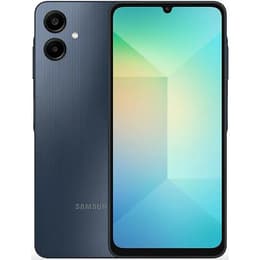
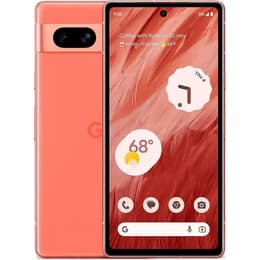

Galaxy A06 Vs Google Pixel 7A

Galaxy A06
Galaxy A06
Starting at

Refurbished price:£70.00

Versus £158.08 new

See options
Google Pixel 7A
Google Pixel 7A
Starting at

Refurbished price:£128.00

Versus £649.99 new

See options

Ratings

The Samsung Galaxy A06 and the Google Pixel 7a are both Android smartphones, but they cater to different segments of the market with distinct philosophies. The Galaxy A06, released in late 2024 (LTE version) and early 2025 (5G version), focuses on essential features and a large display, while the Google Pixel 7a, launched in May 2023, emphasizes camera capabilities and a streamlined software experience. These devices offer varying strengths in terms of performance, display technology, and software support, making them suitable for different user priorities.

Scores

Durability

When considering the longevity of these devices, their release timelines and software support policies are key differentiators.

  • Release and Software Support: The Google Pixel 7a, released in May 2023, is expected to receive five years of major operating system upgrades and security updates from its launch. The Samsung Galaxy A06 LTE version, released in August 2024, is slated for two OS upgrades and four years of security updates, while the 5G variant, released in February 2025, offers four OS upgrades and four years of security updates. This means the Pixel 7a generally offers a longer period of software support, ensuring access to newer Android features and security patches for an extended duration.
  • Build and Durability: The Pixel 7a features a glass front protected by Corning Gorilla Glass 3, a plastic back, and an aluminum frame, along with an IP67 rating for dust and water resistance. The Galaxy A06 models utilize a plastic back and frame with a glass front. While both offer a degree of everyday resilience, the Pixel 7a's Gorilla Glass 3 and IP67 rating suggest a slightly more robust build against environmental factors.
  • Practical Lifespan: Users prioritizing the latest software features and security for the longest possible time may find the Pixel 7a's extended update policy more appealing. The Galaxy A06 5G offers a respectable update cycle for its segment, but the LTE version has a shorter guaranteed support period.

Year of Release

2024

2023

Compatible with latest Update

Yes

Yes

OS

Android

Android

Foldable

No

No

Performance

The performance of these smartphones is influenced by their internal components, impacting how smoothly they handle daily tasks and demanding applications.

  • Processing Power: The Google Pixel 7a is equipped with Google's Tensor G2 processor, designed to handle complex tasks, including advanced computational photography and on-device AI features, resulting in smooth app loading and efficient multitasking. The Samsung Galaxy A06 LTE version uses a MediaTek Helio G85 processor, while the 5G version features a MediaTek Dimensity 6300 processor. These processors are capable of managing everyday applications and light gaming, but the Pixel 7a's processor generally offers a higher level of performance for more intensive use cases.
  • Memory and Storage: The Pixel 7a comes with 8 GB of RAM and 128 GB of internal UFS 3.1 storage, which is not expandable. The Galaxy A06 typically offers 4 GB of RAM (with some variants potentially having more) and storage options of 64 GB or 128 GB, which can be expanded via a microSD card. The Pixel 7a's larger RAM capacity contributes to more fluid multitasking, while the Galaxy A06's expandable storage provides flexibility for users who need more space for media and files.
  • Battery Behavior: The Galaxy A06 models house a substantial 5000 mAh battery, supporting 25W fast charging, which typically translates to extended usage times for many users. The Pixel 7a has a 4385 mAh battery with up to 18W fast charging and 7.5W wireless charging capabilities. User feedback for the Pixel 7a sometimes notes that its battery life can be a point of concern for heavy users, and it may experience heating during intensive tasks.

Memory (GB)

4 GB

8 GB

Screen quality

The visual experience on these devices differs significantly due to their display technologies and specifications.

  • Display Technology and Resolution: The Google Pixel 7a features a 6.1-inch OLED display with a Full HD+ resolution of 2400 x 1080 pixels, offering vibrant colors, deep blacks, and excellent contrast. The Samsung Galaxy A06 models come with a larger 6.7-inch PLS LCD display with an HD+ resolution of 1600 x 720 pixels. The Pixel 7a's OLED technology and higher pixel density provide a sharper and more immersive viewing experience, particularly for detailed content.
  • Refresh Rate and Brightness: The Pixel 7a's display boasts a 90 Hz refresh rate, contributing to smoother scrolling and more fluid animations. The Galaxy A06 LTE version has a standard 60 Hz refresh rate, while the 5G version upgrades to 90 Hz. While both offer adequate brightness for indoor use, some Pixel 7a users have noted that its brightness can be challenging in direct sunlight.
  • Viewing Experience: Users who prioritize a larger screen for media consumption and general browsing might appreciate the Galaxy A06's 6.7-inch display. However, those seeking superior image quality, color accuracy, and a smoother visual experience will find the Pixel 7a's OLED panel and higher resolution more appealing.

Resolution

720 x 1600

1080 x 2400

Screen type

PLS LCD

OLED

Audiovisual

Both smartphones offer camera systems designed for capturing everyday moments, but with different strengths and capabilities.

  • Rear Camera Systems: The Google Pixel 7a features a dual-camera setup with a 64 MP main sensor (with optical image stabilization) and a 13 MP ultrawide lens. It is known for its computational photography, which enhances image quality, especially in challenging lighting conditions. The Samsung Galaxy A06 models also have a dual-camera system, comprising a 50 MP main camera and a 2 MP macro sensor. The Pixel 7a generally delivers more detailed and color-accurate photos, particularly in low light, due to its advanced processing.
  • Front Camera and Video Recording: For selfies, the Pixel 7a includes a 13 MP front-facing camera, while the Galaxy A06 has an 8 MP front camera. The Pixel 7a supports video recording up to 4K at 60 frames per second, offering more versatility for high-resolution video content. The Galaxy A06 records video at 1080p, with the LTE version supporting 60 frames per second and the 5G version at 30 frames per second.
  • Audio Experience: The Pixel 7a comes with stereo speakers, providing a more immersive audio experience for media consumption. The Galaxy A06 includes a 3.5mm headphone jack, a feature absent on the Pixel 7a, which can be a deciding factor for users who prefer wired audio accessories.

Main camera

50 megapixels

64 megapixels

Front camera

8 megapixels

13 megapixels

Miscellaneous

Beyond the core features, several practical elements contribute to the overall user experience of these devices.

  • Connectivity and Ports: The Google Pixel 7a supports Wi-Fi 6E and 5G connectivity (sub-6 and mmWave), offering faster wireless speeds and broader network compatibility. It features a USB-C 3.2 port. The Samsung Galaxy A06 models support Wi-Fi 5 (802.11a/b/g/n/ac) and Bluetooth v5.3, with the 5G variant offering 5G connectivity. Both devices include a USB Type-C 2.0 port. The Galaxy A06 also retains a 3.5mm headphone jack, which is absent on the Pixel 7a.
  • Biometric Security: The Pixel 7a incorporates an under-display fingerprint sensor for secure unlocking. The Galaxy A06 features a side-mounted fingerprint scanner. Both methods offer convenient and reliable access to the device.
  • Design and Handling: The Pixel 7a measures 152 x 72.9 x 9 mm and weighs 193.5 g, offering a more compact form factor. The Galaxy A06 is larger at 167.30 x 77.30 x 8.00 mm and weighs 189 g, providing a larger display experience while maintaining a relatively light build. The Pixel 7a also boasts an IP67 rating for dust and water resistance, adding an extra layer of protection.

Weight

189 g

193 g

Screen size (in)

6.7

6.1

Mobile network

4G

5G

SIM card

Dual Physical SIM

Physical SIM + eSIM

Carrier compatibility

Unlocked

Unlocked

The Samsung Galaxy A06 and Google Pixel 7a offer distinct propositions for smartphone users. The Pixel 7a is often praised for its exceptional camera performance, driven by Google's computational photography, and its commitment to long-term software updates. Users appreciate its clean Android experience and the integration of AI features. However, common criticisms include its battery life, which some users find to be mediocre, and occasional reports of the device heating up during use. The fingerprint sensor has also been noted as sometimes inconsistent.

The Galaxy A06, particularly the 5G variant, is recognized for its large display, substantial battery capacity, and the inclusion of a 3.5mm headphone jack, catering to users who prioritize media consumption and traditional audio connectivity. Its expandable storage is another practical advantage. While specific user sentiment for the A06 is still emerging due to its recent release, devices in this series typically offer a reliable experience for everyday tasks.

Users prioritizing a top-tier camera, a compact form factor, and extended software support will find the Google Pixel 7a well-suited to their needs. Its Tensor G2 chip provides a responsive experience for demanding applications. Conversely, users who value a larger screen, longer battery life, expandable storage, and a traditional headphone jack may lean towards the Samsung Galaxy A06. Both devices represent solid choices within their respective categories, and opting for a quality-assured refurbished option can be a sustainable choice for either model, offering a reliable device while contributing to a more eco-friendly approach to technology.


See all articles

Our recent comparisons





