Tech education

Updated on 6 November 2026
6 November 2026
6 mins read

Thomas Hobbs
From recycled kits to refurbished tech, the world’s first carbon-neutral football club is proving that football can be more sustainable. We went down on a match day to hear more about Forest Green Rover’s mission to make the beautiful game evergreen.
In 2010, the green industry innovator and multimillionaire businessman Dale Vince first visited the English football club, Forest Green Rovers. He was immediately faced with a huge decision. “It was either: rescue this historic football club or let it die,” recalls Vince, who has now been chairman of FGR down in hilly Gloucestershire for the last 16 years.
The chairman of this 137-year-old club is speaking to me on the eve of kick-off for a National League home game against Boston United (which FGR go on to lose 4-1). He’s dressed in patched jeans, a contrast to the stereotypically suited-up football chairman and also an indicator of his out-of-the-box approach towards the beautiful game itself. “I almost immediately saw how important this club was to the local community,” Vince passionately adds.
“I thought to myself, well, how difficult could running a football club really be? And that was that.” Even though it’s fair to say the club’s fortunes on the pitch remain a work-in-progress – in 2022 they were promoted to League 1, before being relegated in 2024 - there are few who would argue against the technological innovation FGR have displayed during the Dale Vince era. For one, its carbon footprint per spectator has decreased by over 50% since the 2011/12 season.
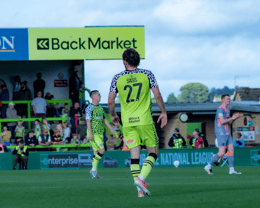
Left-back defender Freddie Sass in action for Forest Green Rovers FC.
Recognized by the United Nations Framework Convention on Climate Change (UNFCCC) as the world’s first carbon-neutral football club and, also crowned “the greenest football club in the world” by football’s global ruling body FIFA, it’s immediately obvious when walking through the club’s aptly titled ground, Eco Park, that they’re doing things differently down here.
When you stroll through the canteen, there are bowls of sunflower seeds on all the tables (the club has a vegan-only menu for both fans and players), ready to be sprinkled for seasoning, and the fumes from a fragrant aubergine curry fill up the air. This is a real juxtaposition to the calorie-building hot dog and burger vans long associated with live British football.
Take a step outside and there’s a multitude of EV chargers encouraging the use of electric cars, while solar panels are visible on the stadium’s roof and the club shop boasts “100% recycled polyester” shirts. I don’t see plastic bottles anywhere.
"If a cardigan rips, you get knitting and go fix it, right? You don't just bin it. So, why should you just throw away your workable devices and make them into e-waste?" - Ethan Ross, goalkeeper at Forest Green Rovers FC
I also notice that all the electronics in use aren’t the latest models, either. From computers to tablets, refurbished electronics are primarily being used by the staff at FGR; all supplied by Back Market as part of its sponsorship of the team. “The refurbished technology we use makes me really proud,” explains Ethan Ross, FGR’s number one goalkeeper.
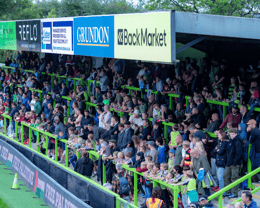
A packed stadium at Forest Green Rovers' Eco Park.
“If a cardigan rips, you get knitting and go fix it, right? You don’t just bin it. So, why should you just throw away your workable devices and make them into e-waste? By seeing the Back Market brand logo in our stands, it tells our fans why repairing tech is important and a real way of caring for the environment.”
Another area where the club is clearly innovating is the grass itself, with its shimmering green colour looking every bit as vibrant as the match pitches found in top flight football. It is all made possible by pioneering techniques. The club essentially converts the urine and wastewater of fans into a nutrient-rich fertilizer for the grass. All the rainwater, meanwhile, is recycled for irrigation.
The pitch is also completely organic in terms of how it is treated, and was previously maintained by a solar-powered GPS robot mower, clarifies Nick Johnstone, the groundsman at FGR. The robot has now gone, but the creative approach continues. “I now have an app where I can control irrigation and rainwater harvesting,” says Johnstone. “I saw recently that the English Football League launched a new scheme aimed at making clubs more sustainable; I’m not sure if that happens without the pioneering work we’ve done here.”
This is a view echoed by the club’s head of sports science, Tom Huelin. “All these little changes, well, they add up to a big difference,” he explains. “There’s a lot of the world’s biggest clubs looking at Forest Green Rovers for inspiration.”
Meanwhile, the club’s goalkeeper Ethan Ross concurs: “The other day the chef cooked cauliflower that tastes just like steak. Because of the food here, a lot of players have converted to veganism, while a lot of the fans are naturally converting as well. There are all these positive shifts going on.”
None of this pioneering work would be cementing itself without the human connection that defines the contemporary FGR’ brand. Go onto their social media channels and you will see everyone from the chefs to the shop assistant (lovingly called Retail Bob) speaking out on viral videos. The idea is to depict the club as one big family, showing that it is possible for a range of different characters to pull together to improve our environment.
"Back in 2010, when I took over, people said, 'What the hell does football have to do with the environment?' They don't say that anymore" - Dale Vince, chairman of Forest Green Rovers FC
“I really like our internal motto, which is: ‘You’re at your best when you are bold’,” says the club’s content and communications manager, Harry Andrews. “We’re always trying something new, whether that is putting a microphone in front of our manager during match days or all of the recycling initiatives. We’re trying to break that one-size-fits-all approach that often goes with football.”
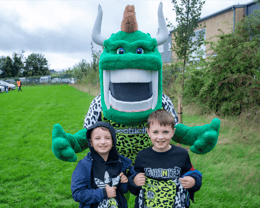
Forest Green Rovers' mascot, Neville, The Green Devil, hands out free recycled polyester shirts to young fans.
So, what’s next for the Forest Green Rovers Football Club? The immediate target is to get back into League 1 and start the climb towards the ultimate prize: getting promoted to the top flight of the English game: the Premier League. Could this goal be possible within the next 10-15 years?
“Well, we will see,” answers a diplomatic Dale Vince, FGR’s ambitious chairman. “Getting into the Championship would be a dream come true, for sure.” Whether this dream is fulfilled or not, Vince says he’s proud of the trickle-down effect his experiment at Forest Green Rovers FC has already triggered. He concludes: “This began as a risk commission, but then the United Nations created a Sports for Climate action program after being inspired by our work.
“Back in 2010, when I took over at FGR, people said, ‘What the hell does football got to do with the environment?’ They don’t say that anymore.” Forest Green Rovers, therefore, is proof that the live football industry doesn’t need to be something based on energy-draining consumption and corporate greed. To paraphrase that earlier referenced inner club motto: FGR is proving that football is at its best when it’s being bold.
All photography courtesy of Oscar Kingsley.
Thomas Hobbs is a UK-based freelance journalist who has written for titles including the Guardian, Financial Times, Telegraph, Pitchfork, New Statesman, Stereogum, BBC Culture and many others. He has interviewed everyone from Nas to Usher, Weyes Blood, and Joe Hisaishi, while collecting and playing vintage video games is one of his favourite past times.