
Christmas

Updated on 8 April 2026
8 April 2026
5 mins read

Oumar Saleh
Freelance journalist
As new data shows the Japanese are becoming more interested in refurbished tech, Back Market has opened its first Tokyo-based store, with writer Oumar Saleh interviewing the brains behind it all.
To many in the West, Japan is still viewed as a vanguard when it comes to providing the world with cutting-edge technology. Led by firms such as Sony, Panasonic, Nintendo, and Toshiba, the Land of the Rising Sun continues to maintain its long-standing reputation as a tech trend-setter.
But despite being at the very cutting edge of electronic devices, and therefore feeding directly into a Fast Tech, always upgrading culture, there are more and more signs that Japan is becoming open to a Slow Tech revolution. A Market Research report published last month estimated that around 60% of Japanese consumers are willing to purchase refurbished electronics from well-known resale chains such as Hard Off and 2nd Street, while 64% have bought second-hand electronic goods in the past year alone.
And, with Japan’s recycling rate for electronics “only around 20%”, it’s clear the market is fertile for new players within the refurbished tech space. It’s against this backdrop that Back Market’s first-ever Tokyo pop-up shop has officially opened.
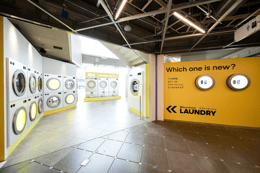
A look inside Back Market's Tokyo pop-up store.
Located on the Tokyu Plaza Harakado in Harajuku, an area seen as a hub of youth culture, it is a fitting location for the brand’s debut pop-up — which ran for two weeks until the 5th of April. With young people out in force during the spring break period which also represents a new beginning in Japanese culture amid fully bloomed cherry blossoms (shinseikatsu), the choice of venue also speaks directly to Back Market’s target audience, as it looks to raise awareness around the benefits of refurbished tech among a younger, trend-conscious generation.
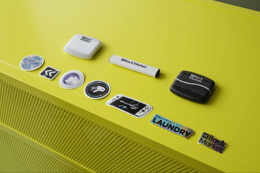
Upon stepping inside the pop-up, I was immediately struck by three oversized gachapon machines — ubiquitous capsule toy dispensers found across Japan — reimagined as giant washing machines. Dubbed the “Laundry Gacha,” visitors can take part by inserting a coin and turning the crank for a chance to win prizes such as refurbished iPhones & Google Pixels; iPads; smartwatches; and a range of Back Market stickers. Chrome laundry drums, inspired by compact Japanese capsule spaces, surround the installation, including one by the entrance that doubles as a selfie booth.
Toward the back, a dedicated station offers visitors the chance to have their smartphones thoroughly cleaned for free by a professional, using a range of products from iFixit. “The inspiration for the laundromat theme comes from the stigma surrounding the cleanliness of second-hand devices,” Mai Ihara, marketing director of Back Market’s APAC division, tells me. “There’s a common phrase in Japan when it comes to them called seibizumi-seihin, which loosely translates to “conditioned” [a product that has been fully serviced], and we really wanted to emphasise what refurbishment actually is and educate others on why it's so important.”
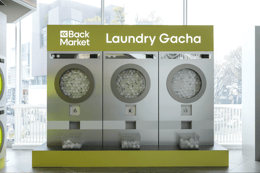
Dubbed the “Laundry Gacha,” visitors could take part by inserting a coin and potentially winning prizes.
Considering the widespread popularity of the second-hand clothing market in Japan, it is somewhat surprising that awareness around the benefits of refurbished tech and addressing e-waste has not reached the same level of acceptance. With over 20,000 stores across the country selling reused garments, second-hand fashion is firmly established as a mainstream practice — one that closely aligns with the cultural value of mottainai (“too good to waste”). The question, then, is why this mindset has not yet fully translated to technology?
“We see the refurbished market in Japan as still relatively immature, with many people not yet considering it a viable option—and that’s not their fault,” explains John Goodwin, vice president of global brand at Back Market. “There hasn’t been the same level of education to guide consumers, unlike, say, the fashion industry 20 years ago… when conversations around the environmental impact take hold. That awareness hasn’t yet fully extended to the electronic devices we buy and use, but we want to spark the conversation with our work in Japan.”
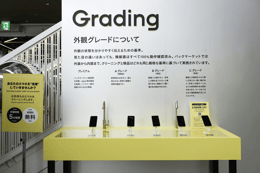

Sleek displays showcasing Back Market’s research and punchy, persuasive maxims about the benefits of refurbishment — “When your car battery dies, you replace the battery rather than buying a whole new car” being a standout — are positioned throughout the space. One sits above a grading station, where iPhones are neatly organised into categories ranging from Premium to A, B, and C. “With the pop-up, we had the opportunity for people to physically experience our rigorous grading system,” Ihara says, as she shows me a C-grade iPhone 14 with barely noticeable scratches around the back camera lenses.
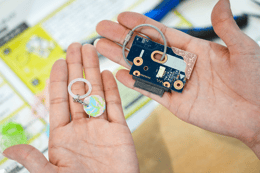
“The inside is as good as new, whereas if you go for an A-grade, you won’t be able to see the difference between it and a brand new device.” The pop-up also gives visitors the opportunity to create one-of-a-kind keychains and accessories from recycled e-waste during weekend workshops — an expression of Back Market’s ethos of repurposing and up-cycling discarded materials rather than sending them to landfill. Alongside these workshops, the on-site cleaning station and the display of refurbished iPhones reinforce the brand’s message, reasserting the value of repair in the physical world while highlighting the skill, precision, and craftsmanship behind every restored device.
“We want to start a major shift, to create conversations to get people to start thinking about the concept of refurbished technology." - John Goodwin
In Japan, where older technologies such as stereos, CD players, and wired headphones are still widely used, the potential to shift attitudes toward refurbished tech feels especially significant. “Japan’s a great market to target because it’s a tech-savvy crowd that’s also interested in using older tech,” Goodwin opines. “There’s a rich culture of nostalgia here, and having so much of it being borne out of tech companies with great lineage, we feel that there’s a great opportunity to break through that barrier.
“We want to start a major shift, to create conversations to get people to start thinking about not just Back Market, but the concept of refurbished technology. Our goal as a leader in the market is to push the whole concept forward."
Oumar Saleh is a Japan-based freelance writer who has written for titles including Stereogum, Okayplayer, NME, Crack, and Passion of the Weiss.