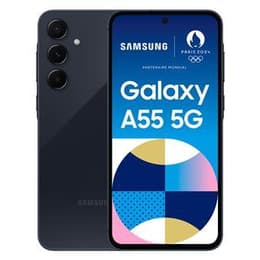


Compare models
Galaxy A55 Vs Google Pixel 6A
- 1-year minimum warranty
- Free delivery on all items
- Free 30-day returns
Differences at a glance
The Samsung Galaxy A55 and the Google Pixel 6a are both Android smartphones designed to offer a balanced experience. The Galaxy A55, released in March 2024, is a more recent offering from Samsung, while the Google Pixel 6a, launched in July 2022, represents Google's earlier mid-range approach. Both devices run on the Android operating system, but they differ in their hardware and software philosophies, leading to distinct user experiences.
Available Models
Colour
Storage (GB)
Scores
Durability
When considering the long-term usability of these devices, their release timelines and software support policies are key factors.
- Release and Support: The Samsung Galaxy A55, released in March 2024, benefits from a more extended software support window, with Samsung promising four major OS upgrades and five years of security updates. This means it is expected to receive updates up to Android 18 and security patches until 2029. In contrast, the Google Pixel 6a, released in July 2022, was promised three years of OS updates and five years of security updates, with its last major OS update likely being Android 15.
- Physical Durability: The Galaxy A55 features Corning Gorilla Glass Victus+ on its screen and an aluminum frame, contributing to a more robust build. It also carries an IP67 rating for dust and water resistance. The Pixel 6a, while also having an IP67 rating for dust and water resistance, uses Corning Gorilla Glass 3 for its display and a plastic back.
- Practical Lifespan: Users prioritizing the longest possible software longevity and a more premium build for everyday knocks and spills may find the Galaxy A55 to be a more future-proof option. The Pixel 6a, while still receiving security updates for a considerable period, will see its major Android version updates conclude sooner.
Year of Release
2024
2022
Compatible with latest Update
Yes
Yes
OS
Android
Android
Foldable
No
No
Performance
The performance of a smartphone is crucial for daily tasks, from launching applications to managing multiple processes simultaneously.
- Storage and Memory: The Samsung Galaxy A55 offers more flexibility with storage and RAM configurations, available with 8GB or 12GB of RAM and 128GB or 256GB of internal storage, with expandable storage via a microSD card. The Google Pixel 6a comes with 6GB of RAM and 128GB of non-expandable internal storage.
- Everyday Responsiveness: The Galaxy A55 is equipped with a current-generation processor designed for efficient multitasking and gaming, showing improved CPU and GPU performance over its predecessor. The Pixel 6a, powered by Google's Tensor chip, delivers strong performance for everyday tasks, smooth app loading, and efficient handling of AI-driven features, often outperforming other devices in its segment at the time of its release.
- Battery Performance: The Galaxy A55 houses a 5000 mAh battery, generally providing reliable battery life that can last through a full day of use. The Pixel 6a has a 4410 mAh battery, and while Google optimized its performance, some users reported that it struggled to last a full day with heavy use, though others found it to offer solid all-day battery life.
Screen quality
The display is a primary interface for smartphone interaction, influencing everything from media consumption to general navigation.
- Display Technology and Size: Both devices feature OLED display technology, known for deep blacks and vibrant colors. The Samsung Galaxy A55 has a larger 6.6-inch Super AMOLED display, providing an expansive viewing area. The Google Pixel 6a features a more compact 6.1-inch OLED display.
- Resolution and Refresh Rate: Both phones offer Full HD+ resolution (2340x1080 pixels for A55, 2400x1080 pixels for Pixel 6a), ensuring clear visuals. A significant difference lies in the refresh rate: the Galaxy A55 boasts a 120Hz refresh rate for smoother scrolling and more fluid animations, while the Pixel 6a has a standard 60Hz refresh rate.
- Brightness: The Galaxy A55 offers a peak brightness of 1,000 nits, enhancing visibility outdoors. The Pixel 6a's display is also described as bright, offering good visibility in various lighting conditions.
Resolution
1080 x 2340
1080 x 2400
Screen type
Super AMOLED
OLED
Audiovisual
For many users, camera capabilities are a deciding factor, influencing how they capture and share moments.
- Rear Camera System: The Samsung Galaxy A55 features a triple rear camera setup with a 50MP main sensor, a 12MP ultrawide lens, and a 5MP macro lens. It supports 4K video recording at 30fps and includes optical image stabilization (OIS) on the main sensor. The Google Pixel 6a has a dual-camera system with a 12.2MP main sensor and a 12MP ultrawide lens. It also supports 4K video recording at 30/60fps and benefits from Google's computational photography.
- Photography Performance: The Galaxy A55 delivers sharp and detailed photos in good lighting, with natural colors, and its low-light performance is decent with Night Mode. The Pixel 6a is highly praised for its camera, often producing excellent photos with accurate exposure and white balance, especially benefiting from its advanced software processing, even with older hardware. Its low-light performance is also strong.
- Front Camera and Video: The Galaxy A55 comes with a 32MP front camera, capable of 4K video recording. The Pixel 6a has an 8MP front camera, which performs well for selfies and video calls, recording 1080p video at 30fps. Both devices offer good video stabilization.
Main camera
50 megapixels
12.2 megapixels
Front camera
32 megapixels
8 megapixels
Miscellaneous
Beyond core specifications, several practical features contribute to the overall user experience and device utility.
- Connectivity and Ports: Both the Galaxy A55 and Pixel 6a support 5G connectivity, Wi-Fi, and Bluetooth. The Galaxy A55 uses a USB-C port and supports expandable storage via microSD. The Pixel 6a also uses a USB-C port but lacks a headphone jack and expandable storage.
- Biometric Security: Both phones feature in-display fingerprint sensors for secure unlocking. The Pixel 6a does not offer face unlock.
- Design and Handling: The Galaxy A55 has a metal frame and glass back, giving it a more premium feel, and weighs 213 grams. The Pixel 6a has a plastic back and weighs 178 grams, making it lighter and slightly more compact. The A55 measures 161.1 x 77.4 x 8.2 mm, while the Pixel 6a measures 152.2 x 71.8 x 8.9 mm.
Weight
213 g
178 g
Screen size (in)
6.6
6.1
Mobile network
5G
5G
SIM card
Dual Physical SIM
Physical SIM + eSIM
Carrier compatibility
Unlocked
Unlocked
Connector
USB-C
USB-C
What the community thinks
Users often praise the Samsung Galaxy A55 for its premium design, vibrant display, and reliable battery life. Its extended software support and expandable storage are frequently highlighted as significant advantages. Some users, however, note that its camera performance, while good, might not always match the computational photography prowess of some competitors, and its battery life, while generally good, can be inconsistent for very heavy users.
The Google Pixel 6a is widely acclaimed for its exceptional camera capabilities, often delivering flagship-level photo quality due to Google's advanced image processing. Its compact size and smooth performance for everyday tasks are also frequently appreciated. Criticisms often revolve around its 60Hz display, which some find less fluid than higher refresh rate screens, and its battery life, which can be inconsistent for heavy usage. The lack of expandable storage and a headphone jack are also common points of feedback.
Users prioritizing a modern design, a larger, smoother display, and longer software support may find the Samsung Galaxy A55 well-suited to their needs. Its expandable storage also appeals to those who require more space for media and apps. Conversely, users who prioritize an outstanding camera experience and a more compact form factor, and who value Google's software-first approach to photography, may lean toward the Google Pixel 6a. Both devices offer a solid Android experience, and choosing a quality-assured refurbished option for either model can be an eco-friendly alternative to purchasing new.