
Compare models
Galaxy Z Flip7 Vs Google Pixel 10
- 1-year minimum warranty
- Free delivery on all items
- Free 30-day returns
Differences at a glance
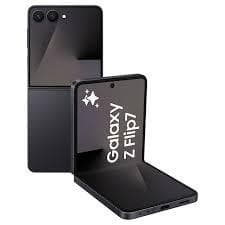
The Samsung Galaxy Z Flip7 (2025) and the Google Pixel 10 (2025) represent two entirely different approaches to modern smartphone design, contrasting a foldable clamshell form factor with a traditional slate layout. Both devices run on Android 16 and target users looking for current mobile technology, yet they diverge significantly in physical construction, everyday handling, and hardware features.
While the Galaxy Z Flip7 prioritizes pocket-friendly portability through a folding screen layout, the Google Pixel 10 focuses on a standard candy-bar body equipped with a triple-lens rear camera setup. Choosing between them depends heavily on whether physical versatility or conventional ergonomics better suit your daily routine.
Available Models
Colour
Storage
Scores
Durability
Both smartphones launched in mid-2025 and share contemporary hardware foundations, but their physical designs introduce different structural considerations for long-term ownership.
- Release timeline and software support: Both models arrived in 2025 running Android 16, ensuring they receive concurrent software features, security updates, and modern operating system capabilities from their respective ecosystems.
- Structural longevity and design: The Google Pixel 10 uses a rigid slate construction with standard drop resistance, whereas the Galaxy Z Flip7 features a folding hinge mechanism that requires routine care over years of opening and closing.
- Expected practical lifespan: Users who select the quality-assured refurbished option for either device can expect multi-year durability, though traditional slate phones typically endure higher mechanical resilience over extended daily use.
Year of Release
2025
2025
Compatible with latest Update
Yes
Yes
OS
Android
Android
Foldable
Yes
No
Performance
System capabilities and everyday speed are handled by custom hardware configurations in both devices, supporting smooth multitasking and responsive application behavior.
- Storage and memory configurations: The Galaxy Z Flip7 offers options starting at 256GB paired with 12GB of RAM, while the Google Pixel 10 provides 128GB or 256GB variants alongside 12GB of RAM for efficient app switching.
- Everyday speed and multitasking: Both devices handle demanding apps, web browsing, and split-screen multitasking smoothly thanks to their current-generation processors and ample memory headroom.
- Battery behavior: The Pixel 10 features a larger battery capacity that comfortably powers a full day of standard use, while the Galaxy Z Flip7 relies on a slightly smaller power cell to maintain its slim folding profile.
Screen quality
Display technology defines the primary interaction difference between these two models, offering distinct visual experiences for media consumption and daily navigation.
- Display technology and form factor: The Galaxy Z Flip7 features a flexible main screen alongside a functional cover display for quick notifications, while the Pixel 10 utilizes a flat 6.3-inch screen with high peak brightness levels.
- Visual clarity and outdoor readability: Both screens deliver sharp text reproduction and high refresh rates up to 120Hz for smooth scrolling, alongside strong outdoor visibility under direct sunlight.
- Media viewing experience: The Pixel 10 offers an uninterrupted traditional viewing area for videos, whereas the Z Flip7 provides a taller aspect ratio when fully unfolded for immersive content consumption.
Resolution
1080x2520
1080x2424
Audiovisual
Photography and media recording capabilities vary noticeably due to the physical layout and lens configurations integrated into each chassis.
- Camera hardware setup: The Google Pixel 10 incorporates a versatile triple-lens array featuring wide, ultrawide, and dedicated telephoto sensors, while the Galaxy Z Flip7 relies on a dual-camera system optimized for flexible angles.
- Everyday photography and low light: Both devices capture detailed images and process low-light environments effectively using computational photography tools and large sensor inputs.
- Audio and video output: Stereo speakers on both models deliver clear sound for hands-free calls and casual media playback, complemented by reliable microphone arrays for video recording.
Front camera
10 megapixels
42 megapixels
Miscellaneous
Practical daily features, connectivity standards, and physical dimensions determine how comfortably each smartphone integrates into a traveler's or professional's pocket.
- Connectivity and ports: Both smartphones support modern 5G networks, Wi-Fi standards, and Bluetooth connections, utilizing standard USB-C ports for charging and data transfer.
- Biometrics and security: Fast biometric authentication is available on both models through facial recognition and integrated fingerprint sensors for secure device unlocking.
- Dimensions and handling: The Pixel 10 presents a standard slate footprint weighing 204 grams, whereas the Galaxy Z Flip7 folds compactly to 13.7 millimeters in thickness while weighing a lighter 188 grams.
Weight
188 g
204 g
Screen size (in)
6.9
6.3
Mobile network
5G
5G
SIM card
Physical SIM + eSIM
Physical SIM + eSIM
Carrier compatibility
Unlocked
Unlocked
Connector
USB-C
USB-C
What the community thinks
User feedback highlights distinct preferences for each device based on lifestyle and ergonomic needs. Owners of the Galaxy Z Flip7 frequently praise its compact footprint when folded and the convenience of checking notifications on the outer screen, though some note that the folding crease remains visible under certain lighting conditions. Conversely, Google Pixel 10 users frequently commend its reliable battery duration and the addition of a dedicated telephoto zoom lens, while some mention that the standard slate size lacks the pocketability of a clamshell device.
Users prioritizing a compact, easily storable device that fits into small pockets may prefer the Galaxy Z Flip7, while users prioritizing traditional ergonomics, telephoto zoom versatility, and extended battery endurance will lean toward the Google Pixel 10. For those considering an eco-friendly alternative, exploring a quality-assured refurbished option provides a sustainable path to owning either of these devices.