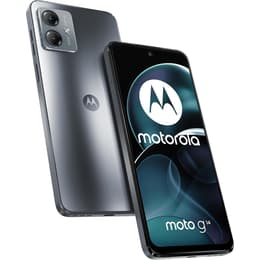

Galaxy A56 Vs Motorola Moto G14

Galaxy A56
Galaxy A56
Starting at

Refurbished price:£274.00

Versus £422.50 new

See options
Motorola Moto G14
Motorola Moto G14
Starting at

Refurbished price:£91.24

Versus £139.99 new

See options

Ratings

The Samsung Galaxy A56, a mid-range smartphone released in March 2025, and the Motorola Moto G14, an entry-level device launched in August 2023, cater to different user priorities within the Android ecosystem. While both devices run on the Android operating system, the Galaxy A56 offers a more advanced overall experience with a superior display and longer software support, whereas the Moto G14 focuses on providing essential smartphone functions.

Scores

Durability

The practical lifespan of these devices is influenced by their release timelines and software support policies, with the Galaxy A56 offering a significantly extended period of updates.

  • Software Longevity: The Galaxy A56, released in 2025, is designed to receive six major Android OS upgrades and an impressive seven years of security updates, extending its usability and security well into the future. In contrast, the Moto G14, launched in 2023, typically receives one major Android OS upgrade and up to three years of security patches.
  • Build Durability: The Galaxy A56 features an aluminum frame and Gorilla Glass Victus+ on both the front and back, contributing to its robust feel and offering IP67 dust and water resistance, meaning it can withstand immersion in up to 1 meter of water for 30 minutes. The Moto G14 is built with a plastic back and frame, protected by Panda Glass on the front, and offers an IP52 water-repellent design, providing protection against splashes.
  • Repairability: The Galaxy A56 has a repairability score of 8.4 out of 10, indicating it is relatively repair-friendly, though slightly less so than its immediate predecessor. The Moto G14 has a lower repairability score of 5.0 out of 10, primarily due to the use of adhesive for the back cover and battery, making disassembly more challenging.

Year of Release

2025

2023

Compatible with latest Update

Yes

Yes

OS

Android

Android

Foldable

No

No

Performance

Performance capabilities vary considerably between these two smartphones, reflecting their different market segments and intended use cases.

  • Everyday Responsiveness: The Galaxy A56 is equipped with a more powerful current-generation processor, allowing it to handle demanding applications, complex multitasking, and moderate gaming with smooth and fluid responsiveness. Users report that it can feel as smooth as higher-end devices in general use.
  • Task Handling: The Moto G14's processor is designed for essential daily tasks such as web browsing, social media, messaging, and light applications, providing a capable experience for general use. It is well-suited for users who do not engage in intensive gaming or heavy multitasking.
  • Storage and RAM: The Galaxy A56 offers configurations with 8GB or 12GB of RAM and 128GB or 256GB of internal storage, utilizing UFS 3.1 for faster data access. The Moto G14 comes with 4GB or 8GB of RAM and 128GB or 256GB of internal storage, using UFS 2.2. Both devices support expandable storage via microSD cards up to 1TB.

Memory (GB)

8 GB

4 GB

Screen quality

The display experience on these two devices presents a clear distinction, primarily due to differences in panel technology and refresh rates.

  • Display Technology: The Galaxy A56 features a 6.7-inch Super AMOLED display, known for its deep blacks, vibrant colors, and high contrast ratios, enhancing the viewing experience for media consumption and general use. The Moto G14 utilizes a 6.5-inch IPS LCD panel, which provides good clarity and color accuracy, suitable for everyday viewing.
  • Smoothness and Brightness: The A56 boasts a 120Hz refresh rate, resulting in noticeably smoother scrolling and animations, alongside higher peak brightness of up to 1900 nits for better outdoor visibility. The Moto G14 has a standard 60Hz refresh rate and adequate brightness for indoor use, with some users finding sunlight legibility to be good.
  • Resolution and Clarity: Both phones generally offer Full HD+ resolution (2340x1080 pixels for A56, 1080x2400 pixels for G14), ensuring sharp text and clear images. The screen sizes are comparable, providing ample viewing area.

Resolution

1080 x 2340

1080 x 2400

Screen type

Super AMOLED

IPS LCD

Audiovisual

The camera systems on the Galaxy A56 and Moto G14 offer different capabilities, particularly in versatility and performance across various lighting conditions.

  • Rear Camera System: The Galaxy A56 features a triple-camera setup with a 50MP main sensor with optical image stabilization (OIS), a 12MP ultrawide lens, and a 5MP macro lens, providing versatility for different types of shots. The Moto G14 comes with a dual-camera system, including a 50MP main sensor and a 2MP macro lens.
  • Photography Performance: The A56 generally produces good daylight photos with wide dynamic range and accurate color reproduction, and its Night mode helps in low-light conditions, though extreme darkness can introduce noise. The Moto G14 delivers good daylight shots, with HDR improving dynamic range, but its low-light performance and macro lens are considered average.
  • Video and Audio: Both the front and rear cameras on the Galaxy A56 can record 4K video at 30 frames per second, with solid stabilization. The Moto G14 records video at 1080p at 30 frames per second for both cameras. The Galaxy A56 includes stereo speakers, while the Moto G14 also features stereo speakers with Dolby Atmos support.

Main camera

4K@30fps

50 megapixels

Front camera

13 megapixels

8 megapixels

Miscellaneous

Beyond the core features, several practical elements distinguish these two smartphones in terms of connectivity, design, and user interaction.

  • Connectivity Options: The Galaxy A56 supports 5G connectivity, offering faster mobile data speeds where available, along with newer Wi-Fi 6 and Bluetooth 5.3 standards. The Moto G14 is limited to 4G networks and uses Wi-Fi 5 and Bluetooth 5.0.
  • Ports and Sensors: Both devices feature a USB-C port for charging and data transfer. A notable difference is the Moto G14's inclusion of a 3.5mm headphone jack, which is typically absent on the Galaxy A56. For biometric security, the Galaxy A56 often incorporates an in-display fingerprint sensor, while the Moto G14 typically uses a side-mounted fingerprint sensor integrated into the power button.
  • Design and Handling: The Galaxy A56 measures 162.2 x 77.5 x 7.4 mm and weighs 198g, featuring an aluminum frame and glass construction that contributes to a premium feel. The Moto G14 measures 161.5 x 73.8 x 8 mm and weighs 177g, with a plastic build that makes it lighter.

Weight

197 g

177 g

Screen size (in)

6.5

6.5

Mobile network

5G

4G

SIM card

Dual Physical SIM + eSIM

Dual Physical SIM

Carrier compatibility

Unlocked

Unlocked

Connector

USB-C

USB-C + Jack 3.5mm

The Samsung Galaxy A56 and Motorola Moto G14 serve different user needs, with their respective strengths aligning with distinct priorities. User feedback for the Galaxy A56 often praises its vibrant AMOLED display, long-lasting battery, and extended software support, making it a compelling option for those seeking a device that remains current and performs reliably over several years. Some users note that while its primary camera performs well, the macro lens might be underwhelming, and it may not offer the absolute highest performance for intensive gaming compared to some rivals.

The Motorola Moto G14 is frequently lauded for its solid battery life and capable performance for everyday tasks, along with the inclusion of a 3.5mm headphone jack, which is a practical benefit for many. Common observations include its display being good for its class but not matching higher-end panels, and its camera system performing best in good lighting conditions.

Users prioritizing a device with a premium design, a highly responsive and vibrant display, and a commitment to long-term software updates will find the Galaxy A56 well-suited to their needs. Conversely, users who value essential smartphone functionality, good battery endurance for daily use, and the convenience of a headphone jack, without requiring top-tier performance or an advanced display, may lean toward the Moto G14. Both devices are available as quality-assured refurbished options, providing an eco-friendly alternative for consumers.

See all articles

Our recent comparisons