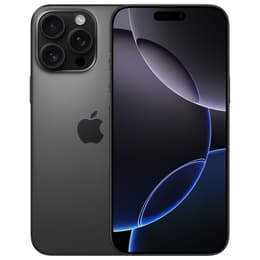

Galaxy A26 Vs iPhone 16 Pro Max

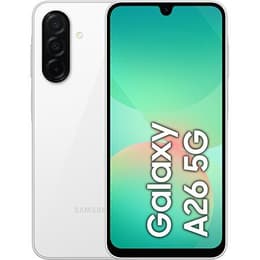
Galaxy A26
Galaxy A26
Starting at

Refurbished price:£152.00

Versus £419.55 new

See options
iPhone 16 Pro Max
iPhone 16 Pro Max
Starting at

Refurbished price:£658.00

Versus £1,199.00 new

See options

Ratings

The Samsung Galaxy A26 and the Apple iPhone 16 Pro Max represent distinct segments within the smartphone market, offering different experiences tailored to varied user needs. The Galaxy A26, released in March 2025, is an Android-based device focusing on essential features and extended software support. In contrast, the iPhone 16 Pro Max, launched in September 2024, is Apple's flagship iOS offering, emphasizing advanced performance, a sophisticated camera system, and premium build quality. These differences are evident across their core specifications and overall user propositions.

Scores

Durability

When considering the longevity of these devices, several factors come into play, including their release timelines, software support, and physical durability.

  • Release Timeline and Software Support: The Samsung Galaxy A26, released in March 2025, benefits from Samsung's commitment to providing six years of Android OS updates and six years of security updates, extending its software lifespan until March 2031. The iPhone 16 Pro Max, released in September 2024, typically receives iOS updates for five to seven years from its launch, ensuring a long period of software relevance.
  • Physical Durability: The Galaxy A26 features Corning Gorilla Glass Victus+ on both its front and back, paired with a plastic frame, and boasts an IP67 rating for dust and water resistance, allowing submersion in up to 1 meter of water for 30 minutes. The iPhone 16 Pro Max utilizes a titanium frame and Ceramic Shield front cover, offering enhanced resistance against drops and scratches, alongside an IP68 rating for dust and water resistance, capable of withstanding submersion up to 6 meters for 30 minutes.
  • Expected Practical Lifespan: Both devices are designed for extended use, with the Galaxy A26 offering a clear, long-term software update policy. The iPhone 16 Pro Max, while having a shorter period as Apple's absolute top-tier model before a successor, is built with premium materials and benefits from Apple's consistent long-term software support, contributing to a substantial practical lifespan.

Year of Release

2024

2024

Compatible with latest Update

Yes

Yes

Foldable

No

No

Performance

The performance capabilities of the Galaxy A26 and iPhone 16 Pro Max cater to different user expectations, reflecting their respective market positions.

  • Processor Capabilities: The Galaxy A26 is powered by an Exynos 1380 processor, which provides sufficient power for everyday tasks, general use, and casual gaming. Users may experience occasional minor delays when multitasking or switching between demanding applications. The iPhone 16 Pro Max features the A18 Pro chip, which delivers significantly higher performance, excelling in demanding applications, intensive gaming, and complex AI workloads.
  • Storage and Multitasking: The Galaxy A26 offers storage options of 128GB or 256GB, with 6GB or 8GB of RAM, and includes a microSD card slot for expandable storage. The iPhone 16 Pro Max comes with 8GB of RAM and storage options starting from 256GB, extending to 1TB, utilizing faster NVMe storage. The iPhone's larger RAM and optimized software contribute to smoother multitasking and app handling.
  • Overall System Responsiveness: The iPhone 16 Pro Max provides a highly fluid and responsive user experience across all operations, from app loading to navigating the interface, due to its powerful processor and optimized iOS ecosystem. The Galaxy A26 offers a generally smooth experience for its category, though it may not match the instantaneous responsiveness of a flagship device during heavy usage.

Memory (GB)

8 GB

8 GB

Screen quality

Both devices feature OLED display technology, but they differ in resolution, brightness, and overall viewing experience.

  • Display Technology and Clarity: The Galaxy A26 features a 6.7-inch Super AMOLED display with a Full HD+ resolution of 1080 x 2340 pixels, resulting in a pixel density of approximately 385 ppi. This provides clear and vibrant visuals for everyday content consumption. The iPhone 16 Pro Max boasts a larger 6.9-inch Super Retina XDR OLED display with a higher resolution of 2868 x 1320 pixels, achieving a sharper 460 ppi.
  • Brightness and Refresh Rate: The Galaxy A26's display offers a 120Hz refresh rate for smooth scrolling and animations, with an average brightness of around 700 nits, making it usable outdoors but potentially challenging in direct sunlight. The iPhone 16 Pro Max features a ProMotion display with an adaptive refresh rate up to 120Hz, capable of scaling down to 1Hz for power efficiency. It offers a typical brightness of 1000 nits and a peak brightness of 2000 nits, ensuring excellent visibility even in bright outdoor conditions.
  • Viewing Experience: The iPhone 16 Pro Max provides a more immersive viewing experience with its larger screen, higher resolution, superior brightness, and thinner bezels. The Galaxy A26 delivers a good quality display for its class, suitable for media consumption and daily tasks, though with a slightly lower pixel density and peak brightness.

Resolution

1080 x 2340

1320 x 2868

Audiovisual

The camera systems on the Galaxy A26 and iPhone 16 Pro Max are designed for different levels of photographic capability and versatility.

  • Rear Camera Systems: The Galaxy A26 is equipped with a triple rear camera setup, including a 50MP main sensor with Optical Image Stabilization (OIS), an 8MP ultrawide lens, and a 2MP macro lens. The iPhone 16 Pro Max features a more advanced triple camera system, comprising a 48MP wide camera with sensor-shift OIS, a 48MP ultrawide camera, and a 12MP periscope telephoto lens offering 5x optical zoom and 3D sensor-shift OIS.
  • Photography Performance: The Galaxy A26 performs well in daylight conditions, capturing images with decent detail and dynamic range, though colors can sometimes appear muted, and low-light performance is an area for improvement. The 2MP macro lens is noted for its limited utility. The iPhone 16 Pro Max delivers exceptional image quality across various lighting conditions, including significantly improved low-light performance, and its telephoto lens provides versatile zoom capabilities.
  • Video Recording and Front Camera: The Galaxy A26 supports 4K video recording at 30 frames per second (fps) with its main camera and has a 13MP front-facing camera that produces good selfies. The iPhone 16 Pro Max offers advanced video recording capabilities, including 4K at up to 120fps with Dolby Vision and enhanced stabilization, alongside a 12MP TrueDepth front camera known for its quality and features.

Front camera

13 megapixels

12 megapixels

Miscellaneous

Beyond core specifications, practical elements like connectivity, ports, and build materials contribute to the overall user experience.

  • Connectivity and Ports: The Galaxy A26 supports 5G networks, Wi-Fi 5, and Bluetooth 5.3, featuring a USB-C 2.0 port for charging and data transfer. It lacks a 3.5mm headphone jack and has a mono speaker. The iPhone 16 Pro Max offers advanced connectivity with 5G (including mmWave), Wi-Fi 7, and Bluetooth 5.4. It includes a USB-C 3.2 Gen 2 port with DisplayPort support for faster data transfer and video output, and relies on dual eSIM technology.
  • Sensors and Biometrics: The Galaxy A26 features a side-mounted fingerprint scanner for secure unlocking. The iPhone 16 Pro Max utilizes Face ID for biometric authentication and includes a LiDAR scanner for enhanced depth sensing in photography and augmented reality applications.
  • Build Materials and Handling: The Galaxy A26 has a glass front and back with a plastic frame, measuring 164 x 77.5 x 7.7 mm and weighing 200g. The iPhone 16 Pro Max features a more premium titanium design with a Ceramic Shield front and textured matte glass back, measuring 163 x 77.6 x 8.25 mm and weighing 227g. The iPhone also introduces an Action Button and a new Camera Control button for quick access to functions.

Weight

197 g

227 g

Screen size (in)

6.5

6.9

Mobile network

5G

5G

SIM card

Dual Physical SIM

Physical SIM + eSIM

Carrier compatibility

Unlocked

Unlocked

Connector

USB-C

USB-C (USB 3)

The Samsung Galaxy A26 and iPhone 16 Pro Max cater to distinct user preferences, each excelling in different areas. User feedback for the Galaxy A26 often highlights its value as a general-purpose smartphone, praising its display, long software support, and capable main camera for its segment. However, some users have noted concerns regarding battery performance and occasional overheating, as well as the limited utility of the macro camera. The iPhone 16 Pro Max is frequently lauded for its exceptional battery life, powerful performance, and advanced camera system, particularly its video capabilities and low-light photography. Its premium build and vibrant display also receive consistent praise.

Users prioritizing a long-lasting software experience, a vibrant AMOLED display for everyday media, and a solid main camera without needing top-tier performance for intensive tasks may find the Galaxy A26 well-suited to their needs. It serves as a reliable daily driver for communication, social media, and casual content consumption. Conversely, users who demand the highest levels of performance for gaming, professional-grade photography and videography, and a premium, durable build will likely lean towards the iPhone 16 Pro Max. Its superior display, advanced connectivity, and robust ecosystem are ideal for power users and those deeply integrated into the Apple environment. Both devices offer quality-assured refurbished options, providing an eco-friendly alternative for consumers seeking to make informed and sustainable choices.

See all articles

Our recent comparisons