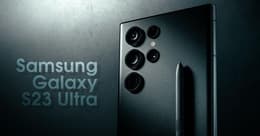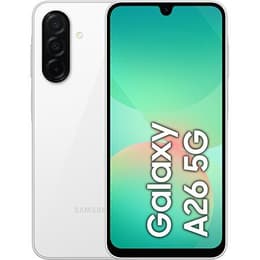

Galaxy A26 Vs Galaxy S23+

Galaxy A26
Galaxy A26
Starting at

Refurbished price:£152.00

Versus £419.55 new

See options
Galaxy S23+
Galaxy S23+
Starting at

Refurbished price:£257.00

Versus £1,199.99 new

See options

Ratings

The Samsung Galaxy A26 (released March 2025) and the Samsung Galaxy S23 Plus (released February 2023) represent different segments of Samsung's smartphone lineup. While both operate on the Android platform, the Galaxy S23 Plus was a flagship device at its launch, offering premium features and performance, whereas the Galaxy A26 is positioned as a more recent mid-range option with a focus on extended software support and practical features. The primary distinctions lie in their processing power, camera capabilities, and overall build quality.

Scores

Durability

When considering the longevity of these devices, their release timelines and software support policies are key factors.

  • Release Timeline: The Galaxy A26, launched in March 2025, is a newer device compared to the Galaxy S23 Plus, which debuted in February 2023. This difference in release year directly impacts their expected practical lifespan.
  • Software Support: The Galaxy A26 is notable for its extended software commitment, promising six major Android OS upgrades and six years of security updates from its release [22, 41, 43]. In contrast, the Galaxy S23 Plus was launched with a policy of four years of OS updates and five years of security updates [27, 28]. This means the A26 will receive software support for a significantly longer period.
  • Build Durability: The Galaxy S23 Plus features Corning Gorilla Glass Victus 2 on both its front and rear, complemented by an Armor Aluminum frame, contributing to its IP68 water and dust resistance rating [12, 21, 30]. The Galaxy A26 also offers robust protection with Corning Gorilla Glass Victus+ on the front and back, and an IP67 rating for water and dust resistance, though it utilizes a plastic frame [3, 9]. The S23 Plus offers a slightly higher degree of water resistance.

Year of Release

2024

2023

Compatible with latest Update

Yes

Yes

OS

Android

Android

Foldable

No

No

Performance

Performance is a significant area of divergence between these two Samsung smartphones, reflecting their different market positions.

  • Processing Power: The Galaxy S23 Plus is equipped with a high-performance processor, designed to handle demanding applications, intensive multitasking, and graphic-heavy gaming with fluidity and responsiveness [1, 11, 19, 29]. Users can expect a consistently smooth experience even with complex tasks. The Galaxy A26, powered by a mid-range processor, provides reliable performance for everyday tasks such as web browsing, social media, and general app usage [2]. While capable for daily activities, it may show limitations with very demanding applications or extensive multitasking.
  • Storage and Multitasking: The Galaxy S23 Plus typically comes with 8GB of RAM and offers storage options of 256GB or 512GB, without expandable storage [7, 13, 15]. This ample RAM supports seamless app switching and efficient multitasking. The Galaxy A26 offers 6GB or 8GB of RAM and 128GB or 256GB of internal storage, with the added flexibility of a microSD card slot for expansion [3, 9, 17].
  • Battery Endurance: The Galaxy S23 Plus features a 4700 mAh battery, which, combined with its efficient processor, often provides excellent battery life, with many users reporting up to two days of use on a single charge under normal conditions [10, 11, 13, 19, 29, 31]. The Galaxy A26 is equipped with a larger 5000 mAh battery [6, 9, 17], which, given its mid-range components, is expected to deliver substantial endurance for typical daily usage.

Memory (GB)

8 GB

8 GB

Screen quality

The visual experience on both devices is delivered through high-quality displays, though with some key differences.

  • Display Technology and Size: Both phones feature Super AMOLED display technology, known for vibrant colors and deep blacks. The Galaxy A26 has a slightly larger 6.7-inch Super AMOLED display [2, 3, 9, 14], while the Galaxy S23 Plus offers a 6.6-inch Dynamic AMOLED 2X display [1, 5, 7, 10, 12, 13, 16, 18, 26, 34].
  • Resolution and Clarity: Both devices provide Full HD+ resolution (1080 x 2340 pixels), ensuring sharp and clear visuals for media consumption and daily interactions [1, 3, 5, 7, 9, 10, 12, 13, 14, 16, 18, 26, 34]. The pixel density is approximately 385 ppi for the A26 and 393 ppi for the S23 Plus, indicating similar levels of detail.
  • Brightness and Refresh Rate: The Galaxy S23 Plus boasts a higher peak brightness of 1750 nits, making it exceptionally visible even in bright outdoor conditions [1, 5, 12, 13, 18, 34]. The Galaxy A26 offers a maximum brightness of 1000 nits, which is still suitable for most outdoor scenarios [8]. Both phones feature a 120Hz adaptive refresh rate, providing smooth scrolling and fluid animations [3, 5, 9, 10, 12, 13, 14, 18, 26, 34].

Resolution

1080 x 2340

1080 x 2340

Audiovisual

The camera systems on the Galaxy A26 and Galaxy S23 Plus cater to different photography needs and expectations.

  • Rear Camera System: The Galaxy S23 Plus features a versatile triple-camera setup, including a 50MP main sensor with optical image stabilization (OIS), a 12MP ultra-wide lens, and a 10MP telephoto lens with 3x optical zoom [1, 5, 13, 16, 20, 25, 26, 33, 36]. This configuration allows for detailed shots across various focal lengths, including effective optical zoom. The Galaxy A26 also has a triple-camera system with a 50MP main sensor (OIS), an 8MP ultra-wide lens, and a 2MP macro lens [2, 3, 9, 14, 17]. The macro lens allows for close-up photography, but it lacks a dedicated telephoto zoom.
  • Photography Performance: The Galaxy S23 Plus delivers strong overall photography performance, with good detail, color reproduction, and improved low-light capabilities, especially benefiting from its advanced processing [1, 11, 25, 29, 36, 37]. Users generally find its camera reliable for a wide range of situations. The Galaxy A26's camera performs decently for everyday photos, though some users note colors can appear muted and low-light performance could be improved [2].
  • Video Recording and Front Camera: The Galaxy S23 Plus supports video recording up to 8K at 30 frames per second (fps) and features a 12MP front camera with autofocus [15, 36, 37]. The Galaxy A26 records video up to 4K at 30fps and has a 13MP front camera [14].

Front camera

13 megapixels

12 megapixels

Miscellaneous

Beyond core specifications, several practical elements differentiate these two devices in daily use.

  • Connectivity Standards: Both devices support 5G connectivity for fast mobile data. The Galaxy S23 Plus features Wi-Fi 6 (ax) for advanced wireless networking, while the Galaxy A26 supports Wi-Fi 802.11 a/b/g/n/ac [7, 9, 14, 16]. Both include Bluetooth 5.3 for wireless accessory connections [3, 9, 14].
  • Ports and Audio: The Galaxy S23 Plus is equipped with a USB-C 3.2 port, offering faster data transfer speeds compared to the Galaxy A26's USB-C 2.0 port [7, 14]. Neither device includes a 3.5mm headphone jack [2, 4]. For audio output, the Galaxy S23 Plus provides stereo speakers, contributing to a more immersive media experience, whereas the Galaxy A26 features a single bottom-firing speaker [2, 27].
  • Biometric Security and Design: Both phones incorporate fingerprint scanners for secure unlocking. The Galaxy S23 Plus uses an in-display ultrasonic sensor [34], while the Galaxy A26 has a side-mounted fingerprint scanner integrated into the power button [9]. The S23 Plus has a more premium feel with its Armor Aluminum frame [21], while the A26 uses a plastic frame [3, 9].

Weight

197 g

196 g

Screen size (in)

6.5

6.6

Mobile network

5G

5G

SIM card

Dual Physical SIM

Dual Physical SIM + eSIM

Carrier compatibility

Unlocked

Unlocked

Connector

USB-C

USB-C

The Samsung Galaxy A26 and Galaxy S23 Plus cater to distinct user needs, reflecting their different market positions and release timelines. The Galaxy S23 Plus, a 2023 flagship, is frequently praised by users for its stellar performance, consistently smooth operation, and excellent battery life that often extends to two days of use [10, 11, 19, 29]. Its camera system, particularly the inclusion of a telephoto lens and strong video capabilities, is also a highlight, though some users note its camera consistency might not always match competitors [27, 32].

The Galaxy A26, released in 2025, stands out with its commitment to extended software support, offering six years of OS and security updates, which is a significant advantage for long-term usability [22, 41, 43]. Users appreciate its vibrant Super AMOLED display with a 120Hz refresh rate and its large battery capacity for reliable daily performance [2, 9, 14]. Criticisms for A-series phones generally revolve around their mid-range performance not matching flagship expectations and camera quality being decent but not exceptional in challenging conditions [2, 23, 39].

Users prioritizing top-tier performance, a more premium build, and advanced camera features like optical zoom will find the Galaxy S23 Plus well-suited to their needs. Its robust processing power makes it ideal for demanding applications and gaming. Conversely, users who value long-term software support, a large display, and reliable everyday performance without the need for flagship-level processing power may lean towards the Galaxy A26. Its expandable storage is also a benefit for those needing more space. Both devices offer a quality-assured refurbished option, providing an eco-friendly alternative for consumers seeking to make informed and sustainable choices.

See all articles

Our recent comparisons