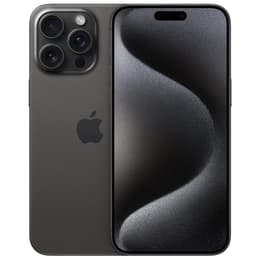

Compare models
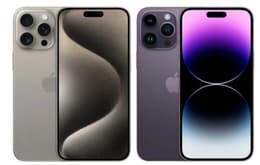
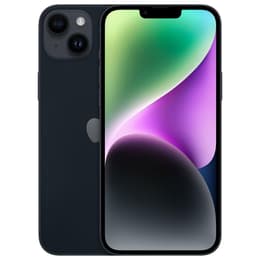
iPhone 14 Plus Vs iPhone 15 Pro Max
- 1-year minimum warranty
- Free delivery on all items
- Free 30-day returns
Differences at a glance
The iPhone 14 Plus, released in October 2022, and the iPhone 15 Pro Max, launched in September 2023, represent different tiers within Apple's smartphone lineup. While both offer large display experiences and run on the iOS operating system, the iPhone 15 Pro Max introduces significant advancements in processing power, camera technology, and display features, positioning it as a more advanced device compared to its predecessor.
Available Models
Colour
Storage (GB)
Scores
Durability
When considering the long-term usability of these devices, several factors contribute to their expected lifespan.
- Release Timeline: The iPhone 14 Plus was released in October 2022, while the iPhone 15 Pro Max followed in September 2023. This one-year difference means the iPhone 15 Pro Max will generally receive software updates for a longer period. [1, 5, 6]
- OS Support: Both devices are designed to receive iOS updates for several years. The iPhone 15 Pro Max, being newer, is expected to receive major software updates for a minimum of five years, extending its support at least until 2028. [1]
- Build Materials: The iPhone 14 Plus features an aerospace-grade aluminum design with a Ceramic Shield front and glass back. [2, 20, 34] The iPhone 15 Pro Max elevates this with a Grade 5 titanium frame, which is known for its high strength-to-weight ratio, making it durable yet lightweight, alongside a Ceramic Shield front and the toughest back glass in a smartphone. [1, 10, 18, 21, 28] Both models offer IP68 water and dust resistance. [2, 3, 29]
Year of Release
2022
2023
Compatible with latest Update
Yes
Yes
OS
iOS
iOS
Foldable
No
No
Performance
Performance is a key differentiator, impacting how smoothly applications run and how efficiently the device handles demanding tasks.
- Processing Power: The iPhone 14 Plus is equipped with a capable processor that handles everyday applications and multitasking with ease, providing a responsive user experience for general use and moderate gaming. [2, 6, 16] The iPhone 15 Pro Max features a more advanced processor, designed for enhanced performance in intensive applications, advanced gaming with improved graphics rendering, and complex computational tasks. [1, 3, 18]
- Multitasking and Responsiveness: The iPhone 14 Plus includes 6GB of RAM, which supports smooth transitions between multiple open applications. [5, 6, 14] The iPhone 15 Pro Max comes with 8GB of RAM, contributing to even more fluid multitasking and improved responsiveness, especially when managing numerous demanding applications simultaneously. [1, 14, 37]
- Storage Options: Both devices offer various storage configurations, with the iPhone 14 Plus available in 128GB, 256GB, and 512GB. [2, 5] The iPhone 15 Pro Max starts at 256GB and goes up to 1TB, catering to users with higher storage needs for media and applications. [1, 7, 13]
Screen quality
The visual experience is central to smartphone usage, and both models offer large, vibrant displays with distinct characteristics.
- Display Technology: Both the iPhone 14 Plus and iPhone 15 Pro Max feature 6.7-inch Super Retina XDR OLED displays, delivering deep blacks and vibrant colors. [2, 3, 6, 11, 34]
- Refresh Rate and Smoothness: The iPhone 14 Plus has a standard 60Hz refresh rate, providing a consistent visual experience for most users. [6, 31] The iPhone 15 Pro Max incorporates ProMotion technology, offering an adaptive refresh rate that can scale up to 120Hz, resulting in noticeably smoother scrolling, more fluid animations, and a more responsive feel during gaming and fast-paced content. [3, 13, 39]
- Brightness and Clarity: Both displays offer excellent clarity and brightness, with the iPhone 14 Plus reaching 800 nits typical and 1200 nits peak HDR brightness. [2, 34] The iPhone 15 Pro Max enhances this with 1000 nits typical, 1600 nits peak HDR, and up to 2000 nits peak outdoor brightness, improving visibility in bright sunlight. [3, 11] The iPhone 15 Pro Max also features thinner display bezels and the Dynamic Island, replacing the traditional notch found on the iPhone 14 Plus. [1, 3, 18, 39]
Resolution
1284 x 2778
1290 x 2796
Screen type
Super Retina XDR OLED
LTPO Super Retina XDR OLED
Audiovisual
For many users, camera capabilities are a primary consideration, and these devices offer different photographic and videographic experiences.
- Rear Camera System: The iPhone 14 Plus features a dual-camera system with a 12MP Main camera and a 12MP Ultra Wide camera, capable of capturing detailed photos and 4K video. [2, 4, 16] The iPhone 15 Pro Max boasts a more advanced Pro camera system, including a 48MP Main camera that can capture super-high-resolution photos, a 12MP Ultra Wide camera, and a 12MP Telephoto camera with 5x optical zoom. [1, 3, 13, 18]
- Low-Light and Zoom: The iPhone 15 Pro Max offers enhanced low-light performance and significantly greater optical zoom capabilities due to its dedicated 5x telephoto lens, allowing for clearer distant shots compared to the iPhone 14 Plus's digital zoom. [3, 13, 18]
- Video Features: Both models support 4K video recording, but the iPhone 15 Pro Max introduces advanced features like ProRes video recording and the ability to capture Spatial Video, which can be viewed on compatible devices for an immersive experience. [13, 29]
Main camera
12 megapixels
48 megapixels
Front camera
12 megapixels
12 megapixels
Miscellaneous
Beyond core specifications, several practical elements contribute to the overall user experience.
- Connectivity: Both devices support 5G cellular connectivity and Bluetooth 5.3. [2, 4, 18, 29] The iPhone 14 Plus uses Wi-Fi 6, while the iPhone 15 Pro Max upgrades to Wi-Fi 6E, offering potentially faster wireless speeds and improved performance in compatible networks. [2, 18]
- Charging Port: The iPhone 14 Plus utilizes the Lightning port for charging and data transfer. [6, 39] The iPhone 15 Pro Max transitions to a USB-C port, which supports faster data transfer speeds (up to 10Gb/s) with compatible cables, and offers broader compatibility with other electronic devices. [1, 8, 13, 17, 26, 39]
- Additional Features: The iPhone 15 Pro Max introduces a customizable Action Button, replacing the traditional mute switch, allowing users to quickly access various functions. [13, 18] It also features a titanium frame, contributing to a lighter feel compared to previous Pro models. [1, 18, 21]
Weight
203 g
221 g
Screen size (in)
6.7
6.7
Mobile network
5G
5G
SIM card
Physical SIM + eSIM
Physical SIM + eSIM
Carrier compatibility
Unlocked
Unlocked
Connector
Lightning
USB-C (USB 3)
What the community thinks
The iPhone 14 Plus and iPhone 15 Pro Max cater to users with differing priorities, reflecting their respective positions in Apple's product evolution. User feedback for the iPhone 14 Plus often highlights its robust battery life and large display as key advantages for everyday use. [31, 39] However, some users note its 60Hz display and the traditional notch as areas where it doesn't offer the most current experience. [31, 35]
Conversely, the iPhone 15 Pro Max receives praise for its cutting-edge camera system, powerful performance, and the smooth visual experience provided by its 120Hz ProMotion display and Dynamic Island. [35, 39] The shift to USB-C is also seen as a forward-looking feature, though some users note the need for a separate cable to achieve the fastest data transfer speeds. [8, 26, 32]
Users prioritizing a large screen and reliable performance for general tasks, media consumption, and solid battery life will find the iPhone 14 Plus to be a capable device. It offers a consistent Apple experience without the most advanced features. For those who demand the latest in mobile photography, top-tier processing power for demanding applications and gaming, a highly responsive and bright display, and the versatility of USB-C connectivity, the iPhone 15 Pro Max aligns more closely with those needs. Both models, whether new or as quality-assured refurbished options, provide a pathway to the Apple ecosystem, allowing users to make an informed and sustainable choice based on their specific requirements.