
Technology

Updated on 21 April 2026
21 April 2026
4 mins read

Thomas Hobbs
Back Market and The Restart Project recently brought awareness of the opportunities around a healthy Right to Repair movement to the UK House of Parliament. At this event, Thomas Hobbs found plenty of reasons to be hopeful.
“When an electronic device breaks, consumers should always have a genuine opportunity to repair it!” argued Mary Creagh, the veteran Labour MP for Coventry East and also the Parliamentary Under-Secretary for the Department for Environment, Food and Rural Affairs. “This Labour government now wants to see repairability at the heart of all production.”
Just a few years ago and the Right to Repair movement was still in its infancy in the United Kingdom. Creagh’s message of support, however, shows just how far things have progressed since then. She was speaking last week at an event hosted by Back Market and The Restart Project at the Houses of Parliament, which was designed to celebrate the fact that 143 MPs have now signed the Repair and Reuse Deceleration in the UK.
If passed, this new law will require manufacturers to make spare parts available for electrical appliances within two years of all smart phone model launches. And, at the event on the 25 March, there were MPs from all the major parties (including James Cleverly, the Conservative Shadow Secretary for Housing and Communities, who is pictured above), which proves how Right to Repair in the UK can be a truly cross-sectional movement.
It also shows why political persuasion shouldn’t get in the way of collective fatigue around an oppressive Fast Tech culture that pushes the constant upgrade and, subsequently, makes e-waste levels soar. More than 90 MPS showed up to support the event, while there was also live repair sessions, school work shops, and networking geared towards establishing more roots for Right to Repair in the UK.
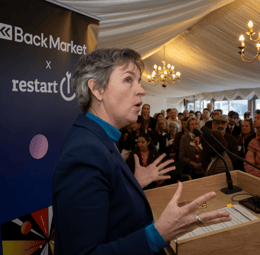
MP Mary Creagh speaking at the latest Back Market and the Restart Project event at the UK Houses of Parliament.
Establishing a fruitful refurbished and circular tech industry isn't just good for the planet (92% less carbon per device), but it's an economic growth driver, too, creating local jobs and making tech affordable for the 1.5 million people in the UK who can't access basic devices. The signs that we’re getting closer to mainstream acceptance of these ideals seem good, with the Repair and Reuse Deceleration now surpassing its goal of 100 MP signatures; the next step is to try to push it through into law.
“An additional £15bn can be generated from circular economy infrastructure over the next ten years in the UK, creating 40,000 jobs,” Creagh added, positively. “That’s economic green growth in action.” Also speaking at the event was Fiona Dear, co-director at the Restart Project, who explained how repair cafes were no longer niche in the UK.
“There are now 700 community repair groups in the UK,” Dear claimed, “and they are the heart and soul of establishing a fruitful Right to Repair movement.” Meanwhile, Katy Medlock, Back Market’s UK General Manager, reinforced how backing refurbished technology and a sustainable Right to Repair movement would help Great Britain get overall pollution levels down in the long run.
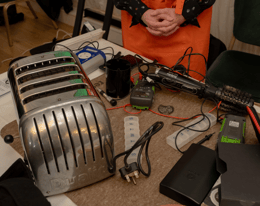
Some of the electrical items that were fixed during the event.
“A refurbished smart phone generates 92% less carbon emissions and 89% less e-waste than buying new, which shows why normalising refurbished tech in the UK is so important,” she said. “It is important that re-use, not re-cycling, becomes the default and if we can make repair culture accessible, then it’s not too late for the UK to become a leader.”
So, where from here? “The Right to Repair movement doesn’t just make good environmental sense, but commercial sense too,” Back Market’s Medlock ambitiously concluded. “Refurbished tech can create jobs and keep devices out of landfills.” We can only hope that by the next time Back Market goes to the Houses of Parliament, it’s to celebrate the Repair and Reuse Deceleration finally being passed into law.
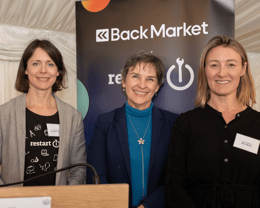
Pictured: Fiona Dear (The Restart Project), MP Mary Creagh, and Back Market's Katy Medlock.
1. Put reuse first to fix the UK's supply challenge
Make reuse (not recycling) the default through ambitious targets, device hand-back incentives, quality-preserving collection, and EPR funding for repair and reuse
2. Ensure products are easily repairable at a fair price
Eliminate practices that shorten device lifespans: parts pairing, inaccessible spare parts, bundling, hard-to-remove batteries
Support training and green jobs initiatives for the circular economy
Make Digital Product Passports fully accessible to independent repairers
3. Build consumer confidence through smart regulation
Align dynamically with EU Right to Repair measures
Set a reduced VAT rate on refurbished devices and repair services
Adapt product requirements (designed for new products) to fit second-hand realities
Thomas Hobbs is a UK-based freelance journalist who has written for titles including the Guardian, Financial Times, Telegraph, Pitchfork, New Statesman, Stereogum, BBC Culture and many others. He has interviewed everyone from Nas to Usher, Weyes Blood, and Joe Hisaishi, while collecting and playing vintage video games is one of his favourite past times.