Samsung

Updated on 9 April 2026
9 April 2026
10 mins read

Sam Davies
Freelance journalist
Wooden wirelesses, 60s transistors and 80s boomboxes are some of the obsolete gadgets having fresh life breathed back into them by tech tinkerers. Sam Davies spoke to this up-cycling community and found out why up-cycling retro speakers is so important.
“I don’t think it’s exaggerating to say this is the best up-cycling I’ve seen or read about on the Internet ever!” comments one Redditor beneath a viral post from a user who has modified a 1950s Granada radio into a fully-working Bluetooth speaker, with the radio’s original buttons and dials now working as volume controls. “TURN THIS INTO A FREAKING BUSINESS PLEASEEEEEEEEE” reads another comment, echoing a sentiment shared by many others on this viral thread.
Ryan Mischkulnig was among the first to start selling up-cycled radios as Bluetooth speakers when he launched a Kickstarter in 2018, offering to convert old radios in return for donations. The webpage featured an impressive array of photos displaying numerous battered but beautiful old models, all turned into devices that could work with your latest smartphone. And, many more sellers have popped up online over the past 10 years: on Etsy you’ll find gems such as a Bluetooth-friendly 1980s Hitachi boombox, selling for more than £800; a more affordable Grundig player at £270; and VintageLightcrafts’ Wall-E-esque radio-and-fog-light robot, which works as both a speaker and a lamp.
It’s not yet clear whether the up-cycling of old radios can go fully mainstream, breathing life back into ancient, dust-covered machines and saving you from splashing out on another UE Boom for your next dinner party. Yet these up-cyclers are at least engaging in a rewarding hobby, which is also a net positive for our environment thanks to the way it keeps old speakers away from the e-waste dump.
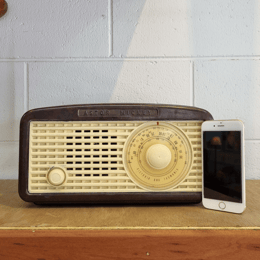
An up-cycled Astor Mickey HQ early 1950s speaker that now works with bluetooth.
“A speaker is a speaker,” says Mischkulnig, who lives in Melbourne. “It hasn’t really changed its design since probably the 1930s or so.” He makes the process sound easy. His process is based on the principle that for nearly a hundred years, speakers have ultimately consisted of a paper cone with a magnet behind it. Therefore, this design can always be re-purposed. In the mid-2010s, when Bluetooth speakers became all the rage, Mischkulnig spotted an opportunity and set about sourcing old radios. “Once I started looking for them, you could trip over them at any car boot sale or vintage market.”
There are a variety of approaches among sellers. While Mischkulnig hijacks the existing mechanisms of an old radio to make it compatible with Bluetooth, Emirhan Yildirim of VintageLightcrafts made his radio-fog-light-robot-speaker-lamp by simply placing a modern speaker inside an old one, preferring to preserve its overall condition. “If we had converted the radio itself to be Bluetooth-enabled, we would have strayed too far from the original,” he explains.
Professor Andreas Fickers of the University of Luxembourg has a third method for restoring old radios. He has studied experimental “media archaeology” for many years now. Fickers hosts workshops inviting people to bring their vintage radios in for him and his team to fix, making them work as radios once more. He is also familiar with the Bluetooth speaker trend and, when I speak to him on a video call, he holds up a dinky Isophon radio from 1960s Germany that he can now connect to his smartphone—gifted to him by his wife a few years ago.
“I have a passion for doing hands-on historical research with old media technologies,” says Fickers. He has a particular fascination with radios and their significance in societies of old. “I explain this with the example of the radio scales that came up in the 1920s and early ’30s,” he enthuses. “That completely changed human-machine interaction. You could travel through Europe by turning the dial.”
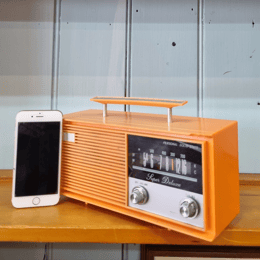
An up-cycled Japanese Super Deluxe speaker, approx 1970s.
Fondness for the aesthetics and interactivity of classic radios is what drives much of the up-cycling craze. Mischkulnig prioritises the interactive capabilities of a device in his conversion process, making the old buttons and dials of the original usable as on-switches and volume adjusters just as they would have been in the old days. He mostly does this by replacing the radio’s existing tech with modern alternatives.
“Generally speaking, I take out two or three components that either are not safe to reuse or are easily repairable or replaceable if somebody wants to restore the radio in future,” he says. “Those would be the power supply, the valves and the volume control. That gives me enough space to mount a new little pre-programmed amplifier. We’ve got custom-printed extensions of the volume control that allow us to fit the original volume knob in whatever position it needs to be fitted within the radio.”
Mischkulnig’s background is in industrial design. “I always had a frustration that circularity and design still don’t see eye-to-eye,” he says. “There’s just not an appetite with companies to even look beyond recycled materials, let alone get into reuse and repair and using what you’ve got.” He recognised a chance for circularity — the use and reuse of products — in the number of disused radios that are lying around the planet. “There’s a heck of a lot of them that are still beautiful looking bits of design, lovely bits of history, things that have got a sentimental attachment and things that have got a lot of the fundamental bits we still need for a new sound system.”
Mischkulnig says he has “always had a fascination with old,” something that’s shared by Yildirim, who is based in Istanbul and used to work as an apprentice in an antique carpet shop. “I would collect antique carpets and repair their torn parts,” he says. “In a way, I was reviving these discarded carpets and selling them.”
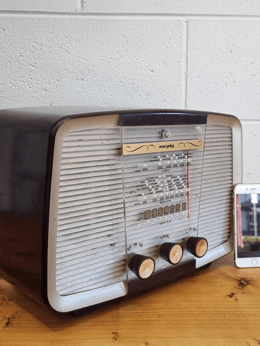
A Murphy A372 from 1957 that now works with an iPhone.
Not only do mass-produced items now dominate our economy, but in tech their obsolescence is often programmed into them. By contrast, the devices of yesteryear — radios included — were built to last for decades, with their endurability one of their prime selling points. What does this say about how society has changed?
“It tells us a lot about the difference in consumer behaviour, of course, the move towards throwaway culture,” says Fickers. “People can afford to buy new stuff, whereas in the past buying a radio meant a really important investment. There is clearly a cultural shift in what kind of value we attach to these objects.” He notes the impact that has had on employment too. “There’s also a change of labour involved. In the ’60s people bought a TV set, but at the same time, they bought a service. Technicians came to fine-tune it. This was millions of people — I don’t exaggerate — working as TV technicians, all over the world. And this has completely vanished.”
He adds that technicians specialising in the repair of devices like televisions and radios survive in the Global South, as well as in the brightly lit all-purpose tech stores on most European high streets, but the up-cycling of old radios is a small revival of a practice that used to be far more widespread.
After leaving the carpet business, Yildirim was wandering through an antique market one day when he saw an ageing man selling old radios and electric meters that he’d customised and redesigned “in various distinct ways.” Yildirim introduced himself and, impressed, returned home to pitch a business idea to one of his childhood friends. They returned and told the man from the market — who they now call Master Geppetto — about their idea. Together they set about piecing together rusty old bits of gear — lights, acoustic guitars, a model skeleton previously used to teach medicine in universities — and selling them as working lamps and speakers. “After that, we wrote a story for each piece and named them,” says Yildirim. “In short, we gave them a soul once again.”

One listing on VintageLightcrafts’ Etsy page is a character they call Echo, a Bluetooth speaker and lamp made from an antique radio and fog light. Like many of their devices, Echo is a lifelike creation worthy of Pixar, and bears more than a passing resemblance to Wall:E. But Yildirim plays down the aesthetic connections: “We don’t take inspiration from any specific thing,” he says. “We simply look at an antique piece and, if possible, learn its history. We imagine what kind of character it would have if it were alive; would it be aggressive, cute, cowardly, or brave? We think about these traits and attach the parts accordingly.”
Echo might be charming, but VintageLightcrafts is not generating enough income for Yildirim and co to live off, and Mischkulnig’s fortunes selling converted radios have been similar. Although the Kickstarter went well, business picked up in earnest when he opened a bricks-and-mortar store in the small city of Geelong, southwest of Melbourne, also offering a service where people could bring in old radios and have them converted into speakers. “When they realised they could bring that in and have that personal piece set up for them, that ended up being a huge part of what we did.”
After the pandemic hit and they were forced to close their doors, they now operate by placing a few pieces in boutique stores around the area and through their own website. Business is steady, but the hardest thing is getting eyes on their products. “It’s not a product that people are looking for,” says Mischkulnig. “They don’t know that a Bluetooth speaker vintage radio exists unless they’ve seen one.”
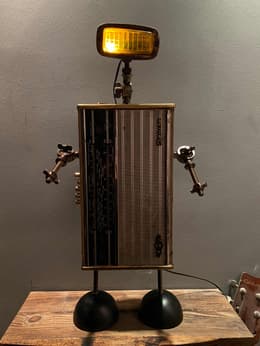
The Echo, a Bluetooth speaker and lamp made from an antique radio and fog light.
There is reason for optimism. “People get nostalgic about things when they age,” says Fickers. “The transistor radio was a generational object which really framed the experience of a whole generation in the 60s. It’s really a larger phenomenon of what I would frame as technostalgia. People like the old design and turn it into new devices.” Fickers also offers a nuanced take on the human instinct of looking to the past. “I don’t encourage nostalgia, but it’s a strong emotional feeling; it’s a natural thing that happens when you age. It’s not melancholia, you’re not getting sick, wanting really to reinstall the past. No, it’s that nostalgic feeling, which is most of the time associated with positive emotions.”
Seeing devices like VintageLightcrafts’ Echo, Fickers’ Isophon or any boombox from the 80s, it’s hard not to feel a pang of nostalgia, even if you weren’t alive when the originals were released. Placed next to the standard-issue speakers you can buy for 30 quid on Amazon, it seems almost too obvious to say which you’d prefer to have sitting on a shelf in your living room. Is it a stretch to say that installing an up-cycled radio as your new go-to listening device could even change the way you hear your music, renewing your appreciation for your favourite sounds, and replacing those endless, anonymous Spotify playlists that many of us have drifting away in the background? Probably not, with the Analog-era sound carrying an audible warmth.
Time will tell whether these beloved appliances from the past will become household fixtures in the future. For now, tinkerers like Mischkulnig and Yildirim are proof that nostalgia can breathe new life into obsolete devices. They even offer hope that the generational objects of today — iPhones, laptops and VR headsets — may one day provide alternative uses, years after their planned obsolescence. “Something that’s not being used anymore by one person doesn’t necessarily make it something that’s not of use,” says Mischkulnig. Yildirim compares up-cycled devices to the industry-standard products of today: “The reason I did this is that nowadays, no matter where we look, we see mass-produced items,” he concludes. “Old products aren’t like that. They have effort, struggle, an idea — in short, they have a soul. I have always strived to make this soul more visible.”
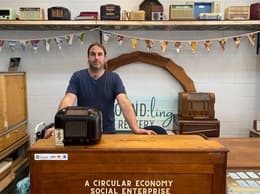
Ryan Mischkulnig has turned his amateur hobby for up-cycling vintage speakers into a legit business.
Sam is a freelance journalist who writes about music, film, video games, sport, tech, politics and just about anything broadly definable as 'culture'. His writing has been published by the BBC, Guardian, Financial Times, Rolling Stone, GQ and Vice.