


Culture journalist Andre Gee talks to three artists repurposing old electronics into art, each giving new value to discarded devices and keeping them away from the e-waste dump.
Thanks to the fast-paced, always-upgrade culture of technology, global levels of electronic waste are on the rise. The world accumulated over 62 million tonnes of discarded computers, TVs, phones, laptops, video game consoles and electronics in 2024, according to the Global E-waste Monitor. As the art world often mirrors societal shifts, there has also been a surge in artists using e-waste to spark conversations about technology’s environmental impact on our planet.
Take Michael Agwu, a Nigerian artist (now based in Philadelphia) who creates otherworldly mosaics from motherboards, remotes, and other discarded tech. His Expressions of Strength series—nine works depicting strong Black women—launched in 2025 and threw Agwu into the spotlight. Challenging traditional portraiture, each face is crafted with a painter’s precision, featuring realistic facial curves and a variety of bold Afro hairstyles.
Making profound art out of e-waste
For Agwu, there’s a direct connection between using e-waste and African history. “A lot of the materials that I use at some point in time signified progress,” the artist explained.
“They were what everybody was willing to do anything for, and today they've been overlooked. With African culture, I have the same feeling. African people are overlooking our own culture. Growing up in Nigeria, I felt like our core values, things that made us who we are…we've lost that due to European influence and colonialism.”
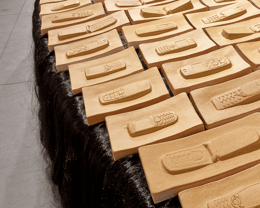
One of many art pieces by Canada's Ian Johnston that's been created by utilising e-waste.
Canadian artist Ian Johnston, meanwhile, has crafted sculptures and video installations that shine a light on our collective, copious electronic consumption. One standout is The Cellular Brick Road, an artwork crafted from phones he received from fellow artists during a residency at Philadelphia’s Clay Studio back in 2008. He was one of the few, if not the only, artists still relying on a landline phone at the time, and became enamoured with mobile phones’ newfound ubiquity.
He asked his peers if they had extra phones, and within days he had an enormous bag at his disposal. The subsequent work resulted in a winding structure made from a plywood base, lined with molds of mid-aughts-era cell phones. Placing flip phones next to basic brick phones encourages the viewers to reconsider these discarded devices as former status signals. Whether they were budget or big-ticket items, obsolescence eventually came for them all.
Discarded phones and computers as social commentary
Of this particular project, Johnston explains: “When I made The Cellular Brick Road, I was thinking of it as a reflection of the disposability of cell phones, built-in obsolescence, and the voracious appetite of consumer culture. The reference to the yellow brick road is multifaceted, but mostly I was thinking of it as the epitome of the scientific road to the future that’s held out like a carrot, never to be attained, all at the expense of the environment.”
“Because of climate change, e-waste is really becoming an issue that people are talking about" - Ian Johnston
Amanda Preske is the founder of Washington, DC’s Circuit Breaker Labs, an organization that turns discarded devices into thousands of pieces of jewelry and artwork. She first started experimenting with e-waste in college. Originally a chemistry major, Preske started tinkering with broken items in her labs, making art by repurposing dead computer motherboards sourced from local recycling centers.
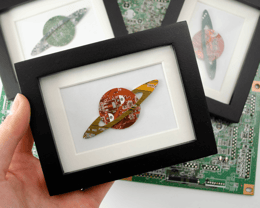
Amanda Preske utilises discarded motherboard parts to make her art.
One of her most popular pieces is pet portraits made from these motherboards. CBL creates an initial mockup with Photoshop software, highlighting each pet’s distinct features. From there, she chooses the motherboard and computer parts that best accentuate those features. “One of the creative challenges of working with electronic waste is that our palette depends on what we can find,” she says.
A permanent shift?
All three artists believe humanity is becoming more environmentally conscious; the rise in creatives using discarded tech in their practice is further proof of this thesis.
Indian artist Haribaabu Naatesan has made a career creating oversized e-waste sculptures [including a life-size Volkswagen Beetle made from motherboards, spark plugs, and typewriters]. Chilean artist Rodrigo Alonso, meanwhile, has also made in-roads by crafting seats from e-waste, epoxy resin, and melted recycled aluminum placed in square cubic molds.
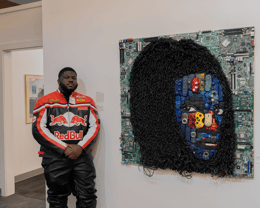
The popular artist Michael Agwu says utilising e-waste gives his work more depth.
These examples show that e-waste art is arguably an entrenched wing of the art world. Agwu believes artists get a kick out of utilising tools that mean so much to the people. “I think that's what makes our work special, because the work is pure memorabilia. We’re using artifacts of the 21st century and, because these materials are not being made anymore, playing around with e-waste to create something new feels like a unique opportunity.”
The obsolete devices that often end up polluting poor countries remain part of a complex issue pinned to our always-upgrade culture. However, Agwu, Johnston, and Preske’s art gives e-waste a more lasting value. “Because of climate change, e-waste is really becoming an issue that people are talking about,” Johnston concludes.
“When I started out doing this, it wasn't very popular to talk about discarded electronics. Now, everyone is talking about it. You know how you say there's a thread tying art together? For a lot of artists that thread is becoming e-waste.” So, what are you waiting for? It’s time to raid the e-waste bin and start creating.