

Credit: Guillaume Collanges
French filmmaker and photographer Guillaume Collanges has captured images of staggering beauty and destruction everywhere from Senegal to China and Colombia. But it’s clear that a reporting trip to Bangka Island, Indonesia—in collaboration with writer Arnaud Guiguitant—left a lasting mark on the Parisian.
While reporting for France24 in 2020, Collanges shot striking photos of the men and boys who work in perilous conditions to mine tin, a metal and raw material commonly used to solder together components of cell phones or laptops. Without tin, it would be impossible to securely connect those smartphone components, making it an integral part of the production of modern electronic goods.
As the annual tech upgrade has become increasingly ubiquitous among both consumers and manufacturers, the demand for tin has also risen. Incredibly, about a quarter of the world’s tin supply comes from this one island the size of Corsica. But what’s the real cost?
On land and at sea, Collanges witnessed people putting their lives in danger just to obtain a metallic powder, cassiterite, which is nature’s primary source of tin. The people he met were “at the bottom of the hierarchy. These are the employees who do the hardest work,” claimed Collanges.
The danger they’re often in is undeniably life-threatening, he added: “Given the risks they take, they could die... this is a back-breaking job that fuels Western capitalism.” Whether they work legally or illegally, their bounty will eventually end up in the same place: on the international market. Their invasive mining techniques also put considerable pressure on the environment, with high-pressure water used to wash away tin-bearing soil, ultimately causing lasting damage to the land.
Offshore, dredging agitates the seabed, laying waste to marine ecosystems in the process. Such practices are killing off coral reefs that were once habitats for fish, polluting local waters, and leaving barren, sterile landscapes where, according to Collanges, “there’s nothing but sand... not even a single plant can grow.”
Here, he talks us through five of the most striking images from his Tin Convicts series, revealing the environmental toll that’s often overlooked in the pursuit of technological progress and profit. Shining a light on the punishing reality of tin production, these images leave no doubt as to the true cost of fast tech to both people and planet.
Credit: Guillaume Collanges
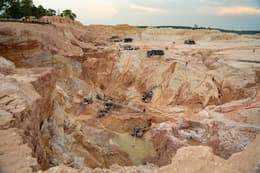
This rugged, unstable pit is a former legal mine that has long been abandoned and is now taken over by artisanal miners working illegally. These miners “dig and dig and dig, deeper and deeper,” says Collanges, using rudimentary sticks and pickaxes to work the terrain, “and after a while the danger is that this rock face at the side will collapse and bury them.” Activists estimate that as many as 100 miners die in Bangka each year. Even without the threat of landslides, the conditions are highly hazardous, and—says Collanges—“hellish.” “It’s incredibly hot in there, and the sound of the pumps and diesel motors is deafening,” he adds. “It’s impossible to even speak to one another over the noise—when I left, my ears were ringing.”
The exhaust fumes from the diesel are also headache-inducingly strong. The men working in this mine—around thirty at a time—don’t own their own equipment or make their own money directly; rather, they are paid a percentage of what they manage to make for their bosses. Many have moved from neighboring islands in the hope of striking it rich. “It’s a hierarchy where there are the wealthy, and then those who have nothing who come to earn a small living by trying their luck,” says Collanges.
Credit: Guillaume Collanges
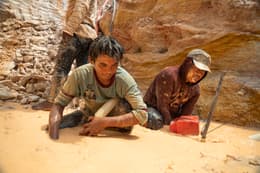
Water is pumped in at high pressure to disturb the floor of the pit, and the men pictured here spend eight hours a day wading through stagnant, muddy slurry in the blazing heat. “It was 40°C down there,” Collanges says. “It’s really grueling. The young man on the left isn’t protected, but the older one has a cap and a hood—most people are covered up with hats and long sleeves because they’re in direct sunlight all day.” In the evening, Collanges saw their bounty: several kilos of cassiterite. By then, the men were exhausted, he says. “It was really draining work, that’s for sure.”
Credit: Guillaume Collanges
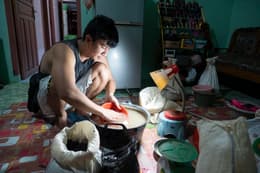
Collanges visited Alfonso, a tin trader, at his home. He buys the wares of illegal miners like Sofiane by weight, and then washes them again at home to check just how much tin he’s actually managed to purchase. Alfonso wouldn’t say exactly where this tin was going, but it is highly likely that it will end up being exported alongside legally mined tin. These people, Collanges explains, are merely cogs in the machine. “The fundamental problem is that they earn a much better living doing this than they would doing anything else.”
Credit: Guillaume Collanges
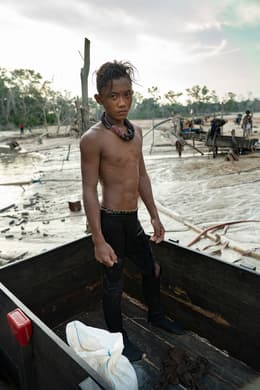
Ikrane, 13, works with his father and brother. He told Collanges and Guiguitant that no one had forced him to leave school two years prior to become a miner. In a sense, it seems hard to believe that a child would choose to enter this dangerous line of work voluntarily. But the lack of employment opportunities for working-class people, the lure of money, and the opportunity to support their families are also highly motivating factors for young people. “Effectively, his childhood is over,” says Collanges. “He was catapulted into adult life very quickly.”
Credit: Guillaume Collanges
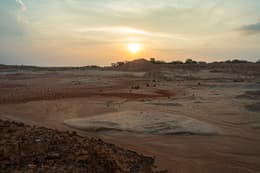
Since the Dutch colonization of the early 19th century, Bangka has been mined for its tin. It’s been said that parts of Bangka look like Mars, and here the resemblance is striking. “This earth gives off ochre, pink, and golden reflections. There’s something lunar, magnificent, and at the same time quite frightening about this photo,” says Collanges. For now, Bangka’s future remains unclear, and while it is likely that both the state and those with the means to do so will continue to exploit this already fragile island for a long time to come, clearly it is far from sustainable. There is, however, says Collanges, a part that we can all play. “The other solution here involves consumption. The answer is perhaps to consume less, and obviously to recycle more.”
The most sustainable phone is the one that already exists.
Back Market is fighting for a world where phones last for 10 years, through care, repair, reuse and refurbishment.