
Photo taken on October 24, 2010, shows the lean soil studded with holes due to mining rare earths here in Xingfeng County, east China’s Jiangxi Province. Credit: Zhou Ke/Xinhua/Sipa Press.
The term “rare earth material” is actually rather misleading. Far from rare, these 17 metallic elements are fairly abundant and found throughout the Earth’s crust — at exceedingly low concentrations. From dysprosium to neodymium, these elements are considered critical because they possess unique magnetic, electrical, and thermal properties, making them difficult to substitute.
These properties make them essential for consumer electronics like smartphones and speakers as well as defence systems, renewable energy technologies, electric vehicles, and advanced manufacturing. Found in rock and mineral aggregates as trace elements, pure rare earths tend to be a by-product of tonnes of processed rock.
Globally, the mining and processing of rare earth elements is a multibillion-dollar industry, but its value is dwarfed by the size of the industries that rely on rare earths: aerospace and defence, artificial intelligence, renewable energy, consumer electronics and others. As the International Monetary Fund explains, the global market for rare earths in 2024 was valued at $31 billion.
“China dominates rare earth processing because it built an integrated industrial system over several decades.” – Mr. Robert Muggah
They add, however, that the figure is an understatement “because the usage of rare earths unlocks trillions of dollars in downstream market creation around the world.” In the United States, for example, rare earths represent about 0.8 per cent of GDP. But in some countries, such as Japan or Germany, “this number is even higher,” the IMF explains, thanks to “rare earth-intensive industries like automobiles or electronics,” which “contribute to a larger share of GDP.”
Disrupting the supply of these vital elements can have an outsized impact on the economy and global national security. Yet despite their importance to international geopolitics, there is one country that dominates the processing of rare earth elements: China. And Beijing’s commanding position has turned these metals into a geopolitical flashpoint, with Europe seeking to secure alternative sources amid growing concerns over the strength of the Chinese supply chain and the power this gives it.
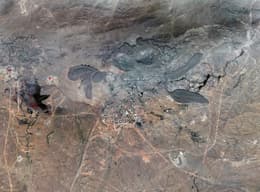
Bayun Obo, a mining town in the west of Inner Mongolia in the People’s Republic of China. Image taken on September 30, 2010. Credits: DigitalGlobe/ScapeWare3d / Getty
China’s rare earth dominance was built over decades
According to climate and social justice expert Robert Muggah, who is Research Director of the Igarapé Institute and Principal at the cyber analytics and risk firm SecDev, China’s apex position in the processing of rare earths is due to “specialised expertise, high capital spending and careful environmental management”.
“China dominates rare earth processing because it built an integrated industrial system over several decades,” Mr Muggah explained. China, he added, “not only controls a large share of mining, but also the more difficult middle stages of separation, refining, metal-making, alloy production and magnet manufacturing.” In 2024, the International Energy Agency reported that China leads refining for 19 out of 20 key strategic minerals. The country’s average market share hovers around 70 per cent. But for rare earth elements specifically, China’s share of separation and refining rises to about 90 per cent.
The consequences of a highly concentrated rare earth supply chain were evident last year following China's introduction of rare earth export controls during the trade war with Washington. The supply of rare-earth permanent magnets fell dramatically, leaving manufacturers in Europe and the United States scrambling to find alternative sources.
Although China’s export controls were eventually loosened, the underlying supply chain risk remains. As the IEA explains, “If [China’s] rare earth export controls were implemented in full, the economic value of downstream production at risk would reach USD 6.5 trillion per year for countries outside China. The United States and Europe face the greatest exposure, with potential direct economic losses estimated at over USD 1.5 trillion each.”
Supply chain leverage and Ukraine
One notable rare earth material that illustrates China’s dominance of the sector is dysprosium, an element used in high-performance magnets and vital for many applications, including wind turbines, electric vehicles, and your mobile phone. When alloyed with other materials, dysprosium adds vibrancy to mobile phone screens, providing haptic feedback for applications and alerts, while ensuring your smartphone’s speakers sound powerful straight out of the box.
Typically, only very small amounts of dysprosium are needed for high-performance components, but as Mr Muggah explains, they are “difficult to substitute,” and even a small disruption in availability “can have an outsized effect on entire industrial supply chains”. One country that has a great deal of rare earth element potential in Europe is Ukraine.
The 2.5-billion-year-old Ukrainian Shield – the mineral-rich geological backbone running through much of the country – holds significant reserves of lithium, graphite, manganese, titanium, and rare earth elements, including 22 of the 34 minerals classified as “critical” by the European Union. Why is this important? Ukraine represents a potential alternative supply source for Europe and the United States at a time when China dominates critical mineral processing.
However, it is unable to exploit its rare earth deposits for another reason entirely. Mr Muggah explains that while some geological surveys suggest that dysprosium may occur in Ukrainian deposits in commercially viable quantities, additional exploration would be needed to confirm its presence. Still, access to that metal will require not only access to areas occupied by Russia but also substantial international investment. These are things unlikely to happen during an ongoing war.
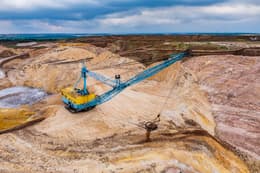
Giant excavator in an open pit mine in Ukraine, 2024. Credit: Anton Petrus
Solutions to redistributing the supply chain
Implementing a lasting ceasefire is one essential to leveraging all of Ukraine’s rare earth elements. Another is accurately establishing where exactly those resources are. Much of Ukraine’s rare earth mapping relies heavily on Soviet-era geological surveys, and some of the deposits mapped may not be economically viable in Ukraine’s present-day market economy.
In fact, research by SecDev, Mr Muggah said, indicates that $12.5 trillion worth of Ukraine’s metals, minerals, and energy is in territory occupied by Russian forces.
As a result, the scale and accessibility of Ukraine’s rare earth resources remain highly uncertain.
Furthermore, SecDev estimates that 33 percent of Ukraine’s deposits of rare earth and other critical minerals, as well as 42 percent of Ukraine’s metals, are inaccessible due to the ongoing Russian occupation. As Mr. Muggah explained to Back Market, Ukraine’s post-war economic future may hang in the balance.
“If Ukraine regains secure access to these areas, it will decide how resources are licensed, developed and taxed,” said Muggah. “That matters because resource policy can either strengthen national sovereignty or create new dependencies if managed poorly.”
“Kyiv’s longer-term goal should be to avoid just becoming an exporter of rare earth ores. The strategic prize… would combine mining with refining, processing, laboratories, environmental oversight and skilled industrial employment.” – Mr. Robert Muggah
Rare earths and the geopolitical connection
The geopolitical impact of Ukrainian mineral sovereignty would not be instantaneous, but gradual, as China has spent decades investing in the costly processing and refining of rare earth elements. By comparison, Ukraine lacks the processing equipment, and it would take years of investment to bolster its supplies.
In the short- to medium-term, Ukraine is unlikely to replace Chinese capacity. But given a long enough time frame, a robust Ukrainian mineral sector, combined with American and European processing capacity and financial assistance, could “reduce some of the leverage” that Beijing enjoys “from controlling critical industrial chokepoints,” Mr. Muggah explained. He added that this could reduce China’s ability “for coercion, price manipulation and export control pressures”.
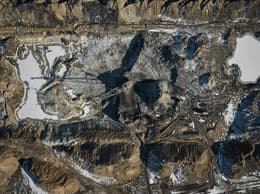
Drag-line excavator mines rare earth materials on Ukrainian soil on February 25, 2025 in the Zhytomyr region of Ukraine. Despite the ongoing war, many mining companies across the country have continued their operations, extracting resources. (Photo by Kostiantyn Liberov/Libkos/Getty Images)
The path forward: Investing across the entire value chain
While Ukraine’s mineral wealth potential is certainly significant, unlocking these resources will require huge investment across multiple sectors. Infrastructure, in particular, is an immediate post-war priority and includes rail corridors, reliable access to electricity, and storage capacity. Estimates of post-war repair costs vary considerably, but ultimately, substantial funding will need to come from international investment to cover the costs of reconstruction.
The next step for Ukraine would be updating its geological data. Updated mineral surveys, ore analyses, and feasibility research are needed before deposits become commercially viable, and attracting private capital will also require environmental reviews, licensing, and costly war-risk insurance. But one of the most critical gaps will be processing.
The value of rare earths and other critical minerals lies in their end products: battery-grade lithium and graphite, high-performance magnets and alloys, and other products. Kyiv’s longer-term goal, Mr. Muggah explained, should be to avoid just becoming an exporter of rare earth ores. “The strategic prize… would combine mining with refining, processing, laboratories, environmental oversight and skilled industrial employment,” he said, providing Ukraine with a secure role in Europe’s supply chains while reducing the continent's dependence on China’s dominant refining and processing capacity and limiting exposure to Beijing.
China’s rare earth pole position has little to do with geology and much to do with processing capacity. Ukraine has the potential to become a major European alternative but mining alone will not be enough. Ukraine’s mineral wealth will only become strategically significant if it can be integrated into a larger industrial ecosystem that includes rare earth processing and export.
Realising Ukraine’s rare earth potential, however, will require not only peace and international investment but years of industrial development. Untapped rare earth wealth in Ukraine has the potential to reshape global supply chains, but only if it is matched by the industrial capacity to translate geology into real geopolitical leverage.
The most sustainable phone is the one that already exists.
Back Market is fighting for a world where phones last for 10 years, through care, repair, reuse and refurbishment.
Related Stories
How the minerals inside your phone are reshaping the world
From cobalt to coltan, the materials used in our technology are extracted from the Earth and moved through global supply chains. But as geopolitical tensions between the US and China grow, how does this affect the technologies we rely on, and the people and communities involved in producing them over the long term?