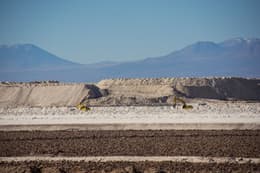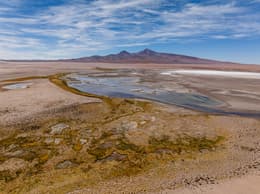
The Atacama Desert is at the core of South American extractivism. Credit: Paula Diaz Levi
For centuries, South America has supplied the world with raw materials. From lithium in the Andean salt flats; copper in Chile and Peru; graphite in Brazil; to gold extracted from the Ecuadorian and Peruvian Amazon, the region is home to some of the world's most sought-after resources—essential for manufacturing everything from smartphones, electric vehicles, and countless other technologies that fuel today's Fast Tech economy.
Yet this extractive model—centered on the large-scale removal of natural resources for export with little or no added value—has also reshaped landscapes, displaced traditional livelihoods, and left deep environmental and social impacts on local communities. Many of Latin America's socio-environmental conflicts are linked to mining and other extractive industries. As documented by Global Witness, the region has consistently ranked as the world's most dangerous for environmental defenders.
One of the regions where these tensions are increasingly visible is the so-called Lithium Triangle, spanning Chile, Argentina, and Bolivia. Home to some of the world's largest lithium reserves, it has become a strategic territory in the global race for critical minerals—and a lens through which to understand the broader challenges of extractivism in South America.
Few people have witnessed those transformations as closely as Chilean microbial ecologist Cristina Dorador. Born in Antofagasta, in northern Chile—the country's mining heartland—she grew up in a region where mining has shaped the economy, landscapes, and daily life for generations, giving her a firsthand understanding of both its benefits and its environmental and social costs.
After studying biology in Chile and earning a PhD in Germany, she has spent decades studying the high-Andean salt flats and the microorganisms that inhabit these extreme ecosystems of the Atacama Desert. Her internationally recognized research has highlighted both the ecological significance and the vulnerability of these unique environments in the face of growing demand for minerals.
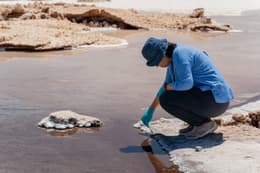
Scientist Cristina Dorador is an expert on South American extractivism. Credit: Paula Diaz Levi
Back Market spoke to Cristina Dorador to better understand why South America has become the epicentre of the global race for critical minerals. Here she recalls how her scientific work has become a window into understanding how the growing demand in the Fast Tech space for raw materials is transforming landscapes, ecosystems, and communities.
Extractivism is not just an economic model, but a way of organizing the relationship between the region, nature, and power. How have extractivist practices shaped life in South America?
Cristina Dorador: Mining for raw materials has been one of the region’s defining forces.. Every country has its own history, of course, but mining is a common denominator. Brazil’s forestry industry has driven deforestation in the Amazon, and many countries focus on food exports. But today, mining may be shaping South America’s future because of the scale of illegal mining in countries such as Colombia, Brazil and Peru. Why? Because it is often carried out in very rudimentary ways, exposing people directly to pollutants. In gold mining, for example, people are exposed to mercury or cyanide, which has direct impacts on health. There is a lack of dignity in this form of survival. In Guatemala, for example, there is a river where people sift through garbage hoping to find bits of metal.
Mining has left a toxic and somewhat cyberpunk legacy for future generations. In South American countries, such as Bolivia, Argentina and Chile, salt flats have always been fundamental to the economy, but they have never really been recognized as such. People always say Chile is a mining country and that copper is the country’s salary. But every mining process requires water and energy. And where does the water come from in the desert? From groundwater, from the salt flats, and from the only river there is—the Loa River. In any case, it is one of the consequences of the Andes being so rich in minerals. The Atacama Desert contains almost the entire periodic table.
In previous work, you proposed the concept of “micro-disaster” to describe how extractivism is altering salt flats and their microbial ecologies. In Earth Matter: An Index on Extractivism, to which you contributed a chapter, nearly a decade of research on extractivism in northern Chile is explored. What scene made you most strongly understand the costs of extractivism?
Cristina Dorador: It’s a mosaic of images. One of the earliest was in 2001, when we went to sample a wetland and found it completely dry because a mining company had taken the water. That was very shocking. Another thing that struck me—almost in a funny way—was that I always saw Coca-Cola bottles filled with a yellow-orange liquid along desert roads. I thought the soda had simply degraded in the sun and changed color. Only later, as an adult, did I learn it was truck drivers’ urine.
“We need to make space for diversity and for voices that have not been heard if we want to imagine different futures. If we fail to do that, it will be very difficult to emerge from the extractivism crisis we are facing”
That says a lot, first, about the terrible working conditions many people endure in what are supposedly the richest regions of Chile. It also reflects the lack of respect for the desert, which is treated like a dumping ground—whether for human waste or for mining waste stored in tailings dams. The Antofagasta Region has the highest GDP in Chile, yet it also suffers from poor education and healthcare outcomes, high poverty rates and precarious housing. It is a historical inequality that dates back to the nitrate era.
That idea of the desert as a place to extract from—and little else—seems very common.
Cristina Dorador: Exactly. Chile depends on global demand for what it exports. During the nitrate era—something Earth Matter discusses extensively—it was sodium nitrate that was being extracted because Europe needed it both as fertilizer and to manufacture gunpowder. But once synthetic nitrate was invented, the entire industry collapsed. That’s why the book also talks about the traces of nitrate—how it left marks in different places around the world. In Germany, for example, there is the Chile House in Hamburg, built with money generated by Chilean nitrate.
Years ago, we also studied the microbiology of the waste piles left behind by nitrate processing plants. The extraction methods were extremely rudimentary. Workers crushed rock under the blazing sun with hammers and under terrible conditions. The material was then mixed with water, boiled and condensed, while everything else remained in these waste piles. We found that nitrogen-cycle bacteria were still active there.
That led us to think that Chile has exported not only nitrate, but also the microbiology associated with all the salts and minerals it exports. Microorganisms live everywhere and adapt to all conditions. When nitrate was spread on soils in Egypt, Europe and elsewhere, helping crops grow, it may not have been only because of the salt itself. It may also have been because of the bacteria from Chile that activated the soil. As an extractivist country, Chile has unknowingly exported biological diversity to the rest of the world.
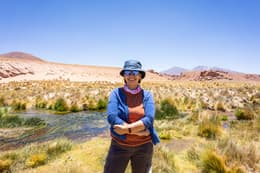
Dorador has committed her life to finding scientific answers to the climate changes triggered by raw material extractivism. Credit: Paula Diaz Levi
Without realizing it.
Cristina Dorador: Without realizing it, because it’s invisible.
What forms of resistance or ways of life in territories affected by extractivism do you find most valuable in confronting this reality?
Cristina Dorador: People living in these territories today are far more aware of what is happening to them. In the past, if you spoke with someone who had lived in a nitrate town or a mining camp, they often remembered it proudly as the best time of their lives—even though they lived beneath a cloud of sulfuric acid. There was a sense of community and shared hardship that is less common today because individualism has become so dominant. Now there is greater empowerment through knowledge. In the Atacama Desert, Atacameños indigenous communities are highly organized when confronting industries such as copper and lithium mining. Through assemblies and their own processes of self-determination, they decide what to do. Also, many young people have studied and become geologists, biologists, and hydrologists—some of them Atacameños—and returned to work for their communities. That is incredibly valuable. But the most important thing is that people are heard. The state often makes decisions without asking. Today, there are more tools to prevent that, but communities still need organization, time and resources if they are to stand up to large extractive projects.
If you could ask for one concrete change for the future, would it be at the level of public policy, a cultural shift, or a new way of imagining the relationship between humans and the rest of nature?
Cristina Dorador: I would say all of the above, but I would arrange them in a hierarchy. First comes knowledge. From childhood, we should understand that we are part of nature, and that if nature suffers, in some way, we will suffer too. This is not necessarily a spiritual matter, although it may be for some people. It’s a scientific one. I also believe we need to cultivate more compassion, care and mutual recognition, beyond the individualism that is ultimately rooted in capitalism. This is inevitably a political discussion, but it has to be a different kind of politics: more inclusive, bringing in new perspectives, because politics itself has often been shaped by discrimination. We need to make space for diversity and for voices that have not been heard if we want to imagine different futures. If we fail to do that, it will be very difficult to emerge from the crisis we are facing.
The most sustainable phone is the one that already exists.
Back Market is fighting for a world where phones last for 10 years, through care, repair, reuse and refurbishment.
Related Stories
The desert feeding the world’s lithium habit
Smartphones crucially need lithium for their batteries and, over in Chile, home to one of the world’s largest reserves of this natural resource, the boom in mining has been somewhat controversial. Paula Diaz Levi explores the pitfalls of lithium extractivism, and how it ultimately prohibits the lives of the local Indigenous communities.