

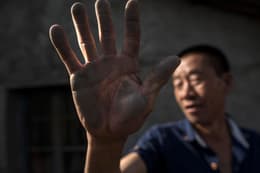
Lyu Shengwen, 55, shows the graphite dust he collected on the side of his house, which he cleaned the day before, in the town of Mashan, China on May 28, 2016. Shengwen lives next door to a graphite factory owned and operated by Aoyu and graphite laden trucks ply the road in front of his home. The northeastern province of Heilongjiang is rich in graphite and there are numerous mines and factories in the region. Locals who live in proximity to the factories complain of contaminated air and water affecting their crops and health. The graphite is a key ingredient in lithium batteries for mobile phones and electric cars. (Michael Robinson Chavez/The Washington Post via Getty Images)
Thick black smog clouds the air in Mashan, northeastern China. Known for its scenic landscapes and dense forests, this lush environment has been marred by the churn of graphite production, an industry that powers the digital age.
Graphite has quickly become one of the most strategically important raw materials on Earth. Fuelling our insatiable need for fast tech, this crystalline compound is fundamental for creating lithium-ion batteries – aka rechargeable batteries – used to fire up smartphones, laptops, electric vehicles and many other devices Westerners tend to rely on daily.
According to Peter Whoriskey who wrote a feature about the environmental impact of graphite mining for The Washington Post in 2016, “after leaving these Chinese mines and refiners, much of the graphite is sold to Samsung SDI, LG Chem and Panasonic — the three largest manufacturers of lithium-ion batteries.” And though lithium-ion is positioned as a sustainable energy source, promising a cleaner future, the mines and communities in which the graphite is being sourced are bearing both a negative human and environmental cost.
China refines approximately 96 per cent of the world's battery-grade graphite, making it an indispensable link in the global technology supply chain. Yet the industry's rapid expansion has come with grave consequences. Fine graphite dust released during mining and processing has been linked to irreversible lung disease (similar to that experienced by coal miners), and while neighbouring communities have long raised concerns about polluted air, contaminated water and damage to farmland, health monitoring remains inadequate.
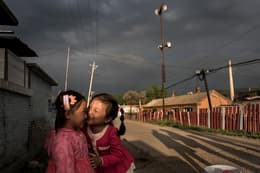
Children play on a street in Liumao, China on May 29, 2016. Liumao sits below BTR, a large graphite mine and factory. The northeastern province of Heilongjiang is rich in graphite and there are numerous mines and factories in the region. Residents of Liumao who live in proximity to the factories complain of contaminated air and water affecting their crops and health. (Michael Robinson Chavez/The Washington Post via Getty Images)
“This was just kids being kids, but I wanted people to think: ‘What's next for them? What's next for that generation? Are they going to be able to have a better quality of life?’”
Mashan is just one of five towns in two provinces impacted by the mining industry. When photojournalist Michael Robinson Chávez arrived in northeastern China for The Washington Post back in 2016, he spent over a week capturing thought-provoking visuals that exposed the harsh realities of life in these regions – for the workers and the people who lived there. The feature states: “Complaints about the pollution [were] met with intimidation. People living near graphite plants frequently appeared fearful of pressing their grievances.”
For Chávez, this assignment was a natural extension of a long career spent documenting humanity's impact on the planet. Over more than three decades, he has photographed war conflicts, communities and climate change, from Latin America to Siberia, earning two Pulitzer Prizes as part of reporting teams at The Washington Post. The first prize was for the newspaper’s global investigation into the impacts of human-induced climate change, and the second for its coverage of the January 6 attack on the U.S. Capitol.
Yet the graphite story was always more than just documenting pollution. It was about making visible a human part of the raw materials supply chain that most will never see. To make people think twice about overconsumption and the true weight of their tech. A decade on, this subject feels even more urgent. As our need to feel tech-connected continues to grow, so does the need to shed light on the realities of extraction. Here, Chávez reflects on his strongest memories photographing the factory workers and their conditions, and he talks through the importance of holding Big Tech businesses accountable for their actions.
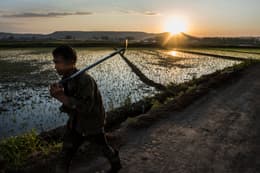
A farmer heads home after working in the rice fields outside Liumao, China on May 29, 2016. Liumao sits below BTR, a large graphite mine and factory. The northeastern province of Heilongjiang is rich in graphite and there are numerous mines and factories in the region. Residents of Liumao who live in proximity to the factories complain of contaminated air and water affecting their crops and health. (Michael Robinson Chavez/The Washington Post via Getty Images)
You went to Northeastern China in 2016 with The Washington Post to capture how dust from the graphite mines was impacting the air and water supply. What's the first memory that comes back to you when you think about that assignment?
I had been to China before, but I had never been to the northeastern Manchuria region. We were there in the summer, so it was beautiful. I mean, these huge forests and really beautiful landscapes… it was just very surprising.
It was a videographer, a reporter, myself and then someone producing for us, a local on the ground. I just remember that we drove to one of the graphite factories. You'll see a picture – there's a guy walking in front of the graphite factory, and he's covered in graphite because it's made up of fine particles, right, that get on everything. And there are really no filtering systems for the workers or for the neighbouring communities.
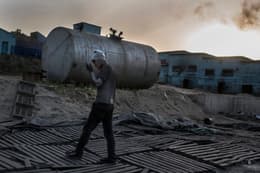
A graphite worker walks across the Jin Yang graphite factory in the town of Mashan, China on May 28, 2016. Workers have very little safety equipment at many of the graphite factories. The northeastern province of Heilongjiang is rich in graphite and there are numerous mines and factories in the region. Locals who live in proximity to the factories complain of contaminated air and water affecting their crops and health. The graphite, which is purchased by Samsung and LG Chem, is a key ingredient in lithium batteries for mobile phones and electric cars. (Michael Robinson Chavez/The Washington Post via Getty Images)
Why does that visual in particular stay in your mind?
He had just cleaned the place about an hour before we got there, because they knew we were coming. We'd rather they didn't do that, but it's a pride of ownership. They're like, "Oh, let's make the place nice," and I thought that was so sweet. But then he said, "Look, you know, this is just an hour's worth." Man, it's like an invisible killer, too, until it lands. You can't really see it flying through the air until it starts accumulating, and then you kind of get a glimpse of it. Breathing all that in would be really, really bad for you.
Even though you were only reporting this story for about a week, what did it feel like to spend that much time in such a noxious environment?
We didn't stay right next to the graphite factories – fortunately, we went to those places. But that was the paradox of it all. You had these graphite factories and this awful dust in the air, especially if the prevailing wind was blowing toward your home or village, yet the landscape was stunning. There were these gorgeous coniferous forests everywhere. It was this real dichotomy. I remember spending a good deal of time with some of the families, going into their homes and talking with them. They were having agricultural issues, problems with the water, and growing crops. They attributed it to runoff from some of these graphite factories. They were upset that no one was doing anything about it, and they weren't afraid of any kind of crackdown.
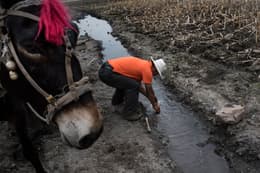
Yu Zhen Jun, a farmer, washes his hands after planting seed in his corn field outside Liumao, China on May 28, 2016. Jun describes the air and soil as "maitai," or filthy, a result of the contamination caused by a nearby graphite factory owned by Aoyu. Jun says his crop yield has decreased as a result of the pollution. The northeastern province of Heilongjiang is rich in graphite and there are numerous mines and factories in the region. Locals who live in proximity to the factories complain of contaminated air and water affecting their crops and health. (Michael Robinson Chavez/The Washington Post via Getty Images)
What do you remember most about photographing the factories themselves?
We had to be very delicate. I remember I just ran into the factory to start taking pictures, because I said, this is it, we either do this or we don't. So the videographer and I run in and the workers start to think: "Oh my gosh, who are these guys?" They started walking towards the office, but we took our pictures, got some good B-roll, and then we jumped back in the car.
A few days later, I remember we were being followed by someone, and we finally confronted them and asked them who they were. And they're just like, "Oh, we're mapping out a cycling race route here in China". And we knew that they were following us around and it was a cover.
“These [raw] materials can pass through several intermediaries before ending up in a product like an iPhone. A company such as Apple may be two or three degrees removed from the original source, which makes the supply chain incredibly difficult to trace.”
Why was it important to document the conditions of workers and hold companies accountable for what you found?
We felt it was important that people understand what these workers are going through, where the materials are being sourced from, and the human cost behind it all.
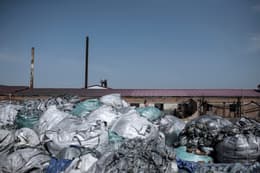
Bags that are used to carry graphite on cargo trucks lie adjacent to a graphite factory in the district of Mashan, China on May 28, 2016. The northeastern province of Heilongjiang is rich in graphite and there are numerous mines and factories in the region. Locals who live in proximity to the factories complain of contaminated air and water affecting their crops and health. The graphite is a key ingredient in lithium batteries for mobile phones and electric cars. (Michael Robinson Chavez/The Washington Post via Getty Images)
More than a decade later, how much progress has been made in addressing the workers' rights issues, environmental impacts on local communities, and the lack of transparency in global supply chains that you documented?
I really don't know how much has changed. My sense is that much of this is still going on. The difficult part is knowing whether the mining operations we documented are still directly connected to those Fast Tech supply chains. In Congo, many of the mines are Chinese and Lebanese-owned, and in China the industry is largely Chinese-owned as well.
The problem is that these materials can pass through several intermediaries before ending up in a product like an iPhone. A company such as Apple may be two or three degrees removed from the original source, which makes the supply chain incredibly difficult to trace. To really know what's happening, you'd have to keep investigating it constantly.
The most sustainable phone is the one that already exists.
Back Market is fighting for a world where phones last for 10 years, through care, repair, reuse and refurbishment.