

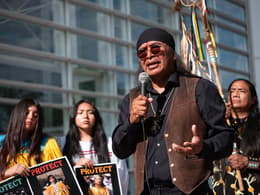
Dr. Wendsler Nosie Sr. addresses the crowd gathered outside the Sandra Day O'Connor Federal District Courthouse in Phoenix, Arizona on May 7, 2025, following a hearing on an emergency injunction to prevent the United States government from transferring Oak Flat to Resolution Copper until the Supreme Court could weigh in. Two days later, on May 9, 2025, Judge Steven P. Logan ruled in favor of the Apache Stronghold, writing, "There is no close question in this matter. It is abundantly clear that the balance of equities 'tips sharply' in Plaintiff's favor, and... they have presented serious questions on the merits that warrant the Supreme Court's careful scrutiny."
Shortly afterwards, the Supreme Court turned their backs, with most justices refusing to vote on whether to hear the case, a decision that Supreme Court Justice Gorsuch called “a grievous mistake - one with consequences that threaten to reverberate for generations.”
The drive on U.S. Highway 60 to Oak Flat in east-central Arizona curves as it climbs from desert flatlands. Columns of rock suddenly tower along the route. These formations can intimidate drivers, mainly because they appear like jagged Greek columns made of volcanic rock.
But for the San Carlos Apache Tribe and other tribal nations in this region, Oak Flat is the only place where sacred prayers can be conducted. This ancestral land hosts a wealth of cultural history: it’s where religious and coming-of-age ceremonies are conducted, and also where tribal members collect traditional food sources such as acorns – known for their nutritional value – from Emory oak trees.
“It’s all about the Earth,” explained Wendsler Nosie Sr., who leads the non-profit organisation, Apache Stronghold. He co-founded the organisation to defend the land and religious freedom over a decade ago. Nosie has advocated protecting Oak Flat from Resolution Copper, a joint venture owned by mining companies Rio Tinto and BHP.
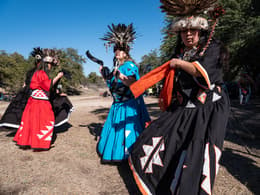
Pomo dancers offer prayers through songs and dance during the gathering at the Oak Flat Campground following the 9th Annual Oak Flat Sacred March/Run on February 18, 2023. Members of tribes from across the country come to participate and support the effort to protect Oak Flat, along with supporters of all backgrounds.
The company is pursuing a large-scale underground copper mine that would decimate the area and, in March 2026, Resolution Copper received ownership of the acres that encompass Oak Flat as part of a land exchange with the United States government and the Trump administration. “It’s all about these sacred places where God touched the Earth. Oak Flat – Chí’chil Biłdagoteel, as it’s called in Apache – is one of these places,” Nosie said.
Copper is a critical material for technologies including electric vehicles, wind turbines, solar panels, smartphones and AI data centers. As demand rises, so does the need to secure the mineral. Part of President Donald Trump’s agenda is building mineral supplies in the U.S. and reducing the country’s reliance on international sources. Its extraction would come at a significant environmental cost to this landscape.
“This place is who we are on this Earth. It keeps us connected to Mother Earth to understand the giver of life. What life it gives and how it gives.”
Why Oak Flat is sacred
Native Americans had thriving, sustainable societies long before colonization, and the creation of the first English settlement in the U.S. in 1607. Due to assimilation and forced relocation of tribes, many areas that held cultural significance were suddenly outside reservation borders created by the federal government, subsequently cutting off access for their people.
The San Carlos Apache Reservation was established in 1871. Oak Flat, which is not part of the reservation, is approximately 45 miles away. For the religious beliefs of the Western Apaches, Oak Flat is where spiritual beings called Ga’an live and breathe. Ga’an are messengers between the Creator and Apaches in the physical world. This land is also where the Sunrise Ceremony, the coming-of-age ceremony for young women, is held. Sweat lodge ceremonies for boys entering adulthood also take place there.
Nosie explained that ceremonies at Oak Flat connect individuals with Mother Earth and bring them to the beginning of Apache life. “This place is who we are on this Earth,” he said. “It keeps us connected to Mother Earth to understand the giver of life. What life it gives and how it gives.” Apache Stronghold’s efforts to stop the destruction of Oak Flat include raising awareness at local, national, and international events and suing the U.S. government.
The lawsuit currently in federal court argues that the ruination of Oak Flat violates Apache treaty terms and the Native Americans’ right to freely practice their traditional religions. As the fight for the area has progressed over the years it has grown to include supporters from other Native nations from across the U.S. and worldwide, Nosie explained. “When you look at the word environment, you’re talking about all the animals,” he said. “You’re talking about the land. You’re talking about the water. You’re talking about the wind. You’re talking about all the conditions that give everything life.”
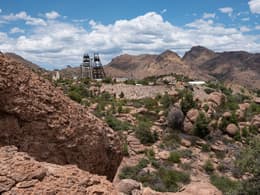
The existing Resolution Copper mine, on the outskirts of Tonto National Forest, has been mining copper and dewatering the area for many years already. Perched near Apache Leap, the mine is an imposing sight over Oak Flat. Loud mine traffic passes the Oak Flat campground at all hours. This mine is a small blip compared to the destruction that the proposed new mine will cause. June 30, 2024
In addition to the sacredness of the area, environmental groups oppose the mine because the land is habitat for endangered and threatened species, including ocelots and Arizona hedgehog cacti.
Prior to the land exchange, the U.S. Forest Service managed a 50-acre campground at Oak Flat and in 2019, Nosie and Apache Stronghold assembled a campsite there. Towering Emory oaks surround their campsite and leaves rustle in the breeze with the soft patter of gentle rain. As dusk settles over the landscape, thousands of stars emerge overhead, filling the night sky. Trying to count each point of light is enough to make you dizzy.
Nosie explained that the Apache harvest acorns from the oaks, a practice done for countless generations. These are typically ground into a powder and boiled as a soup or used as a key ingredient. It is a food source served during Sunrise ceremonies. “It’s been a big part of our way,” he said. “We’re killing these kinds of places that have natural food that can grow from the Earth and feed thousands of people. To give that up for copper for short-term gains for the Trump administration is crazy.”
“Climbing, camping, public roads, mining and ranching have coexisted in the Oak Flat area for the last 100 years and that practice will continue now and in the future.”
However, the other side argues the mine will bring jobs and economic benefits to local communities and Arizona.
“Resolution Copper’s success will be measured not just in tons of ore extracted, but in the strength of the partnerships we build, the local prosperity we generate, and the trust we earn from our neighbors,” countered Vicky Peacey, the company’s president and general manager.
For now, Resolution Copper is continuing access to the public, including requests by Native Americans to conduct ceremonies and other activities related to culture and traditions. They hired 4Winds Contracting, a company owned by a member of the San Carlos Apache Tribe, to oversee maintenance, facilities and road access at the campground.
“Climbing, camping, public roads, mining and ranching have coexisted in the Oak Flat area for the last 100 years and that practice will continue now and in the future,” Peacey said in a news release.
The metal powering the modern world
Copper is one of the most sought-after and oldest metals used by human beings. It is a valuable mineral because it produces electricity and heat and is resistant to corrosion. Found in electrical wiring (for items like charging cables), it powers our telephone networks, electronic devices such as smartphones, and serves as a key component in electric vehicles.
Last year the U.S. Geological Survey added copper as a critical mineral for the United States. The agency reports that the amount of copper in smartphone devices far exceeds the amount of any other metal. From the data centers fueling AI to electric vehicles and the electric grid, copper is an essential metal powering the Fast Tech movement and has become indispensable to late-stage American capitalism and Western economic growth.
To reach the copper deposit buried thousands of feet underground, Resolution Copper would use a technique called panel caving. This method would remove 1.4 billion tons of ore and produce 40 billion pounds of copper, (according to the Record of Decision released in March 2026 by the Forest Service). The result would be a crater up to 1,115 feet deep and about two miles wide, basically deep enough to fit the Empire State Building from the bottom to the top floor.
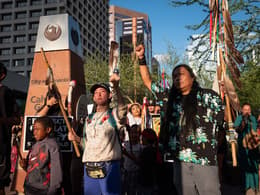
After a Sacred Run covering the roughly 153 miles between the San Carlos Apache Reservation and Phoenix in prayer, Apache Stronghold members and their supporters marched the final few blocks to the Sandra Day O'Connor Federal District Courthouse on May 6, 2025. Upon reaching the courthouse, they held a prayer vigil before the Apache Stronghold's hearing on May 7, requesting an emergency injunction to prevent the United States from transferring Oak Flat to Resolution Copper.
From sacred land to mining project
Oak Flat used to be part of the Forest Service’s Tonto National Forest. However, that status changed in March 2026 when the land exchange for the area was completed between the agency and Resolution Copper.
“This is another important project in advancing President Trump’s goal of mineral independence and energy dominance by boosting domestic mineral production,” said the news release that announced the land swap.
Since Arizona became a state in 1912, copper has become one of five industries that helped build its economy. Copper deposits under Oak Flat were only discovered in 1995, making it the largest undeveloped copper deposit in the world. The U.S. Congress in December 2014 authorized the land exchange as part of a last-minute rider in a defense spending bill. It stated that Resolution Copper would get acres of national forest lands, including Oak Flat, and the United States would receive various land parcels in Arizona. President Barack Obama approved the bill that month.
“Before allowing the government to destroy the Apaches’ sacred site, this court should at least have troubled itself to hear their case,”
The land swap was contingent on the publication of an environmental impact statement (EIS). At the end of Trump’s first term, the U.S. Department of Agriculture published an EIS for Resolution Copper. Yet President Joe Biden’s administration pulled it back. The final EIS was eventually published in June 2025 under the second Trump administration. The transfer in March saw the federal government receiving more than 5,400 acres of land and Resolution Copper receiving approximately 2,400 acres.
“Completing this land exchange unlocks a major domestic source of copper, essential for defense, grid modernization, and next-generation energy, and positions the nation to secure its future by expanding mineral production and unleashing America’s full resource potential,” U.S. Agriculture Secretary Brooke Rollins said in a news release. The Forest Service and Resolution Copper have stated that mining activities will create 1,500 jobs, generate $149 million annually in payroll, produce up to $120 million each year in estimated state and local tax revenue, and contribute $200 million yearly to the federal government.
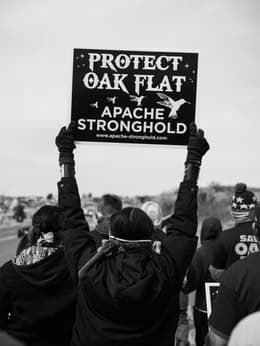
Apache Stronghold members and their supporters march through Globe, Arizona, during the 9th Annual Oak Flat Sacred March/Run on February 17, 2023. During the Sacred Run, participants symbolically break the bounds of the reservation by running in prayer from Old San Carlos back to Oak Flat, their ancestral homelands.
But the battle isn't over
Yet on January 12, 2021 Apache Stronghold filed a complaint in federal court seeking to prevent the land exchange. Two days later, they submitted a request for a temporary restraining order and preliminary injunction. The request made its way to the U.S. Supreme Court in 2024.
But by May 2025, the court declined to hear the matter, giving no reason for denying it. Justices Neil Gorsuch and Clarence Thomas dissented from the denial. Gorsuch called the decision not to hear the case “a grave mistake.”
“Before allowing the government to destroy the Apaches’ sacred site, this court should at least have troubled itself to hear their case,” Gorsuch wrote. Other legal efforts persist despite Oak Flat now sitting on private land. The San Carlos Apache Tribe filed a lawsuit that argued the land swap violates federal environmental laws and tribal treaty rights.
There is an active legal challenge by the Arizona Mining Reform Coalition that claims the land swap violates environmental and consultation laws. The last case was brought by four Apache women seeking to protect access to Oak Flat for religious ceremonies. Sandy Bahr is director of the Sierra Club’s Grand Canyon Chapter in Phoenix, Arizona – one of the oldest environmental advocacy groups in America, with local chapters across the country. She explained that the environmental effects of copper mining are water quantity, water quality, air quality and impacts to the land.
Another issue with copper mining is how the mineral is extracted from the ore, either through smelting or leaching. “We’re always concerned about water, even in years when there haven’t been shortages declared on the Colorado River,” Bahr explained. “We see the impacts on our rivers and streams. Arizona has lost a lot of the original riparian vegetation.”
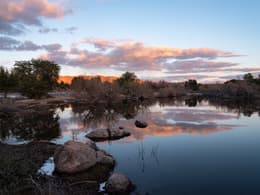
Sunset is reflected in the water at Oak Flat on February 15, 2023. Water at Oak Flat is sacred and holds great spiritual significance in Apache ceremonies. Resolution Copper has been dewatering the area for years now, forcibly removing groundwater, and the proposed new mine will use - and contaminate - billions of gallons of water in a region already affected by severe drought. With climate change exacerbating the issue, this pool and others are no longer present at Oak Flat.
Although the land exchange is done, Bahr noted that Resolution Copper still needs to acquire land to hold waste produced from the mine. According to the Forest Service’s Record of Decision, Resolution Copper “has indicated that it intends to place the tailings storage facility on private lands or Arizona State Trust lands.”
Resolution Copper proposes to use state trust land known as Skunk Camp to store mining waste. To do this, the company needs approval by the Arizona State Land Department. The Sierra Club’s Grand Canyon Chapter is a plaintiff in the lawsuit led by the Arizona Mining Reform Coalition. “You can tell that it’s an important place, even if you’re ignorant of the details – just by being out there,” Bahr said about Oak Flat. “There aren’t that many places where you can see those massive oak trees. There are also lots of indications of people having been there for a very long time.”
Nosie mentioned that mining activities tamper with aquifers – a source of groundwater in Arizona – and mine waste threatens the Gila River watershed. And for Nosie, saving and preserving this area is essential for future generations. “You can never clean contamination”, he said. “We’re in a critical period and a critical time.”
Oak Flat is just one battle in a much larger global story. As governments and industries race to secure the copper needed for renewable energy and the Fast Tech revolution, similar conflicts are emerging wherever valuable minerals are found. The questions facing Arizona are increasingly confronting countries around the world: How do we secure the raw materials needed for the future without sacrificing places, cultures and ecosystems that cannot be replaced? Finding the correct answer will be crucial.
The most sustainable phone is the one that already exists.
Back Market is fighting for a world where phones last for 10 years, through care, repair, reuse and refurbishment.